

The most flexible sealant on the shelf might actually be the worst choice for your concrete driveway. If you are sorting through conflicting contractor advice and wondering about silicone or polyurethane mastic which is better, you aren’t alone. It is frustrating to watch joint seals crack and pull away, especially when you know that water seeping beneath the slab can wash out supporting soil and trigger costly slab settlement.
You shouldn’t have to guess which material will stand up against heavy vehicle tires, intense weather, and shifting subbases. In this guide, you will discover whether silicone or polyurethane mastic is better for your concrete joints based on durability, climate, and traffic demands. We’ll break down the key mechanical differences between both sealants, show you how to match the right material to horizontal versus vertical joints, and explain how proper joint sealing protects your concrete slabs over the long haul.
Key Takeaways
- Determining whether silicone or polyurethane mastic which is better comes down to matching the sealant’s physical properties to vehicle traffic loads and slab orientation.
- Polyurethane mastic delivers superior mechanical adhesion and abrasion resistance, making it the ideal choice for horizontal driveway and sidewalk expansion joints.
- Silicone sealants excel in vertical joints and high-UV exposures due to exceptional elasticity and weather resistance, but they lack the puncture resistance needed under heavy tires.
- Mastic maintenance acts as your primary barrier against water infiltration, preventing soil erosion, subbase voids, and slab destabilization.
- Applying fresh sealant over unlevel or rocking concrete will fail quickly without stabilizing and lifting the underlying slab first.
Understanding Concrete Mastic: What Are Silicone and Polyurethane Sealants?
Concrete slabs naturally expand and contract as temperatures swing throughout the year. Without planned gaps, thermal pressure forces concrete to crack, crumble, or buckle. Expansion joints create room for this movement, but open gaps invite trouble. A specialized joint mastic, or elastomeric sealant, acts as a flexible gasket between slabs. It keeps dirt out while allowing individual slabs to shift freely. When property managers evaluate silicone or polyurethane mastic which is better, they are really comparing two distinct chemistries built for demanding jobs.
Unsealed or neglected joints create an easy path for surface runoff. Water slips down into the subgrade, washing away the gravel base beneath driveways, sidewalks, and commercial slabs. In areas with expansive clay soil, like North Texas, this pooling moisture causes subbase soils to swell dramatically, followed by shrinkage during dry spells. Over time, that cycle creates empty voids beneath the concrete, leading to uneven settlement, trip hazards, and fractured edges. Routine mastic maintenance acts as your first line of defense against subbase void formation and structural concrete failure.
The Vital Role of Mastic in Concrete Expansion Joints
Joint mastic protects more than just slab aesthetics. When joint filler tears or peels away, debris fills the gap. Trapped gravel prevents the concrete from expanding in summer heat, which causes spalling along the edges. Moisture intrusion also erodes underlying dirt, leaving heavy vehicle loads unsupported. Keeping joints properly sealed preserves load transfer across slabs and extends their service life.
Chemical Profiles: How Polyurethane and Silicone Formulations Differ
Understanding the chemistry helps clarify whether silicone or polyurethane mastic which is better for your property’s specific needs:
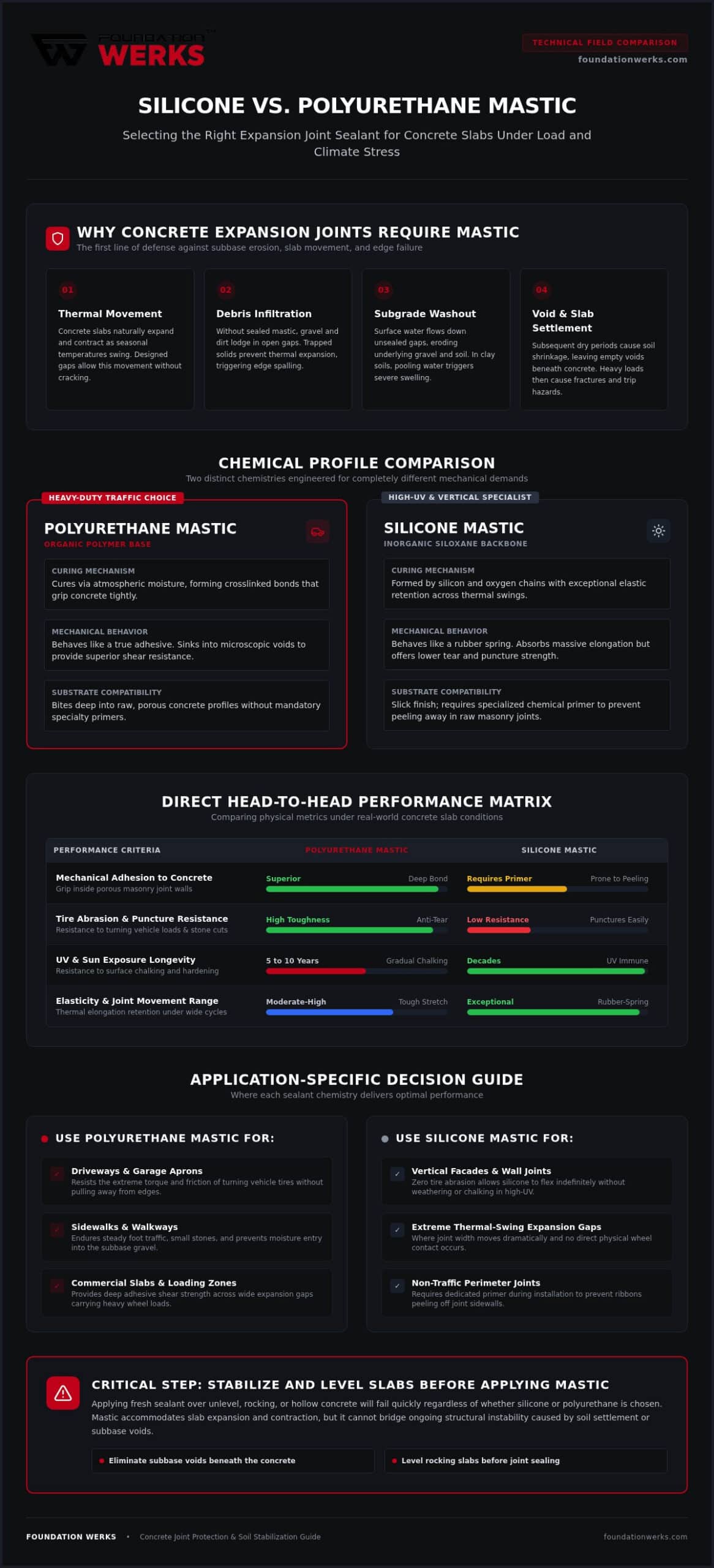
- Polyurethane Mastic: This is an organic polymer material that cures through exposure to atmospheric moisture. It forms exceptionally tough crosslinked bonds that grip concrete tightly. Because concrete is naturally porous, polyurethane bites deep into the masonry profile, providing superior shear resistance under vehicle tires.
- Silicone Mastic: Built on an inorganic siloxane backbone consisting of silicon and oxygen atoms, silicone is renowned for elastic retention. It withstands intense thermal swings without drying out, though its slick surface can struggle to form a lasting grip on raw, unprimed masonry.
These molecular differences explain why polyurethane bonds like an adhesive while silicone behaves like a rubber spring. Matching those traits to the demands of your site determines how long your joint seal lasts.
Key Performance Factors: Durability, Flexibility, and Environmental Resistance
Lab tests show how sealants react under ideal conditions, but real-world concrete joints face harsh environmental punishment every day. Deciding silicone or polyurethane mastic which is better requires looking past lab datasheets to see how materials handle the combination of friction, weather, and shifting subgrades. In field applications, physical wear often breaks a joint seal long before its chemical bonds give out.
Adhesion Strength and Substrate Bonding on Porous Concrete
Concrete has a rough, open pore structure that challenges chemical adhesion. Polyurethane acts like a true adhesive, sinking into microscopic voids along the joint walls to form a tenacity that resists peeling. Silicone offers high internal flexibility, but it tends to pull away from raw concrete unless an installer applies a specialized primer first. Without that added step, silicone often suffers adhesive failure, peeling off the joint sidewall in clean ribbons when slabs pull apart.
UV Exposure, Thermal Cycling, and Texas Climate Impact
Extreme climates quickly expose the physical limits of both materials. Rigorous ASTM test methods for sealants show that silicone provides exceptional resistance to ultraviolet radiation, keeping its rubbery feel for decades without drying out. Polyurethane, by contrast, slowly chalks and hardens under blistering summer sun, typically needing replacement after five to ten years. In North Texas, however, intense heat combines with deep clay soil movement. Winter freezes cause soaked ground to swell, while dry summers pull moisture out of the dirt, forcing joints through wide cycles of tension and compression.
Traffic Tolerance and Mechanical Abrasion Resistance
Movement capability is only half the battle on horizontal flatwork. Heavy vehicle tires, turning wheels, foot traffic, and routine pressure washing create constant surface friction:
- Polyurethane Mastic: Its dense, rubberized composition provides high tear strength. Turning tires roll across polyurethane without gouging chunks out of the bead, and commercial pressure washers will not peel it from the joint channel.
- Silicone Mastic: While capable of stretching up to 100% of its joint width, silicone is soft. Sharp gravel dragged by car tires or targeted water jets from power washers can slice or gouge it, destroying the watertight seal.
When you weigh silicone or polyurethane mastic which is better for driveways and commercial slabs, mechanical durability frequently wins over pure UV resistance. If you notice wide gaps or shifting panels across your property, scheduling professional joint seal or mastic installation helps lock out surface water before subgrade damage spreads.
Silicone vs. Polyurethane Mastic: Direct Head-to-Head Comparison
Every joint sealant involves mechanical trade-offs. Asking silicone or polyurethane mastic which is better requires matching material strengths to the orientation and abuse level of the joint. One product delivers maximum toughness, while the other provides unmatched elasticity.
A comprehensive scientific review of concrete sealants highlights these trade-offs clearly: polyurethane provides the rugged abrasion resistance required for heavy traffic, whereas silicone offers superior weathering endurance under constant solar exposure. Choosing between them means deciding whether your joint needs surface armor or maximum flexibility.
When Polyurethane Mastic Outperforms Silicone
Horizontal surfaces subject to rolling loads demand polyurethane. Driveways, parking ramps, and warehouse aprons experience constant shear force from vehicle tires. Polyurethane stays bonded under these stresses, resisting punctures from pebbles pressed into the joint. It also accepts paint and tinted coatings, allowing it to blend smoothly with colored decorative concrete. Additionally, polyurethane does not attract airborne dust or motor grime, keeping your slab joints visually clean over years of use.
When Silicone Mastic Takes the Lead
Silicone proves superior in situations requiring extreme stretch without mechanical wear:
- Vertical Façade and Wall Joints: High movement gaps along precast concrete walls or retaining panels benefit from silicone’s ability to compress and extend up to 50% or more without tearing.
- Pool Coping Perimeters: Surrounding pool decks face continuous chlorinated water splash and intense sunlight. Silicone thrives in this damp, chemical-heavy environment where vehicle traffic is absent.
- Non-Traffic Expansion Gaps: Slabs experiencing massive thermal shifts but zero vehicular loading remain sealed longer under silicone elasticity.
Maintenance Cycles and Long-Term Value Assessment
No joint filler lasts indefinitely. Sealants require planned inspection cycles to catch failures before water reaches the subgrade. Polyurethane typically serves reliably for five to ten years in exposed horizontal joints. Replacing it is straightforward: technicians slice out the failed bead, lightly clean the concrete sidewalls, and inject a fresh run.
Silicone lasts longer in non-traffic areas, often functioning for ten to twenty years. Its main drawback surfaces during replacement. Silicone leaves behind a microscopic layer of silicone oil deeply embedded in the concrete pores. New polyurethane or silicone will not bond to this residue. Contractors must mechanically grind the joint sidewalls back to raw concrete before reapplying any sealant, significantly increasing future labor requirements.
Balancing these real-world maintenance demands is key when deciding silicone or polyurethane mastic which is better for your concrete maintenance plan.
Application-Specific Selection: Driveways, Pool Decks, and Commercial Slabs
Every concrete surface endures a different kind of daily stress. A driveway handles turning tires and oil drips, while a pool deck battles chlorinated splashing and constant foot traffic. Picking silicone or polyurethane mastic which is better requires mapping sealant properties directly to these daily service conditions. Installing the wrong material leads to joint failure and premature slab degradation.
Protecting Residential Driveways, Patios, and Pool Coping
Residential flatwork needs tough protection against daily vehicle maneuvering. Polyurethane joint sealants provide the firm mechanical body required to bridge driveway joints without tearing under turning radial tires. For pool decks, the perimeter expansion joint separating the concrete coping from the pool shell experiences shifting moisture levels. Here, specialized chemical-resistant mastic protects against splash-out while preventing soil washout behind the pool walls. In both applications, using a closed-cell foam backer rod is critical. Sizing the rod 25% wider than the joint ensures an hourglass sealant shape with a proper 2:1 width-to-depth ratio, allowing the material to flex without pulling away.
Industrial Slabs, Warehouse Floors, and Heavy Loading Docks
Commercial facilities present an entirely different mechanical challenge. Heavy forklifts and pallet jacks with hard composite wheels concentrate immense point loads directly on joint edges. Flexible elastomeric mastics, whether silicone or polyurethane, compress too easily under these wheels, causing concrete joint shoulders to spall and fracture under traffic. Industrial interiors require specialized semi-rigid joint fillers combined with targeted slab stabilization. If you manage an active distribution center, exploring warehouse floor joint repair in Dallas can help restore solid support beneath heavy traffic zones, while reviewing a complete guide to commercial concrete crack repair offers proven methods to protect your working floors.
Joint Preparation and Installation Pitfalls to Avoid
Even premium mastic fails if the joint channel is poorly prepped. Successful installation requires strict attention to three steps:
- Sidewall Cleaning: Concrete joints must be mechanically cleaned using diamond blade saws or wire wheels to remove old filler, followed by oil-free compressed air to clear fine dust.
- Backer Rod Placement: Never pour mastic into an open void without a backer rod. Without it, the sealant adheres to the base, resulting in three-sided adhesion that tears during seasonal joint movement.
- Moisture Control: Applying polyurethane over damp concrete traps moisture. This triggers gas formation during the curing reaction, leaving porous bubbles inside the sealant bead that ruin the watertight barrier.
Knowing your site’s physical exposure settles the question of silicone or polyurethane mastic which is better for your property’s specific needs.
Professional Joint Sealing and Slab Stabilization for Concrete Longevity
Applying fresh sealant over rocking or sunken concrete will not solve your joint problems. When water slips past torn expansion joints, it washes away the subgrade beneath the slab. In North Texas, expansive clay soils compound this issue by shrinking away during dry spells and swelling during heavy rains. These subbase voids leave heavy concrete unsupported. Slabs begin to rock under vehicle tires, creating dynamic movement that snaps fresh mastic seals within months.
Why Mastic Replacement Pairs with Polyurethane Concrete Raising
Sealing misaligned joints leaves jagged trip hazards and accelerates edge spalling. Before installing new joint filler, the underlying concrete panels must sit level and firmly supported. Addressing subbase voids stops slab deflection before you caulk. Facility managers facing shifting panels often review techniques for stabilizing uneven warehouse floors to realign panels and lock down joint shoulders before recaulking.
The Foundation Werks Approach to Concrete Joint Preservation
Foundation Werks takes a complete approach to joint protection and concrete health. We restore slab support and seal out water using targeted steps:
- Precision Foam Lifting: We inject high-density polyurethane foam weighing just 2 pounds per cubic foot beneath settled slabs. In contrast to heavy traditional mudjacking materials that can add 100 pounds per cubic foot to vulnerable soil, this lightweight material fills hidden voids and gently lifts slabs back into alignment.
- Aesthetic Preservation: Injection requires tiny 5/8-inch drill holes that are patched cleanly after lifting, preserving slab appearance.
- Zero Downtime: The foam cures quickly, leaving residential driveways and industrial warehouse bays ready for immediate use on the day of completion.
- Professional Joint Installation: Our technicians extract degraded filler, grind joint sidewalls clean, place proper closed-cell backer rods, and tool fresh mastic for a durable, watertight bond.
Scheduling Your Site Assessment and Free Estimate
Homeowners and commercial facility managers across McKinney, Frisco, Prosper, Allen, and the broader Dallas-Fort Worth metroplex frequently ask about silicone or polyurethane mastic which is better for their property. While polyurethane mastic remains the preferred choice for heavy-traffic flatwork, neither material can succeed on an unstable foundation. Scheduling an inspection before rainy weather arrives protects your concrete from subbase erosion. Contact Foundation Werks to evaluate your slabs, stabilize underlying soils, and restore your concrete joints.
Protect Your Concrete Slabs with the Right Joint Strategy
Deciding silicone or polyurethane mastic which is better comes down to matching chemistry to your site conditions. Polyurethane delivers the mechanical grip and abrasion resistance needed for driveways and high-traffic flatwork. Silicone excels on vertical walls and pool coping where maximum elasticity matters most. Neither sealant can succeed on its own if underlying soil erosion has already left your slabs unsupported.
Foundation Werks helps property owners across McKinney, Frisco, Dallas, and surrounding North Texas communities stabilize concrete before moisture causes settlement. Our eco-friendly foam weighs just 2 pounds per cubic foot and injects through discreet 5/8-inch holes, restoring slab support with immediate same-day surface usability.
Taking proactive steps today keeps your joints sealed, halts subbase washout, and preserves your flatwork for years to come.
Frequently Asked Questions
Is polyurethane or silicone mastic better for concrete driveways?
Polyurethane mastic is better for concrete driveways. Vehicular traffic requires high abrasion resistance and strong tear strength to withstand turning radial tires. Soft silicones tear easily when cars roll over trapped pebbles. When homeowners evaluate silicone or polyurethane mastic which is better for heavy-traffic flatwork across North Texas, polyurethane’s tenacious mechanical bond to porous concrete makes it the superior choice.
Can silicone sealant be painted after curing on concrete joints?
No, standard silicone joint sealant cannot be painted. Its inert surface repels paint, causing water-based and oil-based coatings to bead up, crack, and flake away. If your concrete project requires color-matching or decorative coatings, polyurethane mastic is necessary because it readily accepts paints and elastomeric architectural coatings once fully cured.
Why do concrete expansion joints fail and pull away from slab edges?
Joint failure happens due to poor surface preparation, trapped moisture, or dynamic slab movement. If concrete sidewalls aren’t cleaned of dust and old residue, sealants experience adhesive failure. In DFW communities like Frisco and McKinney, active clay soil shifts slabs aggressively, pulling joints past their movement limits and causing premature debonding.
How long does polyurethane mastic typically last in outdoor concrete?
Polyurethane mastic typically lasts five to ten years in exposed outdoor flatwork. Direct ultraviolet radiation and severe thermal cycling slowly degrade organic polymer bonds over time. Routine maintenance inspections ensure you catch hairline cracks and peeling edges early, allowing you to reseal joints before water penetrates the subgrade.
Can I apply new polyurethane mastic directly over old silicone sealant?
No, new polyurethane will not adhere to cured silicone or its residue. Silicone leaves behind trace oils that penetrate deep into porous concrete edges. To achieve a reliable bond, technicians must mechanically grind the joint sidewalls back to clean, bare concrete before installing fresh backer rods and polyurethane mastic.
Why is backer rod required before applying concrete joint mastic?
A closed-cell backer rod prevents three-sided adhesion and controls sealant depth. Without it, mastic sticks to the bottom of the joint, preventing it from stretching freely as slabs pull apart. The backer rod creates an hourglass cross-section, ensuring the sealant flexes from the sides without tearing.
What happens to concrete slabs if expansion joints are left unsealed?
Unsealed joints allow rainwater to wash away the supporting soil beneath your slabs. In North Texas, pooling water triggers extreme swell-shrink cycles in expansive clay, creating hollow subbase voids. Without support, heavy vehicles cause concrete panels to crack, rock, and sink, turning minor joint neglect into severe structural problems.