

An open gap in your driveway or patio is an open door for water to quietly undermine your entire concrete slab. If you are noticing uneven surfaces, you might wonder why is it important to seal all open joints on my concrete with mastic instead of just ignoring them or using a basic hardware store caulk. It’s completely natural to feel overwhelmed by the choices or to worry that a small crack will eventually lead to an expensive slab replacement.
The truth is that the leading cause of sunken concrete is actually soil failure beneath the surface, not the concrete itself. Discover how sealing open concrete joints with professional mastic protects your property from costly soil erosion and slab settling. In the Dallas-Fort Worth area, our soil contains over 50% expansive clay, which shifts dramatically when wet. This article explains the mechanical purpose of concrete mastic, demonstrates how open joints accelerate soil erosion, and offers a reliable long-term maintenance solution for your DFW concrete slabs.
Key Takeaways
- Learn how open joints act as entry points for water, leading to subgrade erosion and the eventual sinking of your concrete slabs.
- Understand why is it important to seal all open joints on my concrete with mastic to prevent the expansive clay soils in North Texas from destabilizing your foundation.
- Compare the long-term savings of professional joint maintenance against the high costs and liability risks of ignoring slab movement.
- Discover the critical role of surface preparation and routing in creating a long-lasting bond between the sealant and your concrete.
- Explore how combining mastic installation with polyurethane concrete raising provides a comprehensive way to level and protect your DFW property.
Understanding Open Concrete Joints: The Hidden Vulnerability in Your Slabs
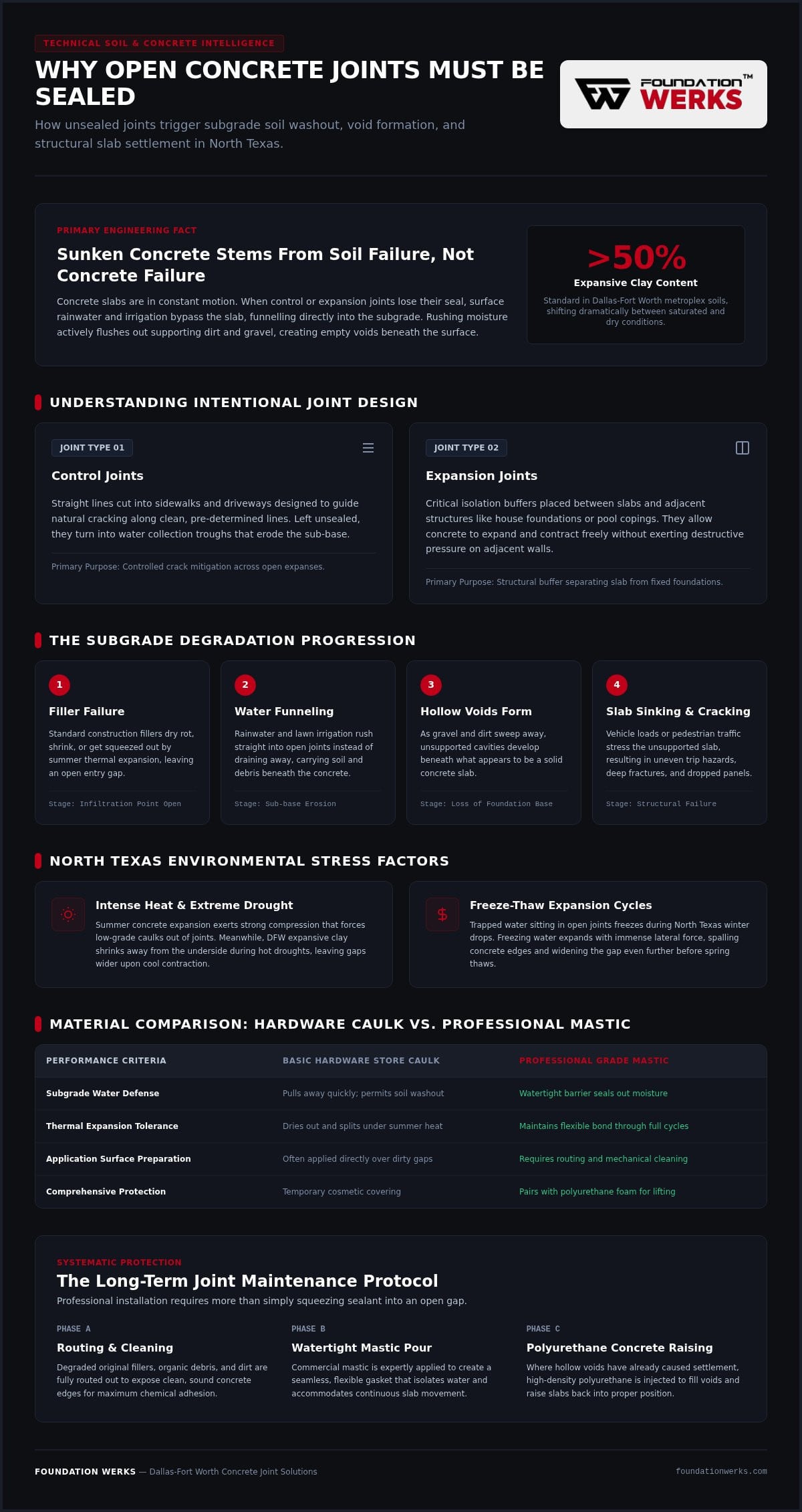
Concrete slabs might look like solid, immovable objects, but they are actually in a state of constant motion. Engineers design concrete with intentional gaps to manage this movement, but these gaps can quickly become a liability if they aren’t maintained. Open joints are structural entry points for moisture damage that can compromise the integrity of your entire property.
To better understand this concept, watch this helpful video:
Over time, original joint materials degrade and leave open gaps that expose the underlying subgrade. You might wonder, why is it important to seal all open joints on my concrete with mastic rather than leaving them alone? When these joints are left exposed, they allow surface water, organic debris, and pests to penetrate deep beneath the concrete. This infiltration creates a direct path for erosion that eventually leads to sinking or cracking.
The Purpose of Expansion and Control Joints
Control joints are the straight lines you see cut into a sidewalk or driveway. Their job is to guide natural cracking along a clean, pre-determined line so the slab stays visually appealing. Expansion joints serve a different purpose, as they isolate slabs from adjacent structures like house foundations or pool copings. Both joint types require a flexible, watertight barrier to remain effective over time. Without this protection, the concrete cannot expand and contract freely without putting stress on the surrounding structures.
Why Original Joint Fillers Fail in North Texas
In the Dallas-Fort Worth area, our weather is particularly hard on concrete. Intense summer heat causes extreme concrete expansion that often squeezes out cheap, low-quality fillers used during initial construction. These standard materials tend to dry out, dry-rot, and shrink within just a few seasons. A professional Sealant must be able to withstand these cycles without losing its bond. For business owners, these failures can lead to broader facility risks, which we detail in our commercial concrete crack repair guide. When the filler fails, the open gap invites water to interact with our local expansive clay, starting a cycle of slab movement that is difficult to stop without intervention.
Why Is It Important to Seal All Open Joints on Your Concrete with Mastic?
Water is the primary enemy of concrete longevity. When joints are left open, they act like funnels that direct rainwater and irrigation straight into the subgrade. This process is the starting point for nearly every major concrete failure we see in the DFW metroplex. Sealing joints with mastic locks out moisture and preserves structural integrity for the long haul, keeping the foundation of your driveway or patio secure.
Preventing Subgrade Soil Erosion and Voids
Rushing water doesn’t just sit under your slab; it actively sweeps away the supporting dirt and gravel through unsealed gaps. As this material washes out, empty spaces or voids form where there should be solid support. This is a critical reason for performing preventive maintenance by sealing joints, as identified by transportation engineers. Without a stable base, the weight of a vehicle or even heavy foot traffic will eventually cause the concrete to crack and sink into these hollow spots. Mastic prevents the formation of hollow voids under driveways and patios by creating a watertight seal that keeps the supporting soil exactly where it belongs.
Combating the North Texas Freeze-Thaw and Drought Cycles
Our local climate presents unique challenges that make sealing even more vital. During a typical North Texas winter, trapped water in open joints expands as it freezes. This expansion puts immense pressure on the slab, often cracking the edges and widening the joints further. When the summer heat arrives, the high clay content in our soil, which often exceeds 50% in Dallas and Frisco, causes it to shrink and pull away from the slab.
A sudden downpour then oversaturates specific spots through those open gaps. In North Texas, water destabilizes highly expansive clay soils, which leads to slab flipping and significant trip hazards. Mastic acts as a flexible shield that keeps moisture levels uniform beneath your slabs. It stretches and compresses with the concrete, ensuring that the underlying clay remains stable regardless of the season. If you have noticed your driveway shifting or joints widening, you can talk to a concrete specialist to see how a professional joint seal can protect your investment. By maintaining a consistent moisture barrier, you prevent the localized saturation that leads to the most common types of slab failure.
Mastic Joint Sealing vs. Leaving Gaps Exposed: A Long-Term Cost Comparison
Choosing between a professional seal and doing nothing is essentially a choice between a minor maintenance cost and a massive reconstruction bill. Proactive mastic installation is a highly cost-effective alternative to full concrete replacement. When you ignore open joints, you aren’t just letting water in; you’re guaranteeing accelerated slab failure. This neglect creates trip hazards that can lead to significant liability issues for both homeowners and business managers. It’s much easier to manage a joint today than it is to replace a whole driveway next year.
For commercial properties, the stakes are even higher. You can see how these costs scale in our specialized guide to warehouse floor joint repair in Dallas, where industrial traffic demands superior durability. Professional engineering studies on Pavement Joint Sealant Practices confirm that consistent sealing is a standard requirement for maintaining structural integrity on a national scale. Commercial-grade mastic maintains its flexibility for years, whereas cheap DIY alternatives often fail within a single season.
Why Retail Caulking Falls Short of Commercial Mastic
Many people try to save a few dollars with hardware store tubes, but over-the-counter silicone lacks the elasticity needed for wide concrete expansion joints. Professional mastic is a different grade of material entirely. It is designed to self-level, creating a seamless and watertight finish. It adheres tightly to concrete sidewalls and resists the harsh UV degradation common in the Texas sun. DIY products often dry out and pull away within months, requiring frequent re-application. This cycle costs you more time and money than doing the job right with commercial-grade materials that actually move with your slab.
The Financial Reality of Sinking Slabs
If you’re asking, why is it important to seal all open joints on my concrete with mastic before the slab actually moves, the answer is found in your long-term budget. Unsealed joints lead to sunken concrete that requires specialized polyurethane foam lifting to restore. While we provide expert lifting services, it’s always more economical to prevent the sink in the first place. Addressing joint sealing early protects your property investment and avoids the premature tearing out of slabs that could have lasted decades longer. Maintaining sealed joints ensures your concrete remains level, safe, and visually appealing, which preserves your home’s curb appeal and overall value. If you want to keep your concrete in top shape, you can request an inspection to identify which joints are most at risk.
The Professional Mastic Installation Process: What to Expect
A professional joint seal is only as good as the preparation behind it. You might understand the theory of why is it important to seal all open joints on my concrete with mastic, but the physical application requires a meticulous, multi-step process to ensure the material actually stays in place. Proper surface preparation is the most critical factor in achieving a long-lasting mastic bond that stands up to the Texas heat. Professionals don’t just pour sealant over existing dirt; they route out old, decayed joint material and organic debris to create a clean, porous surface for the new mastic to grip.
Timing is also a vital component of a successful installation. The process requires completely dry conditions and precise temperature windows to ensure the chemical bond cures correctly. If the concrete is too cold or the air is too humid, the sealant won’t adhere properly to the sidewalls. Professional mastic must be installed perfectly flush with the concrete surface to create a seamless transition that eliminates trip hazards and prevents damage from heavy vehicle tires or lawn maintenance equipment.
Deep Cleaning and Joint Preparation
Our technicians start by using specialized tools to remove rocks, weeds, and failing old caulk that has lost its elasticity. This isn’t a surface-level sweep. We focus on sanding or brushing the joint sidewalls to expose fresh concrete, which ensures maximum mastic adhesion. Once the joint is clean, we install a foam backer rod. This small but essential step controls the mastic depth and prevents the material from sinking too deep into the void. It also allows the mastic to bond only to the two sides of the concrete, giving it the flexibility to stretch and compress without tearing.
Pouring and Curing the Self-Leveling Mastic
After the preparation is complete, commercial-grade mastic is carefully poured or injected into the gap. We use a self-leveling formula that naturally flows to match the exact profile of your concrete driveway or pool deck. This creates a smooth, watertight seal that looks professional and clean. While curing times vary based on the local DFW humidity, these surfaces are typically ready for light foot traffic shortly after the application is finished. When you see the finished product, it’s clear why is it important to seal all open joints on my concrete with mastic using specialized equipment rather than attempting a messy DIY project. The result is a consistent, flexible barrier that shields your subgrade from the elements for years to come.
Protecting Your DFW Property with Foundation Werks Concrete Joint Solutions
Foundation Werks provides expert joint sealing and mastic installation across McKinney, Frisco, and Dallas. We’ve spent years working with the specific soil conditions of North Texas, and we know that a one-size-fits-all approach doesn’t work here. You might be asking yourself, why is it important to seal all open joints on my concrete with mastic if the slab hasn’t moved yet? The answer lies in prevention. We integrate joint repair with Polyurethane Concrete Raising to lift, level, and protect slabs simultaneously, ensuring that water never gets the chance to wash away your foundation again.
Our durable solutions focus on preventative maintenance to avoid the mess and heavy machinery required for traditional mudjacking. We use lightweight, eco-conscious materials that stabilize the ground without adding excessive weight to the already stressed clay soil. For industrial clients, our team specializes in uneven warehouse floor repair in Dallas, providing the same high-level stabilization and joint protection we offer to residential homeowners.
Comprehensive Concrete Stabilization and Sealing
If your slabs have already settled or cracked, our polyurethane foam injection lifts them back to their original grade. This material expands to fill voids, creating a solid base that won’t wash away. We apply premium mastic immediately after the leveling process to protect the subgrade from future water intrusion. Technicians ensure the mastic is installed perfectly flush with the concrete surface to eliminate trip hazards and prevent water from pooling in recessed gaps. This dual-action approach delivers an effective, long-term resolution for residential and commercial properties. By sealing the entry points, we protect the polyurethane foam and the underlying soil from the North Texas rain cycles, effectively stopping erosion before it can restart the sinking process.
Schedule Your Free DFW Concrete Inspection
Our professional crews assess your joints, cracks, and slab levels to provide accurate recommendations tailored to your specific property. We prioritize transparency, clean work environments, and minimal disruption to your landscaping or daily routine. We believe in being educators first, so we’ll walk you through the current state of your concrete and explain exactly how our joint sealing process works. It’s our goal to give you peace of mind by securing your investment with reliable, honest craftsmanship. We focus on delivering results that respect both your time and your property.
Take Control of Your Concrete Maintenance Today
Protecting your property starts with understanding the mechanical vulnerabilities of your driveway and patio. You now know why is it important to seal all open joints on my concrete with mastic to prevent water from washing away the vital soil support beneath your feet. By choosing a professional seal, you’re shielding your investment against the harsh North Texas climate and avoiding the high costs of premature slab replacement. It’s a simple step that saves significant stress and money over time.
Foundation Werks specializes in Polyurethane Concrete Raising and professional joint repair across McKinney, Frisco, and the entire Dallas metroplex. We use eco-conscious materials that offer clean, same-day usability, so your daily routine isn’t disrupted. Our technicians are here to ensure your concrete remains stable and secure for the long term. Don’t wait for a small gap to become a major structural headache. We’re ready to help you restore the beauty and safety of your home’s exterior surfaces.
Frequently Asked Questions
Is mastic better than silicone caulk for concrete joints?
Commercial mastic is far superior to standard silicone caulk because it’s specifically engineered for high-movement areas. While hardware store silicone often dries out and peels away in the intense North Texas sun, our professional mastic remains flexible. It creates a stronger bond with the concrete sidewalls, ensuring a watertight seal that handles the expansion and contraction cycles common in McKinney and Frisco without requiring frequent re-application.
How long does professional concrete mastic joint sealing last?
A professional mastic installation typically provides a reliable seal for several years. The lifespan depends on UV exposure and the amount of foot or vehicle traffic the area receives. Unlike retail products that fail within months, these commercial-grade materials are designed for durability. Regular inspections help you catch minor wear early, ensuring your DFW property remains protected from the localized soil erosion that leads to costly slab settling.
Can water get under concrete if the joints are left unsealed?
Unsealed joints are essentially open funnels that direct surface water straight into the subgrade. In North Texas, this is particularly dangerous because our soil contains high levels of expansive clay. When water reaches this layer, it causes the ground to swell and then shrink, creating voids. This is why is it important to seal all open joints on my concrete with mastic to keep the foundation of your slab dry and stable.
What happens if I do not seal the expansion joints around my pool deck?
Leaving expansion joints open around a pool deck allows water to seep behind the coping and into the pool’s structural bond beam. This moisture destabilizes the soil, leading to slab flipping or cracking that can be dangerous for swimmers. In cities like Prosper and Allen, where pool decks are common, sealing these joints is a critical maintenance step. It prevents water from undermining the deck and causing expensive shifts in your outdoor living space.
Can you apply mastic to wet or damp concrete joints?
You cannot apply mastic to wet or damp concrete joints if you want a successful bond. Moisture prevents the sealant from adhering to the concrete sidewalls, which will lead to premature failure and peeling. Our crews ensure the joints are completely dry and clean before application. If we’ve recently had a typical DFW downpour, we’ll wait for the area to dry thoroughly to ensure the joint repair remains effective for the long haul.
Will sealing my concrete joints stop my driveway from sinking further?
Sealing joints stops the primary cause of sinking, which is water-driven soil erosion. However, if your driveway has already settled, mastic alone won’t lift it back to grade. We recommend a dual approach. First, we use Polyurethane Concrete Raising to level the slabs. Then, we apply the mastic seal. This combination addresses existing damage and protects the new lightweight foam from future water intrusion, keeping your driveway level for years.
How long does it take for concrete mastic to cure before I can drive on it?
Most commercial-grade mastics are tack-free within a few hours, but full curing usually takes about 24 hours depending on the local humidity. While our Polyurethane Concrete Raising allows for immediate usability, we recommend waiting a short period before driving heavy vehicles over freshly sealed joints. This ensures the material has set firmly and won’t be deformed. Our team will provide specific instructions based on the weather conditions in Dallas or Southlake on the day of your service.