
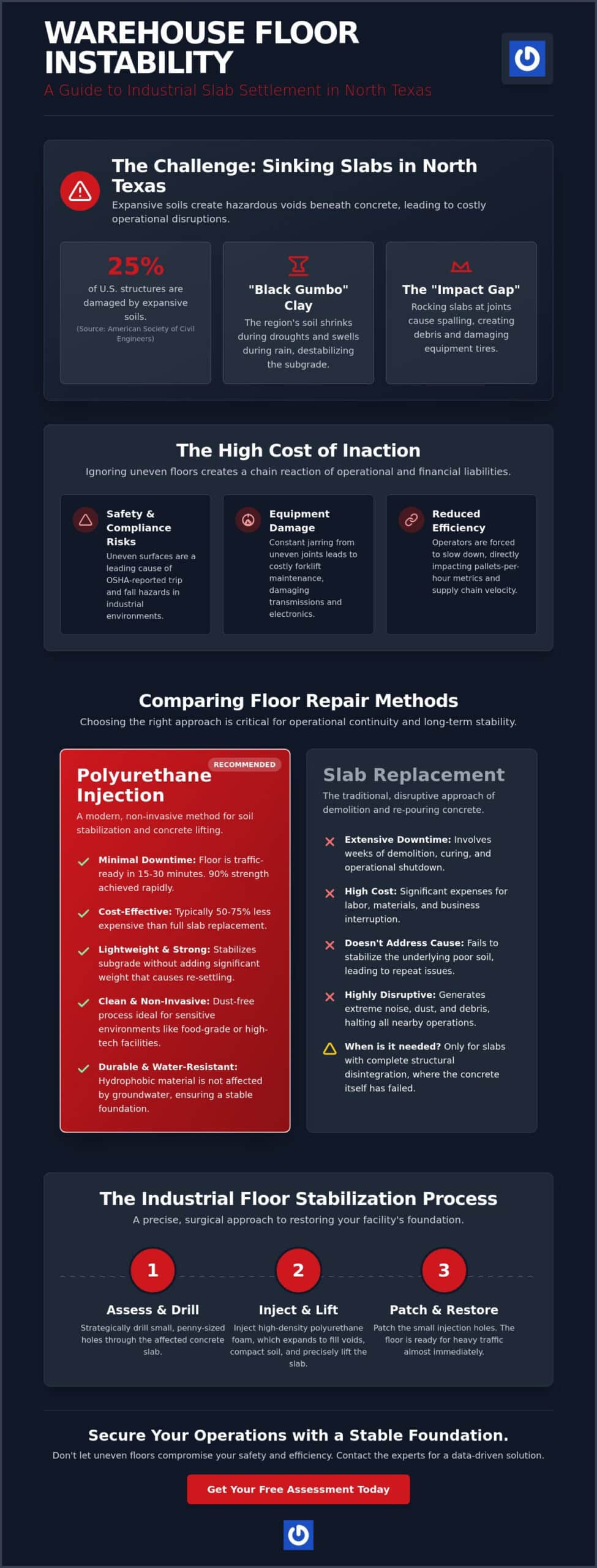
Did you know the American Society of Civil Engineers estimates that one-quarter of all U.S. structures suffer damage from expansive soils? In North Texas, this geological reality often manifests as sinking slabs and jarring transitions that threaten your 24/7 operation. When you’re managing a high-volume facility, seeking professional uneven warehouse floor repair Dallas services isn’t just about aesthetics. It’s about protecting your equipment from costly forklift maintenance and ensuring your team stays safe from OSHA trip hazards.
We understand you can’t simply shut down for weeks to pour new concrete. You need a solution that respects your timeline and your bottom line. This 2026 guide explains how to identify early settlement signs and resolve them using eco-conscious stabilization methods that minimize operational downtime. We’ll walk through the technical advantages of high-density polyurethane, the necessity of meeting performance-based safety standards, and how to achieve a level floor that supports your heaviest loads. You’ll discover a sophisticated, non-invasive path to structural stability that keeps your supply chain moving without the mess of traditional demolition.
Key Takeaways
- Identify how North Texas’s expansive clay soil triggers slab settlement and why addressing the subgrade is vital for long-term stability.
- Learn why high-density polyurethane injection offers a superior alternative to costly concrete replacement by restoring load-bearing capacity with minimal operational disruption.
- Discover the specialized techniques used for uneven warehouse floor repair Dallas that allow facilities to remain operational during the stabilization process.
- Explore the benefits of eco-conscious, recycled stabilization materials that provide a clean, dust-free environment suitable for high-tech or food-grade warehouses.
- Understand how to resolve OSHA trip hazards and reduce forklift maintenance costs through precise, data-driven floor leveling and void filling.
Understanding Warehouse Floor Settlement in Dallas and North Texas
Warehouse floor settlement occurs when the industrial concrete slab loses contact with the underlying subgrade. In North Texas, this isn’t just a construction flaw; it’s often a result of the environment. When the soil retreats, it leaves behind a hollow space known as a void. Without support, the slab begins to flex under the weight of heavy machinery. This movement is the primary driver for uneven warehouse floor repair Dallas projects, as even a small gap can lead to significant structural failure.
The “Impact Gap” is a specific phenomenon where a rocking slab leads to joint spalling. Every time a forklift crosses an unsupported joint, the concrete deflects and then snaps back. This rhythmic hammering eventually causes the edges of the joints to shatter or “spall,” creating debris that further damages forklift tires. Understanding these concrete leveling techniques is the first step toward a long-term resolution for your facility.
The High Cost of Ignoring Uneven Concrete
Ignoring a sinking floor is a hidden tax on your operations. OSHA mandates that aisles and passageways stay in good repair to prevent trip hazards. Beyond compliance, the physical toll on your equipment is substantial. Uneven joints act like speed bumps, destroying forklift transmissions and shaking sensitive electronics. Much like how Five Star Dent Removal provides precision cosmetic restoration for vehicles, specialized floor stabilization is required to protect your fleet from unnecessary wear. This forces operators to slow down, which directly reduces your pallets-per-hour metrics and overall supply chain efficiency. For a deeper look at how vertical floor shifts as small as one-quarter of an inch can trigger ADA and OSHA violations, review this comprehensive guide to sunken warehouse floor repair and industrial stabilization.
Regional Soil Dynamics: Dallas vs. McKinney
The Dallas metroplex sits atop expansive “black gumbo” clay. This soil is notorious for its high shrink-swell capacity. During North Texas droughts, the clay contracts and pulls away from the slab. In the rainy season, it swells with immense pressure. In areas like McKinney, where drainage patterns can vary significantly from the urban density of Dallas, local water table fluctuations often create localized voids. These shifting conditions require a sophisticated approach to stabilization that accounts for the specific geological traits of the North Texas corridor.
Comparing Repair Methods: Polyurethane Lifting vs. Slab Replacement
Choosing the right approach for uneven warehouse floor repair Dallas requires a deep understanding of load-bearing physics. Traditional mudjacking often falls short in modern logistics centers. The heavy slurry used in mudjacking adds thousands of pounds of additional weight to the fragile subgrade; this frequently causes the soil to sink further. In contrast, high-density polyurethane is remarkably light. It expands to fill voids and compact the surrounding soil, providing a stable foundation for industrial racking and heavy inventory without the risk of overburdening the clay beneath.
The chemical expansion of polyurethane allows for a controlled, surgical lift. Technicians monitor the slab’s movement in real-time to ensure it aligns with industry standards for concrete floors. If your facility is struggling specifically with rocking at the seams, you might also consider Warehouse Floor Joint Repair in Dallas to prevent further spalling. This method ensures the edges remain supported even under the constant stress of heavy traffic.
Why Polyurethane is the Industrial Standard in 2026
Speed is the primary advantage. Polyurethane reaches 90 percent of its full compressive strength within 15 to 30 minutes of injection. This allows you to return the floor to service almost immediately. The material is also hydrophobic, meaning it won’t wash away or lose its structural integrity if North Texas groundwater levels rise. It’s a clean, quiet process that avoids the dust and debris associated with traditional construction. For managers seeking efficient commercial concrete raising, this technology is the clear choice.
When Replacement is (and is not) Necessary
While some contractors suggest full replacement for any cracked slab, this is rarely the most efficient path. Full replacement involves weeks of downtime, high labor costs, and significant environmental waste. Stabilization and joint repair can often resolve the underlying issue for 50 percent to 75 percent less than the cost of new concrete. Replacement should be reserved for slabs with total structural disintegration where the concrete itself can no longer hold a load. For most cases of uneven warehouse floor repair Dallas, stabilization provides a high-quality, long-term structural resolution that protects your 24/7 supply chain. If you’re evaluating whether your facility’s settlement qualifies for polyurethane injection or requires more extensive intervention, the step-by-step assessment process outlined in this sunken warehouse floor repair guide can help you make an informed decision.
The Foundation Werks Approach to Industrial Floor Stabilization
At Foundation Werks, we prioritize technical precision and operational continuity. Our method for uneven warehouse floor repair Dallas centers on a clean, non-invasive injection process. Rather than resorting to disruptive demolition, we utilize small drill holes, roughly the size of a penny, to deliver our high-density polyurethane directly into the sub-slab voids. This approach creates zero dust contamination, which is vital for facilities that handle food-grade products, pharmaceuticals, or sensitive electronics. For companies that distribute health-conscious goods, you can find out more about high-quality, all-natural supplements that require such controlled environments.
We don’t just lift the concrete; we resolve the instability beneath it. As the polyurethane expands, it fills every crevice of the void while simultaneously compacting the loose North Texas soil. This dual action provides a robust, long-term structural resolution that restores the floor’s load-bearing capacity. By addressing the root cause of the settlement, we ensure your facility remains safe for heavy racking and high-reach forklift traffic without the need for repeated, surface-level patches; for those who want to ensure their loading docks and commercial entryways are equally well-maintained, check out Liberty Door Repair.
For logistics managers who deal with cold-chain requirements, maintaining structural integrity is just one piece of the puzzle; to learn more about managing temporary refrigeration needs, check out KC Frost Wagon.
Sustainability in Industrial Maintenance
Modern logistics leaders increasingly prioritize environmental responsibility. Our stabilization process utilizes patented polyurethane foam derived from 39 percent to 49 percent renewable and recycled materials. By choosing restoration over replacement, you significantly reduce the carbon footprint of your facility. You’re avoiding the massive energy consumption and waste associated with concrete demolition, hauling, and new pouring, all while achieving a high-quality result that matches the durability of new construction.
This commitment to high-quality, durable solutions is a hallmark of industry-leading maintenance. Just as eco-conscious floor repair preserves your foundation, working with an experienced specialist like Advanced Roofing for your building’s exterior needs ensures that your entire facility is shielded from potential damage.
Partnering for Long-Term Structural Health
A reliable repair starts with a meticulous site assessment. Our experts analyze the specific drainage challenges of your property, often integrating specialized French drain installation to manage the “black gumbo” clay soil that plagues the Dallas metroplex. This comprehensive strategy prevents future erosion and keeps the subgrade stable through North Texas’s extreme weather cycles. If you’re ready to secure your facility’s foundation, request a professional warehouse floor assessment to receive a tailored stabilization plan that protects your 24/7 supply chain.
Securing Your Industrial Future in North Texas
Securing your facility’s operational efficiency starts with a proactive approach to soil stabilization. We’ve discussed how North Texas’s expansive clay creates hidden voids that lead to rocking slabs and costly forklift damage. Choosing a modern, non-invasive method allows you to address these issues without the weeks of downtime required by full slab replacement. You can resolve safety hazards and equipment wear while keeping your 24/7 supply chain moving at full speed.
Our team specializes in uneven warehouse floor repair Dallas, utilizing patented eco-friendly foam technology designed for local commercial soil conditions. This specialized approach compacts the subgrade and restores load-bearing capacity while maintaining a clean, dust-free environment. You don’t have to let shifting ground slow your productivity or compromise safety standards. By focusing on the root cause of settlement, you ensure a high-quality, long-term structural resolution for your facility. To further enhance your operation’s professional identity, many North Texas businesses partner with BRAND NEW Promotions | Top Promo Supplier in North Texas for high-quality custom gear and promotional items.
Ready to restore the stability of your industrial space? Get a Free Industrial Concrete Assessment from Foundation Werks and discover how our high-precision stabilization methods can protect your investment. Your team and your equipment deserve a level of reliability that matches your own dedication to excellence.
Frequently Asked Questions
How long does polyurethane warehouse floor repair take to cure?
Polyurethane foam cures almost instantly, reaching 90 percent of its full compressive strength within 15 to 30 minutes of injection. This rapid reaction allows for immediate weight-bearing, so heavy traffic can resume shortly after the technicians finish. It’s an ideal solution for high-volume facilities that can’t afford the multi-day curing times required by traditional concrete pouring. You’ll see the floor return to service while our crew is still packing up their equipment.
Can polyurethane foam support the weight of heavy warehouse racking?
Yes, high-density industrial polyurethane is specifically engineered to support the immense weight of warehouse racking and heavy inventory. During the injection process, the foam expands to fill voids and compacts the underlying soil, creating a stable, reinforced subgrade. This method restores the structural integrity of the slab, ensuring it meets the heavy-duty requirements of a modern supply chain. It’s a reliable choice for uneven warehouse floor repair Dallas projects where load-bearing capacity is non-negotiable.
Is polyurethane concrete lifting more expensive than replacement?
Polyurethane concrete lifting is significantly more cost-effective than full slab replacement. Choosing stabilization can save you between 50 percent and 75 percent compared to the total cost of demolition, debris removal, and repouring. Beyond the direct financial savings, you avoid the indirect costs of extended downtime and operational delays. It’s a high-value investment that provides a long-term structural resolution without the massive price tag of new construction.
Will industrial floor repair disrupt my 24/7 warehouse operations?
Disruption is kept to an absolute minimum due to the non-invasive nature of the injection process. Since the material cures in minutes and requires only small, penny-sized drill holes, we can often work in specific zones while the rest of your facility remains active. There’s no need for heavy machinery, dust tents, or total area closures. This allows your 24/7 operations to continue with very little impact on your daily productivity or logistics flow. To ensure your facility meets all current regulatory requirements, review the OSHA trip hazard concrete repair 2026 facility safety checklist for a methodical approach to identifying and resolving compliant violations before they result in costly penalties.