

Tearing out and replacing a sinking warehouse floor is often the most expensive mistake a McKinney property manager can make. When you see cracks or uneven slabs, it’s natural to think a full replacement is your only option. However, pouring new, heavy concrete often just adds more weight to the volatile Blackland Prairie clay that caused the sinking in the first place. If you’re looking for commercial foundation repair mckinney, you need a strategy that addresses the soil without shutting down your operations for weeks.
We understand the stress of managing a facility where every hour of downtime impacts your bottom line and every trip hazard increases your liability. You want a solution that’s fast, reliable, and keeps your budget intact. This guide will show you how modern stabilization techniques protect your property from North Texas soil volatility while allowing you to use your floors the same day. We’ll preview the 2026 McKinney building codes, explain why our local clay behaves this way, and walk through the most cost-effective alternatives to concrete replacement.
Key Takeaways
- Learn why McKinney’s expansive clay soil causes concrete to sink and how to spot the warning signs before they become safety hazards.
- Discover how polyurethane concrete raising provides a faster, cleaner alternative for commercial foundation repair mckinney compared to traditional demolition.
- Understand how lightweight foam stabilization allows for immediate floor use, avoiding the business downtime associated with curing new concrete.
- Compare the financial benefits of lifting versus replacing, including how stabilization typically costs about half as much as a full pour.
- Find out the essential steps for a professional site evaluation to identify drainage issues or soil voids that threaten your facility’s integrity.
Why McKinney Soil Causes Commercial Foundation Issues
McKinney sits directly on the Blackland Prairie, a region known for some of the most volatile soil in the United States. This isn’t just a minor inconvenience for property managers; it’s a constant structural challenge. When you’re managing a facility, understanding the need for commercial foundation repair mckinney starts with the dirt beneath your feet. The local ground is comprised of Expansive clay soils that act like a massive, underground sponge. They swell significantly when North Texas experiences heavy spring rains and shrink drastically during the brutal, triple-digit summer heat.
This expansion and contraction cycle puts immense pressure on concrete slabs. In industrial warehouses, this often manifests as “slab curl.” This happens when the top of the concrete dries faster than the bottom, causing the slab edges to warp or lift. Over time, this movement creates voids or empty pockets beneath the floor. Traditional repair methods often focus on the surface, but ignoring these sub-surface gaps leads to recurring issues and safety hazards for your staff and equipment.
Signs of Commercial Foundation Failure in North Texas
Identifying problems early can save thousands in repair costs. In a commercial setting, the signs are often more than just a hairline crack. You might notice tilting machinery that requires constant recalibration or warehouse floors that have developed significant “lips” at the joints. These uneven surfaces are prime locations for forklift accidents and employee trip hazards. You should also look for gaps forming in exterior brickwork or commercial doors that suddenly stick or fail to latch properly. These are clear indicators that the building’s skeleton is moving.
The Role of Soil Erosion in Concrete Settling
While soil movement is a natural part of the McKinney landscape, water management often accelerates the damage. Poor drainage leads to sub-slab washouts, where water literally carries the supporting soil away from the foundation. This is frequently linked to improper gutter runoff or a lack of effective French drains. When the soil washes out, the concrete is left “bridging” a gap. Eventually, the weight of the slab and your inventory causes the concrete to snap and sink. Simply filling a crack with caulk is a cosmetic fix that fails to address the lack of support underneath. Real stabilization requires filling those hidden voids to restore the floor’s integrity.
Polyurethane Foam: The Modern Commercial Stabilization Solution
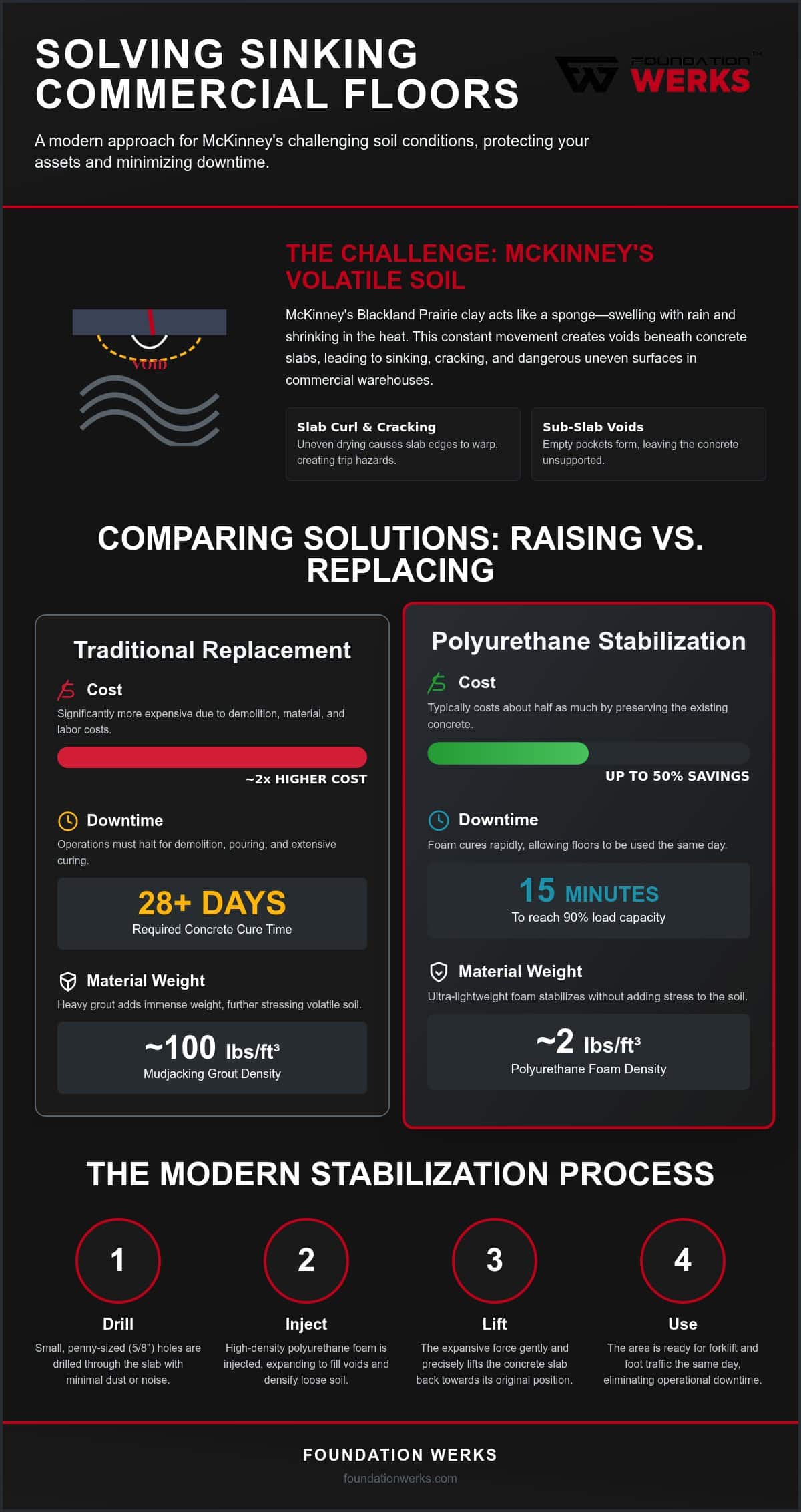
Traditional mudjacking uses a heavy grout mixture that weighs nearly 100 lbs per cubic foot. In McKinney, adding that much weight to already stressed clay is often counterproductive. Our polyurethane material weighs only about 2 lbs per cubic foot. This lightweight nature is critical for commercial foundation repair mckinney because it stabilizes the slab without adding a new burden to the underlying soil. By choosing a lighter material, we reduce the risk of the concrete sinking again under its own weight.
We use Deep Foamjection™ to reach the deeper soil layers that the USDA Web Soil Survey identifies as having high shrink-swell potential in North Texas. This process doesn’t just lift the concrete; it densifies the soil itself. The foam expands in all directions, filling cracks and creating a solid, reinforced base for heavy industrial equipment. Sustainability is also a priority for local businesses. We use eco-conscious, recycled polyurethane foam that is environmentally inert, ensuring your property improvements align with modern green building standards.
The Process of Void Filling Under Concrete Slabs
The injection process is remarkably clean and non-invasive. We drill small, 5/8-inch holes, which are roughly the size of a penny. This allows us to perform void filling under concrete slab surfaces without the mess of heavy machinery or large excavation crews. As the high-density foam enters the void, it displaces trapped water and compresses loose soil particles. Once the void is filled, the foam’s expansive force gently lifts the slab back toward its original position.
Immediate Usability for McKinney Facilities
Time is a primary concern for any facility manager. While a new concrete pour requires a 28-day cure time to reach full strength, our polyurethane foam reaches 90% of its load-bearing capacity within 15 minutes. You don’t have to wait weeks or even days to resume operations. You can have forklifts, heavy trucks, or foot traffic back on the surface the same day we finish the work. This speed allows you to maintain facility uptime during critical business hours without the logistical nightmare of a total shutdown. If you are dealing with uneven warehouse floors, you can speak with our team to see how quickly we can restore your workspace.
Concrete Raising vs. Replacement: ROI for Property Managers
Property managers often default to concrete replacement because it feels like a fresh start. However, the “replacement trap” is a costly cycle that rarely addresses the root cause of the problem. When you choose commercial foundation repair mckinney through lifting and stabilization, you typically spend about 50% less than you would on a full demolition and repour. This savings isn’t just about the material costs. It’s about avoiding the expensive logistics of a construction zone.
The hidden costs of replacement can cripple a facility’s quarterly budget. You have to pay for demolition crews, concrete disposal fees, and the environmental impact of sending tons of material to a landfill. Most importantly, you face massive downtime. New concrete requires a 28 day cure period before it reaches full strength. In contrast, high density polyurethane foam never loses its density or strength over time. It remains a rigid, lightweight support structure that won’t wash away like traditional mudjacking grout. For a deeper look at long term value, you can evaluate concrete slab stabilization in Dallas to see how industrial facilities maximize their ROI.
Technical data supports the longevity of this approach. According to transportation research on polyurethane injection, this method provides a reliable, high strength support system that can withstand heavy traffic loads without degrading. It’s a smarter way to manage your assets without the waste of unnecessary demolition.
When is Concrete Replacement Necessary?
There are times when stabilization isn’t the right path. If a slab is “shattered” with spiderweb cracks every few inches, it lacks the structural integrity to be lifted as a single unit. In these cases, the concrete has reached the end of its functional life. However, if the slab is mostly intact but has simply tilted or sunk, it’s a prime candidate for lifting. We always recommend stabilization as the first evaluation step before committing to a total replacement project.
Liability and Safety Compliance
Ignoring uneven floors is a massive liability risk. OSHA standards are strict regarding trip hazards in warehouses, and even a 1/4 inch offset can lead to slip and fall litigation. Protecting your business means staying proactive about your floor’s condition. You can use our commercial property checklist for concrete void filling to identify high risk areas in your facility today. If you’re ready to secure your floors and eliminate these hazards, contact our team for a site evaluation.
Planning Your McKinney Commercial Foundation Project
A successful project starts with data, not guesswork. The first step in commercial foundation repair mckinney involves a professional site evaluation using laser-leveling technology. This assessment identifies exactly where the slab has deviated from its original grade. Once we have these measurements, we move to identifying the root cause. We look at whether the issue stems from poor soil compaction during original construction, natural clay movement, or hidden drainage failures that are washing out the sub-base.
Your project plan should be multi-phased. We don’t just inject foam and leave. A comprehensive approach involves stabilizing the soil, lifting the slab to the required height, and then performing post-injection testing. We verify the load-bearing capacity of the stabilized area to ensure it can handle your specific machinery or inventory weights. Finally, we address joint sealing. Properly sealed joints prevent water from reaching the newly stabilized sub-base, which protects the work against future soil erosion.
Integrating Commercial Drainage Solutions
In McKinney, water is the primary enemy of concrete. We often integrate French drains into our stabilization plans to redirect North Texas stormwater away from your high-traffic slabs. If water continues to pool near your foundation, the cycle of expansion and contraction will eventually stress the concrete again. By managing runoff through gutter installation or sub-surface drainage, we address the environmental factors that caused the initial sinking. Joint repair is equally critical; once the slab is raised, existing cracks must be cleaned and filled to maintain a moisture-proof barrier.
Choosing a McKinney Commercial Concrete Contractor
Industrial projects require a different level of expertise than residential driveway repairs. When you’re vetting a contractor, verify their experience with high-density, industrial-grade polyurethane systems. These materials are specifically engineered to support the heavy loads found in warehouses and distribution centers. Ask for local DFW case studies that demonstrate success in similar commercial environments. A transparent contractor will provide a detailed, no-obligation estimate that breaks down the stabilization process and any necessary drainage corrections. This ensures you understand the scope of work and the timeline for restoring your facility’s safety and efficiency.
Protect Your Business Assets with Modern Stabilization
Managing a commercial facility in North Texas means staying one step ahead of the Blackland Prairie clay. You’ve seen how the expansion and contraction cycle creates dangerous voids; however, you don’t have to settle for the high costs and long delays of traditional concrete replacement. By choosing commercial foundation repair mckinney through our specialized stabilization methods, you address the root cause of sinking without stopping your operations.
Our patented eco-friendly polyurethane foam technology provides a lightweight, high strength solution that allows for immediate same day use of all surfaces. We focus specifically on McKinney commercial and industrial facilities, ensuring your warehouse or storefront remains safe and compliant with the latest 2026 standards. It’s about making a smart investment in your property’s longevity while avoiding the “replacement trap.”
Ready to eliminate trip hazards and stabilize your floors? Get Your Free Commercial Foundation Estimate today. We are here to help you keep your business moving forward on solid ground.
Frequently Asked Questions
How much does commercial foundation repair cost in McKinney?
Project costs are determined by the volume of polyurethane material required to fill sub-surface voids and the total square footage of the concrete being stabilized. While structural piering or full concrete replacement involves high capital expenditures and disposal fees, lifting and stabilization is typically a more budget-friendly alternative. We provide a detailed site evaluation to determine the specific scope of your project before any work begins.
How long does the polyurethane concrete raising process take?
Most commercial projects are completed in a single day, with the actual injection process often taking only a few hours. Because the high-density foam reaches its load-bearing capacity within 15 minutes, there is no need to wait for weeks of curing. Your facility can return to full operation almost immediately after our team finishes the injection, which minimizes the impact on your bottom line.
Will foundation repair disrupt my business operations?
Minimal disruption is one of the primary benefits of choosing polyurethane for commercial foundation repair mckinney. We use small, 5/8-inch injection holes that don’t require moving heavy inventory or shutting down entire warehouse zones. Our crews can work in specific sections, allowing your staff and equipment to continue moving around the site safely while the work is performed.
Is polyurethane foam safe for the environment in North Texas?
Yes, we use eco-conscious polyurethane foam made from recycled materials that is environmentally inert once cured. It won’t leach chemicals into the McKinney soil or react with groundwater. This makes it a responsible choice for businesses that prioritize sustainability and want to avoid the mess and waste associated with traditional excavation or heavy grout mixtures.
What is the difference between mudjacking and foam lifting?
The main difference is the weight of the material used to lift the concrete. Mudjacking uses a heavy grout that weighs about 100 lbs per cubic foot, which can cause the volatile McKinney clay to sink further under the added burden. Our polyurethane foam weighs only 2 lbs per cubic foot, providing the necessary lift and support without adding excessive weight to the soil.
How do I know if my McKinney property needs a French drain?
You likely need a French drain if you notice standing water near your foundation or visible soil erosion along the edges of your concrete slabs. In North Texas, managing water runoff is essential because excessive moisture causes the clay to swell and shift. Installing a drainage system helps prevent the sub-surface washouts that lead to the sinking and cracks we see in industrial facilities.