

The ground beneath your North Texas facility isn’t nearly as solid as it looks. While the concrete above may seem immovable, the expansive clay soil below is constantly shifting, often leaving behind dangerous empty spaces. If you’ve noticed sinking sections or a hollow sound when walking across your floor, you’re likely facing the need for professional void filling under concrete slab surfaces. It’s a common challenge in our region, but ignoring these gaps can lead to costly structural failures or significant OSHA safety liabilities in a warehouse environment.
We understand the hesitation that comes with foundation issues. You want a stable, level surface without the massive expense and operational downtime of pouring new concrete. This guide explains exactly why these voids form in our unique climate and how modern polyurethane injection offers a sophisticated, long-term resolution for your property. We’ll walk through the technical advantages of high-density polymers over traditional methods, helping you make an informed decision that protects your investment and prevents future erosion.
Key Takeaways
- Learn why North Texas clay soils create subsurface air pockets that threaten the structural integrity of your concrete foundations.
- Discover how professional void filling under concrete slab surfaces uses lightweight polyurethane to stabilize ground without adding unnecessary weight to volatile soil.
- Compare the technical differences between traditional mudjacking and advanced polymer injection to understand which provides a more effective, long-term resolution.
- Understand the precision of the injection process, which uses penny-sized access points and eco-conscious materials to restore support with minimal disruption.
- Gain actionable knowledge on how to identify early warning signs of settlement before they evolve into expensive replacement projects or safety liabilities.
The Science of Voids: Why Concrete Slabs Lose Subsurface Support
A sub-slab void is essentially an air pocket that develops when the soil supporting your concrete migrates, washes away, or shrinks. In the context of The Science of Voids: Why Concrete Slabs Lose Subsurface Support, understanding these gaps is the first step toward a long-term resolution. In North Texas, these voids are often the result of the “Texas Factor,” where the highly expansive clay soils in McKinney and Dallas act like a sponge.
This soil swells during wet seasons and shrinks significantly during intense heat cycles. This constant movement creates empty spaces that demand professional void filling under concrete slab structures to prevent total collapse. Beyond soil shrinkage, hydrostatic pressure and poor drainage often wash away the fines in the soil, leaving the concrete suspended.
To better understand this concept, watch this helpful video:
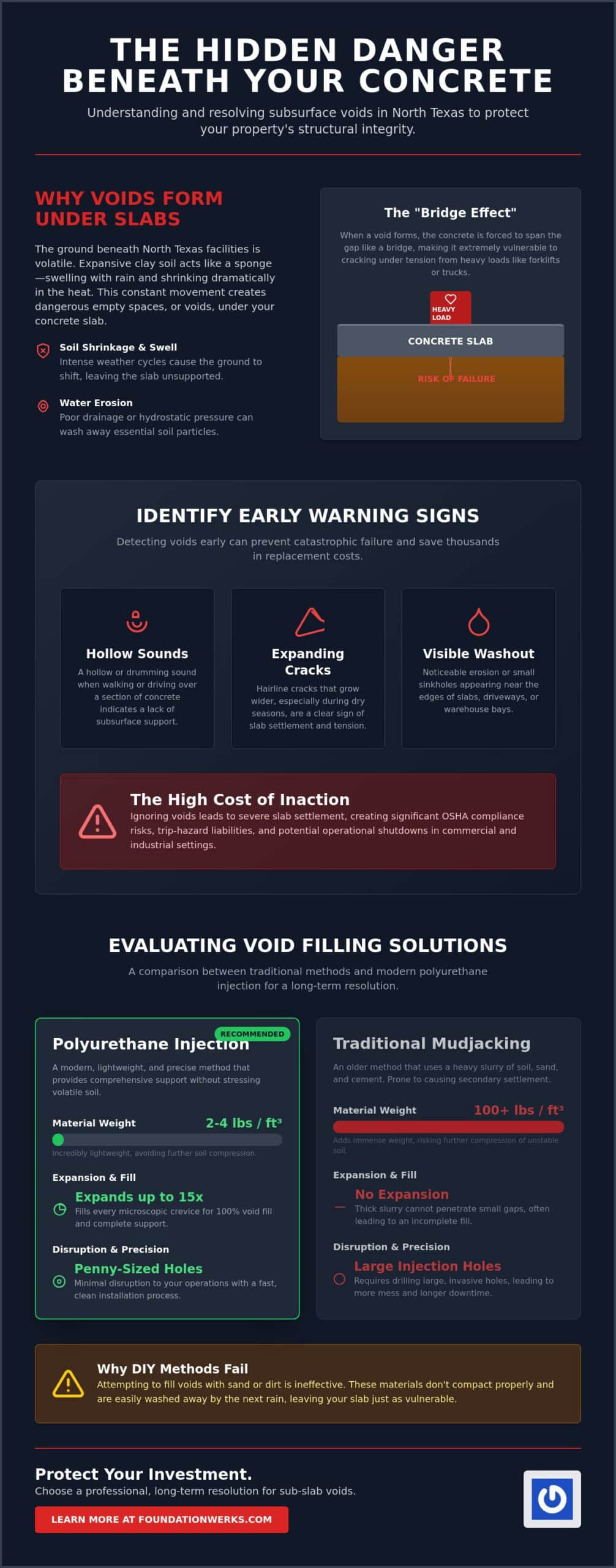
This lack of support creates what engineers call the “Bridge Effect.” Concrete is designed to transfer its load directly into the ground. When a void forms, the slab is forced to span the gap like a bridge. While concrete is incredibly strong under compression, it’s brittle under tension. Without subsurface contact, the weight of a forklift or a delivery truck will eventually cause the concrete to snap.
Common Signs of Voids in North Texas Properties
Detecting these issues early saves thousands in repair costs. Watch for these red flags:
- Hollow sounds when walking or driving over specific slab sections.
- Hairline cracks that expand rapidly during the dry summer months.
- Visible soil washout or “sinkholes” near the edges of driveways or warehouse bays.
The Cost of Inaction: From Trip Hazards to Structural Failure
Ignoring these gaps is a gamble with your property’s safety. Voids don’t stay small; they grow until the slab settles, requiring uneven warehouse floor repair Dallas services. In commercial settings, this isn’t just a maintenance issue. It’s a compliance risk. OSHA strictly regulates floor safety, and uneven surfaces create significant trip hazard liabilities that can halt operations instantly.
Evaluating Solutions: Polyurethane Foam vs. Traditional Void Filling
Traditional mudjacking has served the industry for decades, but it carries a significant drawback: weight. A standard mudjacking slurry consists of soil, sand, and cement, which can weigh upwards of 100 pounds per cubic foot. In North Texas, adding this much mass to unstable clay often causes the soil to compress further, leading to secondary settlement. Modern Professional Slab Stabilization utilizes high-density polyurethane foam instead. This material is incredibly lightweight, weighing only about 2 to 4 pounds per cubic foot, yet it possesses the structural integrity required for heavy industrial traffic.
The “expansion factor” is where polyurethane truly excels in void filling under concrete slab projects. As the liquid polymer is injected, it undergoes a chemical reaction that causes it to expand up to 15 times its initial volume. This expansion force allows the foam to flow into every microscopic crevice and hairline gap, ensuring a 100% fill that traditional slurries simply can’t achieve. This provides a high degree of confidence that the entire subsurface area is supported. For commercial facility managers dealing with recurring settlement, understanding the full scope of concrete slab stabilization Dallas professionals recommend can help you choose the most effective long-term approach.
Why DIY Methods Like Sand or Dirt Often Fail
Property owners often attempt to save costs by washing sand or dirt into visible gaps with a garden hose, but this is a poor substitute for professional void filling under concrete slab structures. This approach is fundamentally flawed because it’s impossible to achieve proper compaction in a hidden subsurface void. These non-binding materials remain loose and are highly susceptible to future water erosion. Without a structural binder, the next heavy rainstorm will simply wash the “repair” away, leaving your slab just as vulnerable as before.
The Advantages of High-Density Polyurethane
The efficiency of polyurethane injection is unmatched in commercial environments. While mudjacking requires days to cure, surfaces stabilized with foam are typically ready for full traffic in about 15 to 30 minutes. The closed-cell structure of the foam also provides superior moisture resistance, creating a water-tight seal that won’t wash out during flash floods. High-density industrial polymers provide the immense compressive strength necessary to support heavy machinery, forklifts, and high-volume commercial vehicles without deformation. If you’re looking for a reliable way to restore your facility, consider exploring our specialized Void Filling and Stabilization services.
Implementing Professional Slab Stabilization and Preventive Care
The professional implementation of void filling under concrete slab surfaces is a surgical process compared to the mess of traditional demolition. We utilize a precision monitoring system while injecting liquid polymer through penny-sized access points. This allows for a controlled expansion that fills the subsurface gap entirely without the dust, noise, or heavy machinery associated with pouring new concrete. It’s a sophisticated, long-term resolution that restores structural integrity while allowing your facility to remain operational throughout the day.
For facility managers, timing is everything. Catching a void before the slab cracks requires a methodical approach. We recommend following a concrete void filling commercial property checklist to identify early warning signs like joint deflection or rocking slabs. By addressing these issues proactively, you avoid the massive capital expenditure of a full tear-out and replacement.
Sustainability in Concrete Repair
Foundation Werks is dedicated to environmental responsibility. We use patented foam formulations made from recycled content, ensuring that your repair doesn’t come at the cost of the planet. Lifting and filling an existing slab is inherently more eco-conscious than demolition. It keeps thousands of pounds of old concrete out of North Texas landfills and eliminates the high carbon footprint associated with manufacturing and transporting new ready-mix concrete.
Preventing Future Voids: Drainage and Maintenance
While polyurethane provides exceptional stability, managing the environment around your concrete is vital for lasting results. In the Dallas-Fort Worth area, runoff is the primary enemy of subsurface soil. Implementing French drains helps redirect heavy rainfall away from your foundation, preventing the erosion that creates voids in the first place. Additionally, commercial concrete crack and joint repairs are essential to create a water-tight barrier on the surface, and you can learn more about Garrett’s Plumbing to ensure that hidden pipe leaks aren’t contributing to soil instability beneath your facility.
For those managing multi-story facilities, ensuring that moisture protection extends to all levels is crucial; you can learn more about specialized repair services for ceiling leaks that complement foundation-level maintenance.
For property owners looking to safeguard their foundations, consulting with water mitigation and restoration experts like DK Production provides valuable insight into managing moisture-related risks before they lead to significant soil erosion.
In other regions prone to soil instability, such as Arizona, professional teams like Dryrite Restoration play a similar role in mitigating water-related damage that can compromise a building’s foundation.
A proactive inspection schedule is the best defense for North Texas properties. Small gaps are much easier and more cost-effective to fill than large, structural voids. By combining advanced polymer technology with proper drainage and joint maintenance, you ensure a stable, level surface that stands up to the unique demands of our local climate.
Restore Stability to Your North Texas Property
Managing the subsurface challenges of North Texas clay requires a specialized approach that balances technical precision with environmental responsibility. We’ve explored how the “Bridge Effect” can compromise even the thickest slabs and why modern polymers offer a superior alternative to heavy traditional fillers. By choosing a high-density solution for void filling under concrete slab surfaces, you’re investing in a stable, level surface that’s built for the unique demands of our local climate.
Foundation Werks specializes in North Texas commercial slab stabilization using patented eco-friendly foam made from recycled materials. Our process is designed for maximum efficiency; your facility remains operational with surfaces ready for traffic in just minutes. It’s a clean, quiet, and sophisticated way to address settlement before it leads to structural failure or OSHA safety violations. Taking action now prevents minor gaps from becoming major liabilities.
Don’t let hidden gaps threaten your facility’s safety. Request a Professional Void Inspection from Foundation Werks today to secure your investment. We’re here to help you navigate these challenges with confidence and expertise.
Frequently Asked Questions
Is void filling under a concrete slab a long-term solution?
Polyurethane injection provides a highly effective, long-term resolution for slab stability in the volatile North Texas climate. While the expansive clay soils in our region are naturally dynamic, this method uses a closed-cell polymer that won’t wash away or compress over time. It offers exceptional durability and structural support compared to traditional mudjacking or temporary soil-based repairs. By addressing the empty space directly, you restore the foundation’s integrity for years to come.
How do I know if I have a void under my warehouse floor?
You can often identify a subsurface gap by listening for hollow sounds when heavy machinery or forklifts pass over specific sections. Other indicators include visible joint deflection where slabs meet or the sudden appearance of cracks during the dry summer months. If you notice a rocking motion in your warehouse floor or see soil washing out from the edges of the slab, it’s a clear sign that the supporting ground has migrated.
Can polyurethane foam support the weight of a forklift or delivery truck?
High-density polyurethane is specifically engineered to handle the intense compressive loads of forklifts and fully loaded delivery trucks. Once the material is injected, it expands and hardens into a rigid, stable base that distributes weight evenly across the subgrade. It’s the preferred choice for industrial environments because it maintains its structural integrity under constant heavy traffic without deforming or failing like traditional soil fills.
What happens if I don’t fill the void under my concrete?
Ignoring a subsurface gap leads to the “Bridge Effect,” where the concrete eventually snaps because it lacks ground support. This results in uneven surfaces, significant trip hazards, and potential OSHA compliance issues in commercial facilities. Over time, the lack of support causes the slab to settle or collapse entirely, turning a relatively simple void filling under concrete slab project into a much more expensive and disruptive replacement job.
How much does professional void filling cost compared to concrete replacement?
Professional void filling is typically a far more cost-effective alternative to the total demolition and replacement of a concrete slab. Since the injection process requires less labor, no heavy machinery, and significantly less downtime, property owners find it to be a fraction of the investment required for new pours. It also eliminates the secondary costs associated with disposing of old concrete and the operational losses caused by days of curing time.
Is the foam used for void filling environmentally friendly?
The specialized polyurethane used by Foundation Werks is an eco-conscious choice that aligns with modern sustainability standards. Our formulations are made from recycled materials and don’t leach harmful chemicals into the surrounding soil or North Texas groundwater. Because this process preserves your existing concrete rather than replacing it, it significantly reduces the environmental impact and carbon footprint associated with new concrete production and landfill waste.