

An uneven warehouse floor is more than a trip hazard; it’s a silent drain on your facility’s productivity and a direct path to OSHA safety violations. In North Texas, the challenge is relentless because our expansive clay soils constantly shift with moisture levels. Achieving effective concrete slab stabilization Dallas facility managers can rely on requires moving beyond temporary patches. You’ve likely seen how recurring settlement leads to forklift damage and compromised joint integrity, creating a cycle of repair that disrupts your daily operations.
We understand that you can’t afford to shut down production for weeks of excavation and pouring. This guide explores how advanced, eco-conscious polyurethane technology provides a sophisticated alternative to traditional methods. You’ll discover a professional process designed to restore floor levelness and mitigate soil erosion without the extensive downtime of full replacement. We’ll walk through the technical precision of high-density injections and how this modern approach offers a stable, long-term resolution for your commercial infrastructure.
Key Takeaways
- Identify subtle indicators of subgrade failure, such as rocking slabs and widening joint gaps, to prevent minor settlement from becoming a major operational disruption.
- Discover how high-density polyurethane injection provides a precision-engineered approach to concrete slab stabilization Dallas managers trust for long-term reliability.
- Explore the benefits of using patented, eco-conscious foams that utilize recycled materials for a sustainable and non-invasive structural repair.
- Maximize your facility’s ROI by eliminating curing times and immediately restoring the level surfaces required for safe, OSHA-compliant forklift operation.
Assessing Concrete Slab Instability in Dallas Facilities
In the commercial sector, the concrete slab stabilization Dallas facilities require is more than just a cosmetic adjustment. It’s a precise engineering process focused on restoring the structural support and levelness of sunken pavement. When your facility begins to show signs of instability, the integrity of your operation is at risk. You should watch for these common indicators:
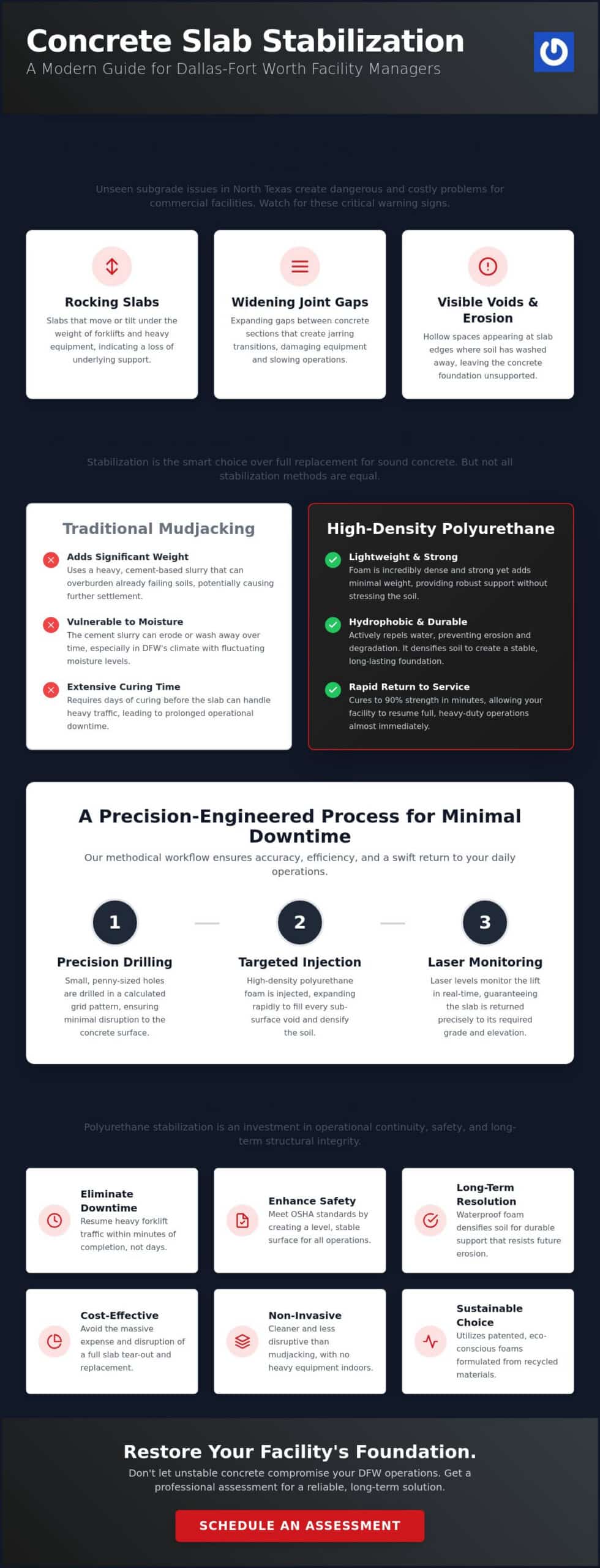
- Rocking slabs that move under the weight of heavy equipment.
- Widening joint gaps that create jarring transitions for forklifts.
- Visible voids appearing at the edges of warehouse floors or exterior perimeters.
To see how these subsurface voids are identified and addressed in real-time, watch this demonstration of the stabilization process:
The Role of North Texas Soil in Concrete Failure
Dallas sits atop the “Blackland Prairie” region, which is characterized by highly expansive clay soil. This soil behaves like a sponge, expanding significantly when saturated and shrinking during intense Texas summers. This constant shrink-swell cycle creates massive subsurface voids that leave commercial slabs unsupported. When poor drainage or perimeter soil erosion is added to the mix, the soil literally washes away from under the concrete, leading to the settlement issues many local warehouse managers face.
When to Prioritize Stabilization Over Replacement
Choosing between stabilization and a full tear-out depends on the condition of the concrete itself. If the slab is structurally sound but unlevel, Concrete leveling through polyurethane injection is the logical choice. Unlike traditional mudjacking, which uses a heavy cement-based slurry that can actually cause further settlement due to its weight, high-density foam is lightweight and moisture-resistant. This modern approach provides the concrete slab stabilization Dallas operations need to maintain safety and efficiency while avoiding the total demolition of existing floors. It’s a cleaner, faster method that respects both your budget and your operational schedule. For McKinney property managers specifically, understanding your options before committing to costly demolition is critical — a dedicated resource on commercial foundation repair McKinney facilities rely on can help clarify when stabilization is the smarter investment.
How to Stabilize Concrete Slabs Using Polyurethane Injection
Modern industrial environments demand solutions that don’t compromise production schedules. High-density polyurethane injection has replaced older, heavier methods as the primary choice for Slab stabilization in North Texas. This precision-engineered method is the cornerstone of the concrete slab stabilization Dallas businesses use to maintain their infrastructure. It uses a patented, eco-conscious foam formulated from recycled materials. It’s a sustainable choice that addresses structural needs without environmental trade-offs. Most importantly, the material reaches 90 percent of its full compressive strength within minutes; this allows your facility to return to full operation almost immediately.
The Step-by-Step Stabilization Process
Our approach to the concrete slab stabilization Dallas managers need is methodical and transparent. We follow a refined workflow to ensure technical accuracy:
- Precision Drilling: Technicians create small, penny-sized holes in a calculated grid pattern across the affected slab to minimize surface disruption.
- Injection: We inject high-density polyurethane foam that expands rapidly to fill every hidden crevice of the underlying void.
- Laser Monitoring: Our team uses laser levels to monitor the lift in real-time, ensuring the slab returns precisely to its original grade and elevation.
Achieving Long-Term Stability with High-Density Foam
The success of this method lies in how the foam interacts with the North Texas subgrade. Unlike mudjacking, which simply adds weight to already struggling soil, polyurethane densifies the surrounding earth. It creates a lightweight yet incredibly strong foundation that supports the slab from beneath. This process is essential for effective void filling under concrete slab structures, especially where moisture is a concern. Because the foam is hydrophobic, it won’t wash away or degrade when exposed to groundwater. If you’re noticing unlevel joints or rocking sections, reviewing the modern stabilization methods available can help you maintain a safe and productive workspace.
Commercial ROI: The Benefits of Modern Stabilization
Investing in the concrete slab stabilization Dallas facilities can count on provides a clear financial advantage over traditional concrete replacement. While a new pour requires days of excavation and weeks of curing, polyurethane stabilization offers an immediate return to service. You’ll see significantly lower labor costs and zero downtime, which is critical for 24-hour operations. By choosing stabilization, you’re not just fixing a floor; you’re protecting your bottom line from the massive expenses associated with full-scale demolition.
Safety and compliance are equally important factors in your ROI calculation. Uneven slabs create trip hazards and jarring transitions that damage forklift suspensions and endanger pallet jack operators. Following industry-recognized Slab Stabilization Guidelines ensures your facility remains OSHA-compliant and efficient. To maximize these results, it’s helpful to integrate this process with warehouse floor joint repair Dallas strategies. This comprehensive approach ensures that the entire floor system, from the subgrade to the surface joints, works in unison to support heavy traffic.
Before moving forward with a major project, we recommend utilizing a concrete void filling commercial property checklist. This tool helps property managers evaluate site conditions and prioritize repairs based on operational risk.
Mitigating Future Risks with Integrated Solutions
Stabilization is most effective when you address environmental factors like North Texas runoff. We often recommend installing French drains to redirect water away from the slab perimeter, preventing the erosion that causes settlement. Additionally, high-quality joint sealing acts as a secondary defense. It stops water from re-entering the soil base and destabilizing the work already performed, protecting the integrity of your floor for the long term.
Selecting a Professional Partner in Dallas
Regional expertise is vital because the soil profile in McKinney differs from that in central Dallas. You need a partner who understands these nuances and prioritizes the use of eco-friendly, recycled materials. Facilities in the northern suburbs should consult a thorough commercial foundation repair McKinney FAQ to understand how Blackland Prairie clay specifically affects their subgrade and what modern solutions are available without extended operational shutdowns. Our commitment to sustainable innovation ensures your facility receives a high-tech solution that respects both your property and the environment. By working with local experts, you gain the peace of mind that comes from a tailored, technically sound restoration.
Secure Your Facility’s Structural Future
Maintaining a safe and efficient commercial environment requires a proactive approach to infrastructure. We’ve discussed how identifying the early indicators of settlement and choosing high-density polyurethane can prevent operational disruptions. By utilizing a method that densifies the soil without the excessive weight of traditional slurry, you protect your floor’s integrity and ensure compliance with safety standards. Effective concrete slab stabilization Dallas managers rely on is a blend of technical precision and an understanding of our unique regional soil.
Foundation Werks specializes in high-value commercial and industrial slabs throughout the North Texas region. We use a patented, eco-conscious foam made from recycled materials to provide a sustainable, high-performance alternative to replacement. Our team is dedicated to restoring your facility’s levelness with minimal impact on your daily workflow. Ready to address your settlement issues with a sophisticated, long-term resolution? Request a Professional Concrete Stabilization Estimate to begin your restoration. Taking decisive action today ensures your facility remains a stable and productive foundation for your business success.
Frequently Asked Questions
How long does concrete slab stabilization last in the Dallas climate?
Polyurethane stabilization provides a durable, long-term resolution for uneven slabs in North Texas. While no solution is immune to the extreme shrink-swell cycles of our local clay, the moisture-resistant nature of high-density foam prevents it from washing out or degrading over time. Its effectiveness is best maintained when paired with proper facility drainage to manage the region’s expansive soil movement.
Can high-density foam support heavy warehouse machinery and forklifts?
High-density polyurethane is specifically engineered to support heavy industrial loads, including forklifts and specialized warehouse machinery. The material expands to fill voids and densifies the underlying subgrade, creating a stable foundation that can handle thousands of pounds per square foot. This makes it a preferred choice for high-traffic environments where maintaining a level surface is critical for equipment safety and OSHA compliance.
Is polyurethane slab stabilization more expensive than traditional mudjacking?
Polyurethane often carries a higher upfront material cost than traditional mudjacking, but it offers a superior return on investment for commercial properties. Because the process requires significantly less labor and uses smaller injection holes, the total project value is often more competitive. When you factor in the zero curing time and the avoidance of heavy equipment on your property, the efficiency of this modern method becomes clear.
How much downtime should my business expect during the stabilization process?
Most commercial facilities experience almost zero downtime, with slabs ready for use within minutes of the injection. Unlike concrete replacement, which can sideline a warehouse for weeks, concrete slab stabilization Dallas projects are typically completed in hours. This speed ensures your forklifts and personnel can return to work without the costly delays associated with traditional demolition and pouring.