

What if the most expensive part of your sinking parking lot isn’t the repair itself, but the liability of an OSHA trip hazard or the weeks of lost revenue during a full replacement? You likely already realize that maintaining a safe, level surface is non-negotiable for facility managers in 2026. However, the prospect of closing off sections of your property for a total commercial parking lot concrete repair project often feels like a choice between a safety risk and a financial hit.
It’s a stressful position to be in, but you don’t have to choose between a broken budget and a broken sidewalk. This guide will show you how to eliminate trip hazards and stabilize your lot using modern polyurethane technology. You’ll learn how this method saves thousands compared to traditional replacement while ensuring minimal disruption to your tenants. We’ll walk through the science of soil stabilization, the latest 2026 OSHA compliance standards, and why a drill and fill approach is the smartest long-term solution for your facility’s bottom line.
Key Takeaways
- Discover why raising concrete typically costs about half as much as a full replacement while allowing your lot to be usable the same day.
- Learn how modern commercial parking lot concrete repair uses high-density polyurethane foam to stabilize heavy loads by filling subterranean voids.
- Understand the critical role of joint sealing and drainage in preventing the water infiltration that leads to soil erosion.
- Identify how to meet 2026 OSHA compliance standards by eliminating trip hazards and pooling water on your property.
- See how eco-friendly materials and minimal equipment footprints provide a long-term solution without damaging your existing landscaping.
Addressing Safety and Liability in Your Commercial Parking Lot
Ignoring uneven concrete surfaces is a gamble that rarely pays off for facility managers. Beyond the immediate eyesore, sunken slabs represent a significant legal and financial liability. In North Texas, these dips are especially dangerous. Our winters might be short, but the freeze-thaw cycle turns pooled water into invisible ice sheets overnight. This turns a simple puddle into a high-risk slip-and-fall zone that can lead to costly litigation or increased insurance premiums.
Distinguishing between cosmetic issues and structural settling is the first step in effective asset management. A hairline crack might be surface-level, but a slab that has dropped below its neighbor indicates a void in the soil below. Addressing this through The Science of Polyurethane Concrete Raising allows you to stabilize the ground before the entire section fails. Proactive commercial parking lot concrete repair isn’t just a maintenance task; it’s a strategic move to protect your property’s value and your company’s bottom line. By fixing the root cause of the settling, you extend the life of your pavement and avoid the massive capital expenditure of a full tear-out.
Identifying OSHA Trip Hazards
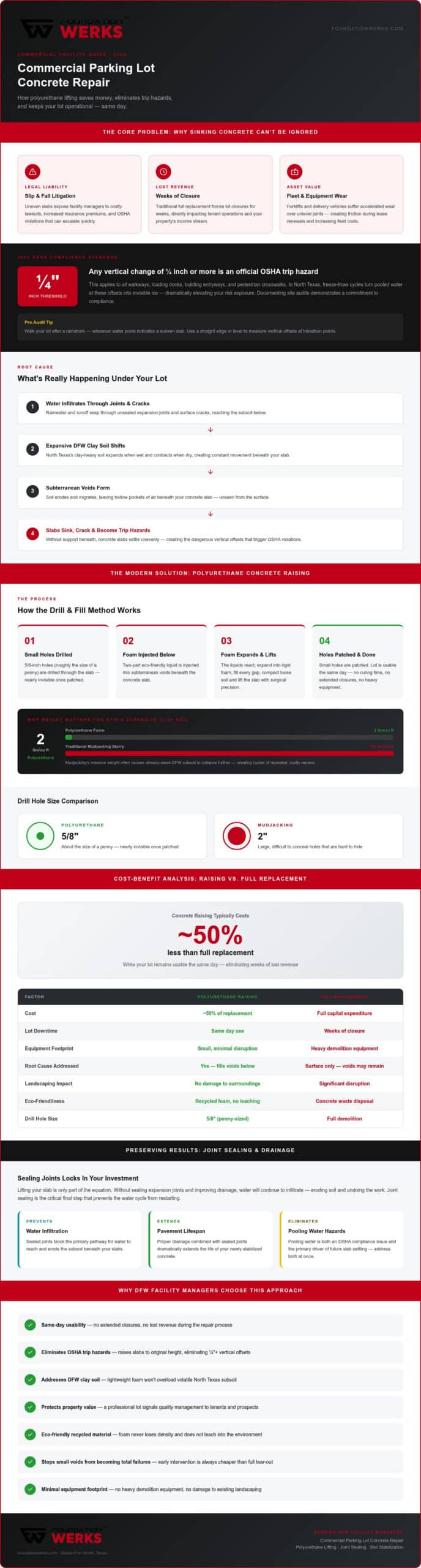
Safety regulations are clear: any vertical change of 1/4 inch or more in a walkway is considered a trip hazard. These changes often occur at transition points like loading docks, building entryways, and pedestrian crosswalks. To conduct a basic site audit, walk your lot after a rainstorm to see where water pools. Use a straight edge or a level to measure vertical offsets. If you can catch these issues early, you can often lift the slab back to its original height for a fraction of the cost of replacement. Documenting these audits also shows a commitment to safety that can be vital for compliance records in 2026.
The Operational Impact of Sunken Concrete
The damage from uneven concrete extends to your equipment and your reputation. Forklifts and delivery vehicles suffer increased wear and tear when they constantly bounce over unlevel joints. This leads to higher maintenance costs for your fleet or your tenants’ vehicles, which can become a point of contention during lease renewals. Additionally, a neglected lot sends a message of poor management to current and prospective tenants. Investing in commercial parking lot concrete repair ensures a smooth flow of traffic and maintains the professional image your facility needs to stay competitive. Early intervention stops a small void from becoming a total slab failure, keeping your operations running without the need for heavy demolition or business closures.
The Science of Polyurethane Concrete Raising for Heavy Loads
Polyurethane Concrete Raising is a high-density stabilization method specifically engineered for the heavy loads of industrial environments. The process involves injecting a two-part eco-friendly liquid through small holes into the subterranean voids beneath your lot. Once underground, these liquids react and expand into a rigid foam that fills every gap and compacts the loose soil. This chemical expansion provides an incredible amount of lifting force, allowing us to level massive slabs with surgical precision. It’s a sophisticated approach to commercial parking lot concrete repair that addresses the root cause of sinking rather than just patching the surface.
In the Dallas-Fort Worth area, managing expansive clay soils is a constant struggle for facility managers. Traditional repair methods often fail because they don’t account for the weight of the repair material itself. Polyurethane is a game-changer here because it’s incredibly lightweight. At only 2 pounds per cubic foot, it provides the necessary lift without adding the crushing weight that leads to further sinking. This ensures long-term stability even in the volatile North Texas soil environment.
High-Density Foam vs. Traditional Mudjacking
Traditional mudjacking uses a heavy slurry of sand and cement that weighs roughly 100 pounds per cubic foot. This massive weight often causes the already weak DFW subsoil to collapse further, creating a cycle of repeated repairs. Our high-density foam avoids this problem entirely. Because the material is so light and strong, it stabilizes the slab without taxing the ground beneath it. Our recycled foam material never loses density or leaches into the environment, providing a reliable base for years to come.
The physical footprint of the repair is also significantly smaller. Mudjacking requires large, 2-inch diameter holes that are difficult to hide. We use 5/8-inch drill holes, which are roughly the size of a penny and nearly invisible once patched. While lifting is the primary goal, Preserving Your Surface with Joint Sealing ensures that water won’t wash away your new foundation. This combination of precision and protection is why foam injection is the preferred choice for modern facility management.
Immediate Usability: No Downtime for Your Business
Business continuity is vital for any commercial parking lot concrete repair project. You don’t have the luxury of closing your lot for days while new concrete cures. Polyurethane foam cures in minutes, allowing for same-day traffic and immediate usability. You can drive a delivery truck over the repaired area almost as soon as our team pulls the equipment away.
There is no grout splatter, no heavy machinery tearing up your landscaping, and no dusty demolition. It’s a clean, quiet process that respects your tenants’ peace and your customers’ access. If you’re ready to see how this technology can work for your property, you can schedule a professional site evaluation to get started.
Concrete Raising vs. Replacement: A Cost-Benefit Analysis
Deciding between lifting and replacing concrete is a major financial decision for any facility manager. The “Half-Cost” Rule is a reliable benchmark: commercial parking lot concrete repair through lifting typically costs about 50% less than pouring new slabs. While the sticker price of new concrete is high, the hidden costs of replacement often double the actual expense. You have to account for demolition labor, concrete disposal fees, and the loss of revenue while your lot is closed for days or weeks. For a high-traffic property, these operational disruptions often outweigh the construction costs themselves.
Evaluating the structural integrity of your current lot is essential before choosing a path. If your slabs are sunken but largely intact, they are perfect candidates for professional repair. However, if the concrete is shattered into small, “alligator-cracked” pieces, lifting won’t provide the structural unity needed for heavy traffic. In those cases, replacement is the only viable option. Our team focuses on identifying these differences early to ensure you don’t spend money on a repair that won’t last. A targeted commercial parking lot concrete repair plan prioritizes slabs that still have structural life but lack proper support.
Calculating the ROI of Stabilization
A lifted slab can provide long-term stability that rivals a new pour when the underlying soil issues are addressed. Maintenance repairs like concrete raising are often categorized as operating expenses rather than capital improvements. This can offer immediate tax advantages depending on your facility’s financial structure. Beyond the balance sheet, the speed of repair means your tenants never lose access to their storefronts or loading docks. For more details on how these savings apply to industrial settings, see our warehouse floor joint repair Dallas guide for industrial ROI context.
Void Filling: Protecting Your Investment
Voids often form under parking lots due to poor initial soil compaction or water washing away the sub-base. If left unaddressed, these empty pockets lead to slab cracking and total failure. We use Deep Foamjection™ to reach deep into the gravel and sub-base layers. This process stabilizes the soil foundation and prevents future settling by filling the gaps that water would otherwise occupy. It’s a proactive way to reinforce your lot without the mess of a full reconstruction project. By choosing stabilization, you’re not just fixing a surface problem; you’re securing the ground that supports your entire property.
Preserving Your Surface with Joint Sealing and Drainage
Water is the primary driver of pavement failure in the DFW Metroplex. While we’ve discussed how polyurethane foam fills voids and lifts slabs, keeping those voids from returning requires a proactive water management plan. When joints and cracks are left open, they act like funnels. Rainwater seeps through these openings and saturates the expansive clay soil beneath your lot. In 2026, soil erosion trends in North Texas show that rapid moisture changes are becoming more frequent, making sub-base protection even more critical for facility managers. This moisture leads to the erosion of the sub-base, creating new pockets of air that eventually cause the concrete to sink again. A truly effective commercial parking lot concrete repair isn’t just about the lift. It’s about sealing the entire system to ensure long-term stability.
The Role of Mastic and Joint Seal Maintenance
Mastic is the flexible, rubberized sealant used to fill expansion joints. Its job is to expand and contract with the concrete while maintaining a watertight barrier. Over time, the intense North Texas heat causes this material to become brittle or pull away from the edges of the slab. You should inspect your joints annually for signs of separation, cracking, or vegetation growth. Replacing failing mastic is one of the most cost-effective ways to prevent major structural damage before it starts. If you’re seeing significant cracking along with joint failure, our comprehensive guide on commercial concrete crack repair offers a deeper look at the technical requirements for these specific fixes.
French Drains: Stopping Erosion at the Source
Sometimes, the problem isn’t just a leaky joint; it’s the way water moves across your entire property. If you notice standing water near your lot or thin layers of silt deposited on the concrete after a storm, your current drainage system is likely overwhelmed. French drains provide a dedicated path for runoff to bypass your parking lot’s foundation entirely. By installing a perforated pipe encased in gravel, we can redirect water to lower ground or storm sewers effectively. This synergy between soil stabilization and proper water management is what creates a reliable, long-term solution for your facility. It prevents the constant cycle of sinking and lifting by addressing the environmental cause of the problem directly.
Why DFW Businesses Choose Foundation Werks
Foundation Werks isn’t just another contractor. We’re a local team that understands the specific challenges of North Texas geology. The expansive clay soil in the DFW Metroplex requires more than a surface patch; it requires an expert who knows how the ground moves from McKinney to North Dallas. Our team brings years of experience in commercial parking lot concrete repair to every project, ensuring that your facility remains safe and professional without the massive overhead of total reconstruction.
We take pride in being a quietly innovative partner for facility managers. Our process is designed to be as non-intrusive as possible. From the initial site visit to the final injection, we prioritize your schedule and your property’s aesthetics. Because our equipment has a minimal footprint, we can work in tight spaces without damaging your landscaping or blocking major thoroughfares. This methodical approach ensures a steady workflow that respects both your time and your budget.
Eco-Friendly and Sustainable Practices
Sustainability is often overlooked in the heavy construction industry, but it’s a core value for us. By choosing polyurethane lifting over replacement, you’re directly reducing the amount of old concrete sent to North Texas landfills. There is no heavy demolition and no need for massive cement mixers idling on your property. Our sustainability commitment is centered on using a patented foam made from recycled materials that provides long-term stability without leaching chemicals into the surrounding soil. This eco-conscious approach allows you to maintain your facility while meeting modern corporate social responsibility goals.
Getting Your Professional Assessment
Every commercial property has unique needs, from the heavy-duty requirements of a warehouse loading dock to the aesthetic standards of a retail center. When you request a free commercial site estimate, we don’t just give you a quote. We conduct a thorough walk-through to identify the root cause of your settling issues. We then create a customized repair plan that fits your specific budget and timeline. We believe in being an educator first, giving you the facts before asking for a commitment.
Our goal is to empower you with the knowledge needed to make an informed decision about your asset management. You’ll receive a clear breakdown of the stabilization process and a timeline for completion. Most of our projects are finished in a single day, meaning you can have a level, safe lot by the time your tenants arrive the next morning. Call 800-464-9684 to schedule your North Texas facility walk-through and experience the Foundation Werks difference for yourself.
Secure the Future of Your Facility’s Pavement
Managing a large-scale property in 2026 requires a careful balance between budget constraints and safety requirements. You now understand that sinking slabs aren’t just an eyesore; they’re a liability that demands a strategic response. By choosing high-density polyurethane foam, you can achieve a level, safe surface at approximately half the cost of full replacement. This eco-friendly method uses recycled materials and allows your tenants or customers to drive on the repaired lot the same day.
Effective commercial parking lot concrete repair is more than a quick fix. It’s about stabilizing the ground and managing water flow to prevent future erosion. Whether you’re dealing with heavy-duty warehouse floors or retail entryways, addressing the root cause of soil instability protects your asset’s value for the long haul. Our team is ready to help you handle these technical challenges with transparency and the local expertise North Texas soil requires. You don’t have to settle for the downtime and expense of traditional demolition when a smarter, faster solution is available.
Take the first step toward a safer property and a more predictable maintenance budget today.
Frequently Asked Questions
How long does polyurethane concrete lifting last in the Texas heat?
High-density foam provides a long-term solution designed to withstand the extreme temperature fluctuations of North Texas. The material is chemically inert and doesn’t degrade when buried beneath the surface. While the concrete itself may still be subject to surface wear, the support structure provided by the foam remains stable for decades. This durability makes it a reliable choice for commercial parking lot concrete repair in the intense heat of Dallas and McKinney.
Can I drive heavy delivery trucks on the lot immediately after repair?
Yes, you can drive heavy vehicles on the repaired slabs immediately after the work is completed. Our polyurethane foam reaches 90% of its full compressive strength within 15 minutes of injection. This rapid curing process is a major advantage for busy DFW business parks that can’t afford long closures. Unlike new concrete pours that require days of curing, our stabilization method ensures your delivery schedules remain completely uninterrupted.
Is polyurethane foam environmentally safe for my property?
Our patented polyurethane foam is an eco-friendly material made from recycled content that won’t leach chemicals into the North Texas soil. It’s a non-toxic, inert substance once it has cured. By choosing this method, you also reduce the environmental footprint of your facility by keeping old concrete out of local landfills. This sustainable approach helps facility managers meet environmental goals while maintaining safe and level infrastructure for their tenants.
What is the cost difference between concrete lifting and replacement?
Raising and stabilizing your existing concrete typically costs about half of what you would pay for a full replacement. This cost-effectiveness comes from the reduced need for heavy demolition, lower labor requirements, and the absence of disposal fees. You also avoid the soft costs of business downtime and tenant dissatisfaction. It’s a strategic financial choice that allows you to allocate your maintenance budget to other critical facility needs without sacrificing quality.
Why do concrete slabs in Dallas and McKinney sink so often?
The primary cause of sinking concrete in the DFW Metroplex is our highly expansive clay soil. This soil swells when wet and shrinks during dry North Texas summers, creating voids beneath your parking lot slabs. When heavy vehicles drive over these empty pockets, the concrete eventually settles or cracks. Proper drainage and void filling are essential to combat these natural soil dynamics and maintain a level, safe parking surface for your property.
Does the foam material lose density or shrink over time?
No, our high-density polyurethane foam never loses density or shrinks after it has cured. Unlike traditional mudjacking slurry, which can wash away or compress over time, our foam remains a rigid, lightweight support structure. It provides long-term stability by filling subterranean voids and compacting the surrounding soil. This ensures that the lift we achieve on the day of the repair stays consistent for years to come despite heavy traffic loads.
Will the 5/8-inch drill holes be visible on my parking lot surface?
The injection holes are roughly the size of a penny and become nearly invisible after we patch them with color-matched cement. We use a 5/8-inch drill bit, which is significantly smaller than the large holes required for traditional mudjacking. This minimal footprint preserves the professional appearance of your retail center or office park. Most visitors won’t even notice that a commercial parking lot concrete repair was performed once the patches have dried.
Can you fix concrete that is severely cracked into small pieces?
We generally cannot lift slabs that have shattered into many small, disconnected pieces, often called alligator cracking. For polyurethane lifting to be successful, the slab needs enough structural integrity to move as a single unit. If your concrete is severely crumbled, we may recommend a full concrete replacement for those specific sections. We’ll identify these issues during your free site walk-through to ensure we provide the most effective solution for your facility.