

Did you know that 25% of all warehouse accidents happen at the loading dock? When you’re managing a high volume facility in North Texas, you’ve likely seen how quickly the local expansive clay soil can cause settling. An uneven slab creates more than just a bumpy ride for your drivers; it leads to forklift damage, OSHA trip hazards, and dock plates that no longer sit flush. If you’re currently facing these issues, you might think a full teardown is your only option for sunken loading dock concrete repair.
We understand the pressure of keeping a facility running. Losing a bay for a week of demolition and curing can cost thousands in lost productivity. The good news is that you don’t have to choose between a broken dock and a closed one. In this case study, we’ll show you how a Dallas facility restored their loading operations in just a few hours. You’ll learn how polyurethane concrete raising stabilizes the subgrade and levels the slab for an immediate return to service. We’ll break down the process of using eco-friendly materials to fix the root cause of the settling without the mess or the massive expense of traditional replacement.
Key Takeaways
- Understand how North Texas expansive clay soil destabilizes heavy industrial slabs and why ignoring early signs of settling leads to costly OSHA hazards.
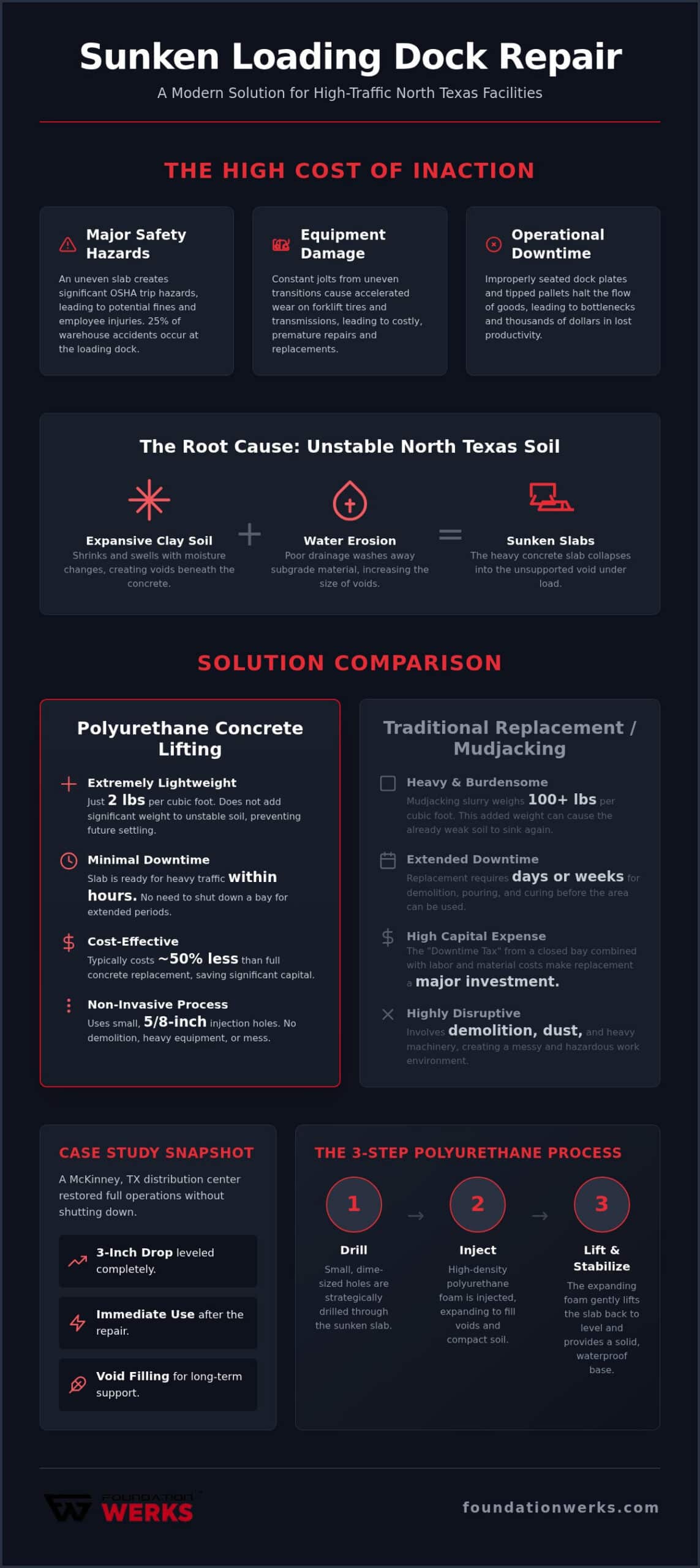
- Compare the benefits of lightweight polyurethane foam, which weighs only 2 lbs per cubic foot, against traditional mudjacking methods that add unnecessary weight to the subgrade.
- See how a professional sunken loading dock concrete repair restored a 3-inch drop at a McKinney distribution center without shutting down operations.
- Learn why polyurethane lifting is a logistics-first solution that typically costs half as much as full concrete replacement while allowing for immediate use.
- Discover the role of joint sealing and void filling in preventing future water-driven erosion to maintain a stable and level loading environment.
Why Loading Docks Sink and the Cost of Inaction
Most facility managers in Dallas-Fort Worth are familiar with the “Texas heave,” but the opposite is just as common. Loading docks are subjected to immense dynamic loads every day. When the soil beneath them fails, the slab follows. This isn’t just a cosmetic issue; it’s a structural one. North Texas is famous for its expansive clay soil. This soil acts like a sponge, expanding when wet and shrinking during our hot, dry summers. This constant movement creates voids. Over time, the weight of heavy trailers and forklifts causes the concrete to settle into these gaps. Understanding the need for sunken loading dock concrete repair starts with recognizing these environmental pressures.
There’s a distinct difference between soil consolidation and erosion. Consolidation happens when soil is compressed over time. Erosion happens when water washes soil away. In many Dallas facilities, poor drainage around the approach pad accelerates this erosion. When water removes the support structure, the concrete slab becomes a bridge spanning a hollow void. Eventually, that bridge collapses under the weight of a 40,000-pound trailer.
The Role of Soil Erosion in North Texas
Poorly maintained gutters or sloping pavement can direct water straight under your dock. This creates hollow spaces. While some might suggest traditional mudjacking, adding 100 pounds per cubic foot of heavy slurry to already weak soil often makes the problem worse. The added weight can actually trigger secondary sinking. Instead, Polyurethane concrete raising offers a lightweight alternative that doesn’t overload the subgrade. Look for small gaps under the slab edge or “pumping” when a truck drives over. These are early signs of subgrade failure that you shouldn’t ignore.
Operational and Safety Risks
A 1-inch drop might not look like much, but it’s a major operational bottleneck. Forklifts hitting that uneven transition suffer accelerated transmission and tire wear. Pallets can tip, leading to inventory loss and cleanup time. More importantly, it creates a significant safety risk. You can find more details on meeting OSHA trip hazard concrete repair requirements in our safety checklist.
Beyond safety, an uneven dock prevents dock plates from leveling correctly. This can cause automated loading systems to error out, leading to thousands of dollars in downtime. Choosing to delay sunken loading dock concrete repair doesn’t just risk a fine. It risks the structural integrity of the entire dock pit as the shifting slab puts pressure on the foundation walls. Catching these issues early prevents a simple leveling job from turning into a total structural failure.
Polyurethane Concrete Raising vs. Traditional Methods
Surface patches or epoxy injections might hide a crack, but they don’t solve the structural problem of a settled slab. For a true sunken loading dock concrete repair, you need to lift the structure from the bottom up. Polyurethane concrete raising has become the industrial standard because it addresses the root cause: the subgrade void. Unlike surface-level fixes, this method provides a structural foundation that supports the heavy traffic of a busy logistics hub.
Weight is the most critical factor in North Texas. Traditional mudjacking uses a heavy slurry of sand and cement that weighs about 100 pounds per cubic foot. On top of our already unstable clay, that’s a recipe for secondary sinking. Our high-density foam weighs only 2 pounds per cubic foot. It offers the necessary lift without adding significant mass to the soil. This lightweight profile is essential for long-term stability in the DFW area.
The Science of High-Density Foam
The process involves injecting a two-part liquid through small, 5/8-inch holes. As these liquids mix, they expand to fill every crevice and compact the underlying soil. This expansion creates a dense, waterproof layer that doesn’t lose its shape. The foam’s compressive strength is specifically engineered to handle dynamic trailer loads and the constant vibration of forklift traffic. We use eco-conscious materials made from recycled components; this keeps your warehouse clean and free of the dust associated with demolition.
Replacement vs. Lifting ROI
Choosing between lifting and full concrete replacement often comes down to the “Downtime Tax.” A new concrete pour can take weeks to cure before it’s ready for heavy equipment. In a high-volume facility, losing a dock for 28 days is an expensive logistical nightmare. Lifting typically costs 50% less than replacement and allows for an immediate return to service. You can drive on the dock the same day the repair is completed. If your facility is struggling with uneven slabs, we can help you explore commercial concrete raising solutions that keep your operations moving.
Case Study: Restoring a Sunken Dock in McKinney, TX
A major distribution center in McKinney recently faced a significant logistical hurdle. One of their high-traffic bays had settled nearly 3 inches, creating a steep slope that made standard loading operations impossible. This level of displacement required an immediate sunken loading dock concrete repair to prevent a total shutdown of the bay. Our team began with an initial assessment using Deep Foamjection™ techniques to identify the exact location and size of the voids beneath the approach pad.
The primary goal was to restore the pad to its original grade. This ensures that the dock levelers can operate safely and provide a seamless transition for forklifts. By targeting the deep-seated voids first, we created a stable base before performing the final precision lift. The entire project was completed in under four hours. Because the foam cures almost instantly, the facility didn’t lose a single day of productivity.
The 4-Step Restoration Process
- Step 1: Precision Drilling. We began by drilling small, 5/8-inch injection ports in a strategic grid pattern across the sunken area. This minimizes the footprint of the repair.
- Step 2: Systematic Injection. Our technicians injected high-density polyurethane into the subgrade. The foam expands in all directions to fill voids that traditional methods often miss.
- Step 3: Controlled Lifting. We monitored the slab’s movement in real time. We lifted the concrete to within 1/16th of an inch of the target grade for a perfectly flush finish.
- Step 4: Site Cleanup. After the lift, we sealed the ports with matching concrete and cleaned the site. The dock was ready for heavy truck traffic immediately.
Technical Challenges Overcome
Lifting concrete around embedded dock levelers is a delicate task. We had to ensure the upward pressure didn’t damage the sensitive hydraulic components or the pit’s structural frame. During the process, we also discovered water infiltration issues. The polyurethane acted as a waterproof barrier, filling those gaps and helping to redirect water away from the foundation. This approach is similar to how we handle a sunken warehouse floor repair, where maintaining drainage integrity is just as important as the lift itself.
If your facility is dealing with uneven slabs or trip hazards, you don’t have to wait for a weekend to get it fixed. You can schedule a professional assessment with our team to see how we can restore your docks without the downtime of traditional replacement.
Long-Term Stabilization and Facility Maintenance
Completing a sunken loading dock concrete repair is only the first step in maintaining a safe facility. The high-density polyurethane we use is engineered for durability. It doesn’t lose density or break down over time, even under the constant vibration of heavy truck traffic. Because the foam is hydrophobic, it won’t wash away during the heavy rain cycles common in North Texas. This material provides a stable foundation that remains intact long after the initial lift.
Protecting that foundation requires a proactive approach to water management. Joint sealing is your first line of defense. By sealing the gaps between concrete slabs, you prevent water from reaching the subgrade and creating new voids. In cases where poor site grading causes chronic pooling, we often recommend French drain installation. This redirects runoff away from the approach pad, protecting the integrity of your dock. For the best results, it’s vital to work with uneven warehouse floor repair in Dallas experts who understand how our local climate impacts industrial concrete.
Preventing Future Settling
Early detection saves money. Facility managers should monitor dock slabs for small hairline cracks or a “hollow” sound when equipment passes over. These are early indicators of subgrade movement. Management of gutters and downspouts is equally important. Ensure that water isn’t dumping directly onto the edge of the approach pad. We suggest routine inspections every quarter to check for joint failure or new signs of erosion in high-traffic areas.
Next Steps for Facility Managers
If you’ve noticed a drop in your dock plates or uneven transitions, don’t wait for an accident to happen. A commercial site assessment can identify voids before they lead to a slab failure. When choosing a concrete lifting contractor, verify they have commercial-grade insurance and experience with industrial dynamic loads. Look for teams that use specialized, eco-friendly materials designed for heavy-duty use rather than residential-grade fillers. Ready to get started? Schedule your free loading dock inspection with Foundation Werks today and keep your logistics moving safely.
Restore Your Facility’s Productivity
Maintaining a safe and efficient loading environment doesn’t have to mean weeks of construction and lost revenue. Polyurethane lifting offers a logistics-first approach that stabilizes the subgrade while returning your dock to service in hours rather than days. By using eco-friendly, recycled high-density foam that weighs only 2 pounds per cubic foot, you avoid the secondary sinking common with heavier traditional methods. It’s a cost-effective way to address OSHA hazards and protect your equipment from unnecessary wear.
Foundation Werks has been serving the entire DFW Metroplex since our inception, helping facility managers solve complex soil issues with precision. Whether you’re dealing with a minor variance or a significant drop, a professional sunken loading dock concrete repair can get your operations back on track without the mess of demolition. Most of our projects are completed in just a few hours, ensuring your team stays productive and your facility stays compliant.
Ready to level your slabs? Request a Free Commercial Loading Dock Estimate today. We look forward to helping you stabilize your facility and keep your business moving forward.
Frequently Asked Questions
How long does a loading dock repair take with polyurethane foam?
Most projects are completed in two to four hours from start to finish. Our technicians drill small 5/8-inch holes and inject the foam, which expands and hardens in minutes. This speed allows us to work around your busy schedule. You can resume full operations almost immediately after we pack up our equipment. It’s a clean process that doesn’t create the dust or debris associated with traditional demolition.
Will the foam hold up under the weight of heavy semi-trucks?
Yes, the high-density polyurethane we use is specifically designed to support the massive dynamic loads of semi-trucks and forklifts. It creates a rigid, structural base that can handle thousands of pounds per square foot. The material doesn’t compress or lose its shape under the constant vibration and pressure of a busy distribution center. It provides the reliable support your heavy equipment needs to operate safely.
Can you lift a dock slab that is already cracked?
We can often lift cracked slabs provided the concrete pieces are still large enough to be stabilized. The foam fills the voids beneath each section, lifting them back into alignment with the rest of the approach pad. After the sunken loading dock concrete repair is complete, we recommend sealing those cracks. This prevents water from seeping back into the subgrade and causing future erosion issues.
Is polyurethane concrete raising better than mudjacking for industrial use?
Polyurethane is much better for industrial use because it doesn’t add significant weight to the already unstable North Texas soil. Mudjacking uses a heavy slurry that weighs 100 pounds per cubic foot, which often causes the slab to sink again. Our foam weighs only 2 pounds per cubic foot. It offers the same lifting power without the risk of overloading the subgrade or shrinking over time.
How much downtime should I expect during the repair process?
You can expect almost zero operational downtime because the foam cures and is ready for heavy traffic in about 15 minutes. Most facility managers schedule these repairs between shifts or during low-traffic periods. Since there is no excavation or large-scale pouring involved, your warehouse remains clean. You won’t have to wait days for concrete to cure, which saves your facility from expensive logistical delays.
Does the foam material wash away with North Texas rain or floods?
No, our polyurethane material is hydrophobic, meaning it won’t wash away or break down when exposed to North Texas rain or flooding. Traditional soil and mudjacking mixtures can erode when water gets beneath the slab. Because the foam is a closed-cell material, it acts as a waterproof barrier. This makes it a reliable choice for sunken loading dock concrete repair in areas prone to heavy runoff or poor drainage.