

What if the solution to your sunken driveway isn’t a jackhammer and a week of construction, but a series of holes no larger than a dime? Most homeowners and facility managers in the DFW area assume that once a slab shifts or cracks, the only fix is to tear it out and start over. We know that seeing a massive quote for total replacement is stressful, especially when you consider the days of lost driveway access or the potential damage heavy machinery might do to your landscaping. You’re looking for concrete replacement alternatives that actually work without breaking the bank or your backyard.
The good news is that modern restoration methods have evolved significantly. You can often save 50% on costs by choosing advanced lifting and stabilization over traditional replacement. In this guide, we’ll explore why precision polyurethane lifting is the smartest choice for North Texas properties in 2026. We will break down the science of eco-conscious foam, compare the long-term durability of lifting versus pouring, and show you how to restore your surfaces to a safe, level state in just a few hours.
Key Takeaways
- Learn how to save approximately 50% on repair costs by choosing precision restoration over a full tear-out.
- Explore modern concrete replacement alternatives like polyurethane raising that fix the root cause of sinking without the mess of heavy machinery.
- Discover how to regain access to your driveway or warehouse floor on the same day, thanks to rapid-cure materials that set in minutes.
- Understand why lightweight, recycled foam is a more sustainable and effective choice for the expansive clay soils found across North Texas.
- Identify the “Crumb Test” and other visual cues to determine if your slab is a candidate for lifting or if it truly requires replacement.
Understanding the Need for Concrete Replacement Alternatives
For decades, the standard response to a cracked driveway or an uneven warehouse floor was simple: tear it out and start over. Property managers and homeowners often viewed "rip and replace" as the only permanent fix. However, in 2026, we’ve seen a massive shift toward smarter concrete replacement alternatives. Tearing out a slab is labor-intensive, loud, and creates a mess that lingers for weeks. Restoration methods focus on preserving what you already have, saving time and resources while providing a level surface that lasts.
To better understand this concept, watch this helpful video:
Choosing restoration over replacement isn’t just about convenience. It’s about precision. Understanding Concrete Leveling is the first step in realizing that your existing slab is likely still structurally sound. The problem isn’t usually the concrete itself; it’s the ground beneath it. By filling the voids that cause sinking, you’re addressing the foundation of the issue rather than just putting a new "band-aid" on a recurring problem.
The Environmental Impact of Concrete Waste
Every time a concrete slab is jackhammered and hauled away, it adds to a growing environmental burden. Cement production is a significant source of carbon emissions, and old concrete often ends up in local landfills. Beyond the environmental toll, property owners face high disposal fees and the cost of heavy machinery transport. We believe in a more sustainable approach. Restoration offers several green benefits:
- Reduced Waste: Keeps heavy debris out of Texas disposal sites.
- Lower Carbon Footprint: Eliminates the need for energy-intensive new cement production.
- Recycled Materials: Uses specialized polyurethane foam that incorporates recycled content.
This lightweight material extends the life of your current infrastructure, requiring far less energy to install than a fresh pour.
Why Slabs Sink: The Root Cause in DFW
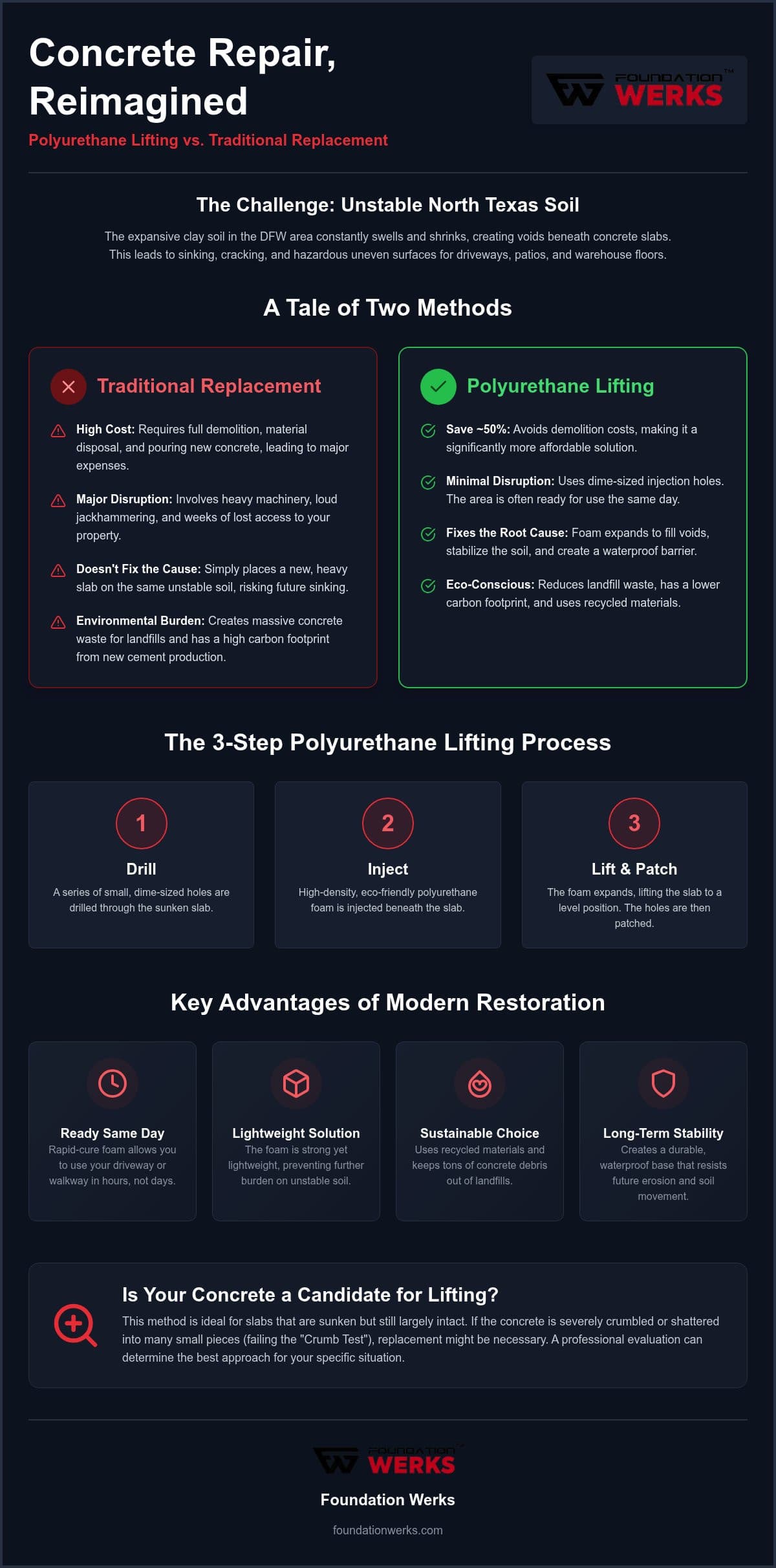
Living in the Dallas-Fort Worth metroplex means dealing with some of the most challenging soil in the country. Our expansive clay soils act like a sponge. They swell during wet seasons and shrink drastically during North Texas droughts. This constant movement creates empty spaces, or voids, under your concrete. When the soil pulls away, the weight of the slab causes it to drop. Traditional replacement doesn’t fix this soil behavior. In fact, the heavy weight of new concrete can actually accelerate sinking. Modern concrete replacement alternatives like polyurethane injection stabilize the soil and fill those voids with a waterproof barrier that resists future erosion.
Material-Based Alternatives vs. Structural Repair Methods
If you are searching for concrete replacement alternatives, you’ll likely encounter two very different categories. One focuses on what you use for a fresh pour, while the other addresses how to save the slab you already have. It’s easy to get lost in technical terms; however, the distinction is vital for your budget and timeline. For those dealing with an existing sunken driveway or warehouse floor, the goal isn’t just different material. The goal is a level surface that stays that way.
New Construction Alternatives
Innovation in the building industry has introduced several sustainable materials for new projects. AshCrete uses fly ash to reduce cement content. Hempcrete offers an eco-friendly, carbon-sequestering option. Composite cements use recycled glass or silica to increase durability. While these are excellent choices for a brand-new project, they aren’t practical retrofitting solutions. If your driveway is already sunken or unlevel, pouring a "greener" concrete still requires the high cost and disruption of a full demolition. These materials don’t address the underlying soil issues that caused the original failure.
The Restoration Alternative: Polyurethane Lifting
For most DFW homeowners, the most effective concrete replacement alternatives are structural repair methods. Instead of replacing the material, we improve the foundation beneath it. Polyurethane Concrete Raising is a precision process that lifts your existing slab back to its original position without the need for a jackhammer.
The technical difference lies in the material weight and hole size:
- Precision: We inject high-density foam through holes only 5/8-inch in diameter. These are nearly invisible once the job is finished.
- Weight: Our recycled polyurethane foam weighs approximately 2lb per cubic foot. Compare this to traditional mudjacking, which uses a heavy slurry weighing nearly 100lb per cubic foot.
- Stabilization: For deeper issues, we use Deep Foamjection™. This high-density solution reaches further into the soil to provide a stable base that resists the shifting North Texas clay.
Choosing this structural alternative avoids the "heavy on heavy" problem. Adding more weight to compromised soil often leads to more sinking. By using a lightweight, waterproof foam, you stabilize the area without adding unnecessary stress to the ground. This method ensures your concrete remains level and usable for years to come without the waste of a new pour.
Polyurethane Raising vs. Full Slab Replacement: The ROI Breakdown
Deciding between a full tear-out and concrete replacement alternatives often comes down to the bottom line. While a new pour looks fresh, the financial and logistical reality is often much harsher than people realize. Replacement requires a massive amount of labor just to get started. You’re paying for a crew to jackhammer the old slab, haul away tons of debris, and prep the ground for a new pour. In contrast, lifting uses your existing material, cutting labor and disposal costs significantly. Most property owners find that restoration saves them roughly 50% compared to the cost of a full replacement.
Cost and Efficiency Analysis
The true ROI of lifting is found in the timeline. Traditional concrete requires a cure time of anywhere from 7 to 28 days before it can handle heavy vehicle traffic. For a homeowner, that’s weeks of street parking. For a business, it’s a month of lost productivity. Polyurethane raising allows for same-day usability. Most slabs are ready for full weight within 15 to 30 minutes of the repair. This speed is especially critical for commercial settings like warehouse floor joint repair Dallas, where every hour of downtime impacts the supply chain. You aren’t just saving on the repair price; you’re saving on the cost of stopped operations.
Longevity and Performance
Many property owners worry that a repair is just a temporary fix. In reality, a new slab poured on the same unstable North Texas clay will likely sink again. This happens because the soil hasn’t changed, and the new concrete is incredibly heavy. Polyurethane foam is a game-changer here because it’s lightweight and waterproof. It won’t wash away during a heavy storm, and it doesn’t add significant weight to the soil. Polyurethane foam never loses density, providing a durable solution that addresses the underlying soil voids. By filling those empty spaces, we create a stable foundation that prevents the slab from shifting again.
Finally, consider the impact on your property. Replacement involves heavy trucks and skid steers that can crush your lawn or crack adjacent sidewalks. It creates clouds of concrete dust that settle on everything. Lifting is a surgical process. We use a single truck and a long hose to reach the repair site. There’s no dust, no heavy machinery on your grass, and no debris left behind. It’s the cleanest of all concrete replacement alternatives, leaving your landscaping and surroundings exactly as we found them. You get a level, safe surface without the chaos of a construction site.
Determining if Your Concrete is a Candidate for Restoration
While many seek concrete replacement alternatives to avoid high costs and disruption, a successful restoration depends entirely on the current state of your slab. We believe in empowering our neighbors with the knowledge to make the right call before any work begins. A simple visual inspection is your first step. Are you looking at a single, clean drop that has created a trip hazard, or is the surface shattered into dozens of small pieces? If the slab is mostly intact but has simply shifted or sunken, it’s likely a perfect candidate for polyurethane lifting.
The Ideal Candidate for Lifting
The best slabs for restoration are those that have maintained their structural strength despite the soil shifting beneath them. We often see this in driveways, sidewalks, and pool decks where a clear settlement pattern has emerged. In industrial settings, uneven warehouse floor repair Dallas projects often involve slabs that are structurally sound but have developed voids due to heavy machinery vibration or soil erosion. If the concrete isn’t crumbling, we can typically inject our lightweight foam through 5/8-inch holes to stabilize and level the surface in a single afternoon.
When Replacement is the Only Option
Sometimes, concrete replacement alternatives simply aren’t viable. We use what we call the "Crumb Test" to help owners decide. If you can kick the edge of a crack and pieces of concrete flake off or crumble like a dry cookie, the material itself has failed. Spiderweb cracking, where cracks run in every direction across the entire surface, usually indicates that the internal reinforcement has given way. In these cases, lifting might temporarily level the slab, but it won’t stop the surface from further degradation. Our team provides an honest assessment because we won’t perform a repair that we don’t believe will last.
Before committing to any method, we also look at the surrounding environment. If water is pooling against your foundation or under your driveway, even the best repair won’t be permanent. Addressing the root cause often involves installing French drains or upgrading your gutter system to move water away from the concrete. We look at the big picture to ensure that once your slab is level, it stays that way for years to come. This diagnostic approach saves you from spending money on a repair that the soil isn’t ready to support.
Implementing a Long-Term Concrete Strategy in North Texas
When you decide to move forward with concrete replacement alternatives, the process should feel like a relief, not another chore on your to-do list. A successful project requires more than just a quick lift. It demands a methodical approach that addresses both the visible symptoms and the hidden causes of slab failure. By following a clear strategy, you can ensure that your driveway, patio, or warehouse floor remains stable for the long haul.
A comprehensive restoration strategy involves four essential steps:
- Professional Site Evaluation: We start with a thorough walkthrough to measure settlement and check the integrity of the concrete.
- Drainage Correction: We identify if water is pooling under the slab. Addressing soil and drainage issues is the only way to prevent future settling.
- Method Selection: We determine if you need void filling to stabilize a hollow area or precision lifting to restore the height of the slab.
- Clean Execution: The repair is performed quickly, allowing you to return to your normal routine the same afternoon.
The Foundation Werks Process
We take pride in a process that respects your property and the environment. Our team uses a specialized, eco-conscious polyurethane foam made from recycled materials. This lightweight solution provides incredible strength without the massive footprint of traditional construction. We inject the foam through 5/8-inch holes, which is roughly the size of a dime. Once we patch these small entry points, the finish is nearly invisible. We’re proud to serve neighbors across the entire DFW metroplex, including McKinney, Frisco, and Dallas. Whether it’s a residential sidewalk or a massive industrial facility, we bring the same level of care and precision to every job.
Beyond the Lift: Maintenance and Joint Repair
Lifting the concrete is a major victory, but maintenance is what keeps it level. Water is the primary enemy of North Texas concrete. If joints and cracks are left open, rainwater will eventually wash away the soil we just stabilized. For business owners, concrete crack repair commercial services are a vital part of facility management. Sealing these gaps prevents water intrusion and protects the underlying foam from unnecessary stress. By combining precision lifting with proactive joint sealing, you create a concrete replacement alternatives strategy that actually stands the test of time.
Secure Your Property with Smarter Concrete Solutions
Choosing a restoration path for your sunken slabs is a decision that impacts your property’s value and your daily peace of mind. You don’t have to settle for the high costs and massive disruption of a traditional tear-out. By exploring concrete replacement alternatives like polyurethane lifting, you can save up to 50% compared to full replacement costs while keeping your landscaping intact. Our process uses an eco-friendly foam made from recycled materials that stabilizes the soil and provides a level surface in just a few hours.
We’ve discussed how identifying the root cause of sinking and selecting the right structural repair can prevent future failure. Whether you’re managing a busy warehouse in Dallas or a residential driveway in McKinney, we are here to help you navigate the best options for your specific needs. We take pride in serving the entire DFW metroplex with transparent advice and reliable results. Our team is ready to provide the expertise you need to make an informed decision.
Your concrete issues don’t have to be a source of constant stress. We look forward to helping you restore your property with a precision solution that is built to last for years to come. Reach out today and let’s get your surfaces back on solid ground.
Frequently Asked Questions
Is polyurethane concrete lifting a permanent fix?
Polyurethane lifting is a permanent solution because the material is waterproof and won’t lose its density or shape over time. Unlike traditional mudjacking which uses a heavy soil and cement slurry, this foam doesn’t wash away during heavy Texas rainstorms. While the lift itself is permanent, we always recommend addressing drainage issues to prevent the surrounding soil from shifting further in the future.
How much cheaper is concrete lifting compared to replacement?
Choosing restoration typically saves you about 50% compared to the total cost of tearing out and pouring a new slab. You avoid the expensive labor of demolition, the high fees for hauling debris to a landfill, and the cost of new raw materials. It remains one of the most financially sound concrete replacement alternatives for both homeowners and commercial property managers.
Can I drive on my driveway immediately after polyurethane lifting?
You can typically drive on your driveway just 15 to 30 minutes after the injection process is complete. The specialized foam reaches nearly its full structural strength almost immediately after being injected. This speed is a major benefit for busy households and businesses that can’t afford to wait the 7 to 28 days required for new concrete to cure before supporting vehicle traffic.
Will the foam used in concrete lifting harm my plants or landscaping?
The foam is environmentally inert and won’t leach harmful chemicals into your soil or groundwater. Our process is also much kinder to your yard than a full replacement. We don’t use heavy skid steers or dump trucks on your grass. Instead, we use a single hose to deliver the foam, ensuring your flower beds and lawn remain completely undisturbed.
What is the best alternative to concrete for a new eco-friendly driveway?
For brand new construction, permeable pavers or recycled composite cements are excellent eco-friendly choices. However, the greenest option for an existing property is avoiding a new pour altogether. By using concrete replacement alternatives like our recycled polyurethane foam, you keep tons of debris out of local landfills and eliminate the high carbon footprint associated with manufacturing new cement.
How do I know if my concrete slab is too damaged to be lifted?
Your slab is likely too damaged if it exhibits severe spiderweb cracking or if the surface has begun to crumble into small fragments. We look for structural integrity; if the concrete is still in large, solid pieces, it can usually be lifted. If the edges flake off easily when touched, the concrete has lost its internal strength and requires a full replacement.
Does concrete lifting work on the heavy clay soil found in Dallas?
Polyurethane lifting is specifically designed to handle the expansive clay soils common in the Dallas-Fort Worth area. The material is lightweight, so it doesn’t add extra weight to soil that is already prone to shifting. It effectively fills the voids created when clay shrinks during dry spells, creating a waterproof, stable foundation that helps your concrete stay level through every season.
How large are the holes drilled for the polyurethane injection process?
We only drill precision holes that are 5/8-inch in diameter, which is roughly the size of a dime. This is a significant improvement over older methods like mudjacking, which require much larger 2-inch holes. After the injection is finished, we fill these small holes with a matching concrete mixture, making the repair sites almost impossible to see once they have dried.