

What if leveling a sunken concrete slab didn’t require shutting down your driveway or commercial facility for days? It’s natural to worry about lost operational hours, especially if you fear that parking a heavy vehicle might crush freshly injected material beneath your concrete. Fortunately, the curing time for polyurethane foam injection is measured in minutes rather than days. Because high-density foam reaches about 90% of its compressive strength in roughly 15 minutes, you don’t have to face the multi-day closures required by traditional mudjacking or fresh concrete pours.
In this guide, you’ll discover exact timelines for both foot traffic and heavy vehicular loads, clearing up common confusion between initial chemical expansion and full structural cure. We will also examine how soil moisture and temperature impact the reaction, giving you the practical clarity you need to schedule repairs with zero unnecessary downtime.
Key Takeaways
- Understand the precise curing time for polyurethane foam injection, which enables safe foot and vehicle traffic within thirty minutes.
- Discover why expanding polymers dramatically outpace the multi-day wait times required by traditional mudjacking and fresh concrete pours.
- Learn how subterranean soil temperatures and moisture levels interact with chemical cross-linking during installation.
- See how closed-cell lifting material provides long-term subgrade stabilization without breaking down or washing out beneath slabs.
- Plan residential or commercial repairs confidently to restore sunken concrete surfaces with zero unnecessary downtime.
Polyurethane Foam Curing Timeline: From Injection to Full Load Capacity
Most property owners assume that leveling heavy concrete requires days of waiting. In reality, the curing time for polyurethane foam injection moves at a rapid pace because it relies on an internal chemical reaction rather than moisture evaporation. The lightweight material expands underneath the slab, sets within minutes, and allows surfaces to handle foot and vehicle traffic the very same day.
Understanding the exact timeline helps you plan around site operations without unnecessary delays. To see this expansion process in action, watch this helpful video:
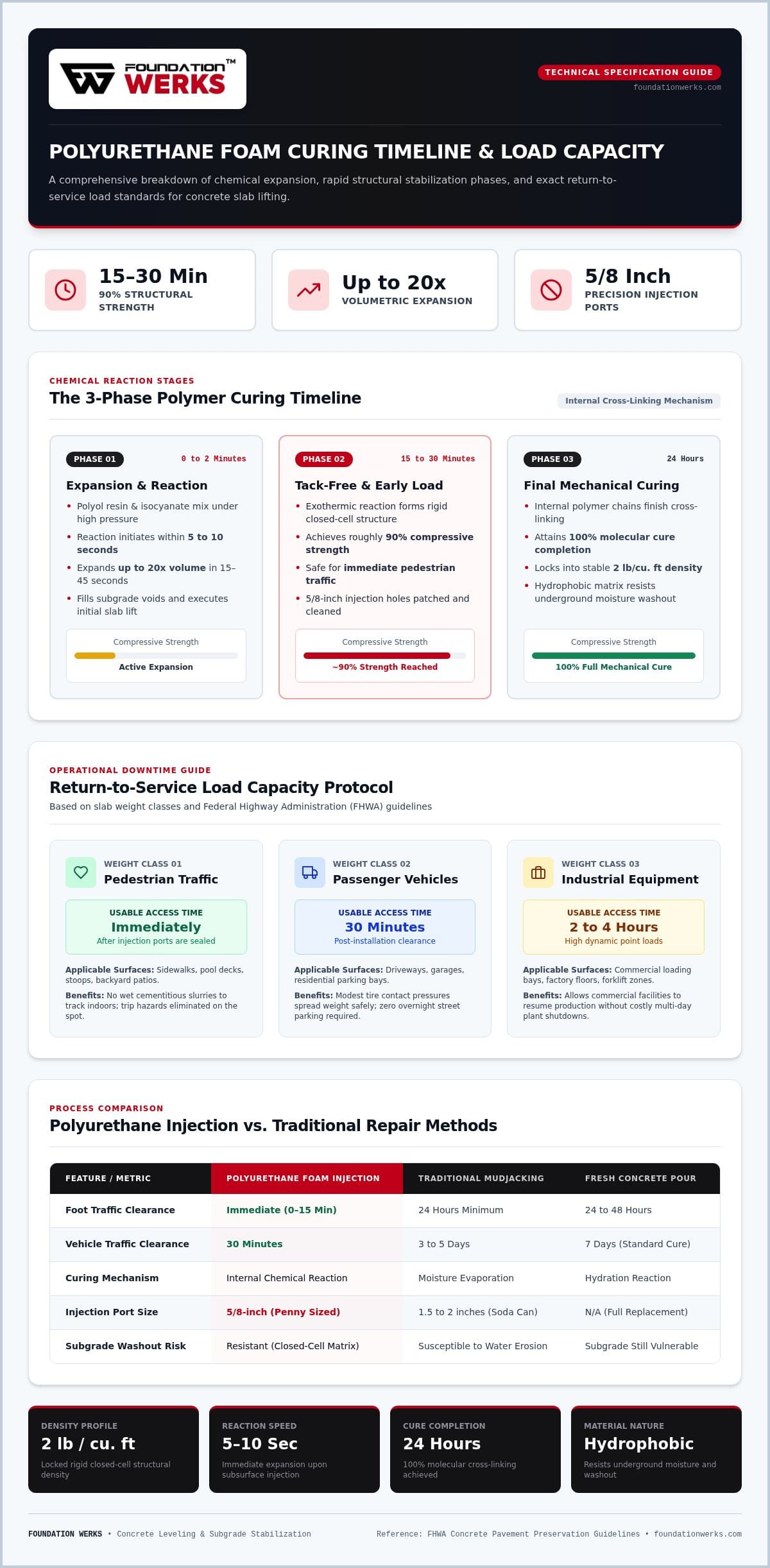
When evaluated across modern concrete leveling techniques, polyurethane stands apart by separating fast physical lifting from ultimate mechanical stabilization through three clear phases.
Phase 1: Initial Expansion and Reaction (0 to 2 Minutes)
The process starts when two liquid components, polyol resin and isocyanate, mix inside an injection gun under high pressure. Injected beneath the slab, this hydrophobic mixture begins expanding within 5 to 10 seconds. Within 15 to 45 seconds, the liquid expands up to twenty times its volume, filling loose subgrade voids and lifting the concrete to its proper alignment.
Phase 2: Tack-Free and Early Structural Strength (15 to 30 Minutes)
An exothermic reaction quickly converts the expanding liquid into a rigid, closed-cell polymer structure. Within 15 to 30 minutes, the foam achieves roughly 90% of its total structural compressive capacity. At this stage, pedestrians can walk across the slab safely. Technicians clean up the area and patch the tiny 5/8-inch injection holes while the subgrade holds firm beneath passenger vehicles.
Phase 3: Final Mechanical Curing (24 Hours)
While surfaces return to service almost immediately, internal polymer chains continue to cross-link over the next 24 hours. During this final phase, the curing time for polyurethane foam injection reaches 100% molecular completion. The resulting closed-cell matrix remains locked at its 2 lb per cubic foot density, resisting underground moisture washout and providing reliable, long-term support for heavy commercial loads.
How Soon Can You Walk and Drive on Injected Concrete?
One of the biggest concerns during any repair project is usable access. Homeowners worry about parking in the street, while plant managers calculate the steep cost of idle machinery. Fortunately, the rapid curing time for polyurethane foam injection means surface shutdowns are brief. Return-to-service protocols depend strictly on the weight class placed onto the slab.
Federal standards emphasize this rapid rebound. As detailed in the FHWA Concrete Pavement Preservation Guide, polyurethane slab stabilization allows high-traffic infrastructure to reopen within 15 to 30 minutes, avoiding the lengthy detours that conventional repairs demand. Here is how that translates across different everyday load scenarios:
- Pedestrians: Immediately after injection ports are sealed.
- Passenger Vehicles: 30 minutes post-installation.
- Heavy Machinery and Forklifts: 2 to 4 hours for high dynamic point loads.
Foot Traffic Timelines for Residential Slabs
Sidewalks, pool decks, stoops, and backyard patios can handle foot traffic the second our crew finishes. Because polyurethane expands and solidifies without messy cementitious slurries, you never have to worry about tracking wet material onto lawns or living room carpets. Trip hazards disappear immediately, giving family members and visitors safe, level walkways without any waiting period.
Vehicular Traffic: Driveways, Garages, and Parking Bays
Standard sedans, SUVs, and pickup trucks spread their weight across broad tire footprints, generating modest contact pressure on leveled slabs. Once the 30-minute mark passes, you can pull straight into your driveway or garage. There is no need to leave vehicles parked overnight on narrow residential streets or juggle parking permits while waiting for concrete to cure.
Industrial Loads: Forklifts and Commercial Facilities
Commercial loading bays and factory floors operate under extreme conditions. Solid-tire forklifts carry dense point loads that exert massive downward force onto joints and underlying base soils. Giving the material a brief two-to-four-hour buffer allows internal polymer bonds to build the compressive strength required for heavy traffic. Commercial operators can read our guide on uneven warehouse floor repair Dallas to plan section-by-section leveling around production schedules. If your team needs to eliminate trip hazards quickly, exploring professional leveling with Foundation Werks helps keep your facility moving forward smoothly.
Curing Time Comparison: Polyurethane Foam vs Mudjacking and New Pours
When concrete settles, property owners face three primary choices: lift the existing slab with polyurethane, pump a heavy slurry underneath, or demolish and pour fresh concrete. Evaluating the curing time for polyurethane foam injection against these alternatives reveals massive differences in operational downtime and structural burden.
Field testing confirms the speed advantage of expanding polymers. Extensive Oregon DOT research on injected polyurethane demonstrates that structural lifting foam reaches 90% of its ultimate compressive capacity in 15 minutes, whereas hydraulic cement grout slurries require extended drying periods. The contrast between these repair methods comes down to speed, weight, and process disruption:
- Polyurethane Foam: Injected through tiny 5/8-inch holes, fully functional within 15 to 30 minutes, and adds only 2 lb per cubic foot of weight.
- Traditional Mudjacking: Requires 1.5-inch to 2-inch holes, takes 24 to 72 hours to dry, and adds roughly 100 lb per cubic foot to vulnerable subsoils.
- Complete Concrete Replacement: Entails days of demolition and forming, requires 7 days for light vehicle use, and demands 28 days for full design hydration.
Traditional Mudjacking Cure Times and Limitations
Mudjacking depends on a physical drying process rather than an exothermic chemical bond. Because the mixture blends topsoil, water, and Portland cement, it must evaporate moisture over 24 to 72 hours to gain strength. As this water evaporates, the slurry shrinks, often leaving underlying voids. Adding 100 lb per cubic foot of dense material also places severe overburden onto shifting North Texas clay soils, increasing the odds of secondary settlement.
Full Concrete Replacement Downtime
Pouring a brand-new slab disrupts everyday routines for weeks. Crews must jackhammer broken slabs, haul heavy debris away, compact base aggregate, build wooden forms, and pour fresh mix. Even after finishing, you must keep vehicles off the driveway for at least a full week, with final compressive strength taking 28 days under standard ASTM guidelines. Beyond avoiding weeks of detours, leveling existing concrete costs roughly half the expense of full replacement. Commercial operators weighing these two paths can read our detailed breakdown on warehouse floor joint repair in Dallas: raising vs. replacement to analyze logistical impact before scheduling on-site work.
Key Variables That Influence Polyurethane Foam Curing Speed
Chemical reactions rarely happen in a vacuum. While the curing time for polyurethane foam injection remains remarkably fast across almost all job sites, real-world environmental conditions dictate the exact reaction speed. Ground temperatures, subsurface water, and void geometry all influence how polymer chains cross-link beneath a settled slab.
Understanding these field variables ensures precise lifting without unwanted structural movement or under-cured material. Here are the core factors our technicians evaluate on every project:
- Subsurface soil heat: Accelerates the exothermic reaction cycle.
- Cold ground conditions: Extends early gel time by several seconds.
- Underground saturation: Requires hydrophobic formulations to displace moisture without dilution.
- Cavity volume: Thicker pockets retain internal heat, promoting faster core solidification.
Ground Temperature and Seasonal Weather Variations
Subterranean soil temperatures directly govern chemical activity. Sweltering Texas summer heat warms the subgrade, accelerating polymer expansion. Injection gun operators must work with sharp precision to prevent over-lifting before the material sets. During colder winter months, chilly ground slows the initial chemical trigger. Specialized rigs counter this drop by circulating materials through heated delivery hoses, keeping the liquids at ideal temperatures before injection.
Subgrade Moisture and Standing Water Conditions
Traditional slurry mixtures break down when pumped into wet, muddy subgrades. Closed-cell polyurethane behaves differently. As a hydrophobic material, it aggressively displaces standing water beneath sunken concrete rather than absorbing it. The chemical reaction continues unimpeded, curing into a dense structural barrier that resists erosion from underground drainage paths. Property managers facing persistent surface leaks can reference our commercial concrete crack repair guide to protect their joint systems against ongoing water intrusion.
Void Dimensions and Injection Layer Thickness
The physical space beneath a slab shapes the curing profile. Large subterranean voids trap heat from the exothermic reaction, which speeds up internal polymer bonding. For deep settlement issues, Deep Foamjection™ delivers expanding material through specialized multi-depth pipes to bind loose soil below the surface. Applying the material in staged, multi-lift layers keeps expansion rates uniform across large warehouse slabs or extended commercial corridors, keeping the entire curing time for polyurethane foam injection strictly under control.
Long-Term Foam Stability: What Happens After Curing Ends?
Once the initial curing time for polyurethane foam injection finishes at the 24-hour mark, the polymer settles into an inert, rigid structure. It doesn’t break down, shrink, or wash away with normal soil activity. Instead, it maintains its structural density beneath the slab, delivering a durable, long-term foundation that resists repeated settlement without adding dead weight to active subgrades.
Knowing what happens underground after the crew packs up helps property owners plan for ongoing slab health. The stability of the material comes down to environmental durability, proper joint care, and precise local application.
Moisture Resistance and Subsoil Preservation
Closed-cell polyurethane functions as a dependable physical barrier against moisture. Intense North Texas rainstorms often saturate foundation soils, but hydrophobic foam won’t absorb groundwater or rot beneath the slab. Pests cannot burrow into or nest inside the rigid polymer cells. Because the material remains chemically inert once fully cured, it will not leach synthetic compounds into nearby garden beds or subsurface water tables.
Post-Curing Slab Care and Joint Sealing
Even with stabilized subgrade beneath your slab, proper surface maintenance keeps your concrete in peak condition. Sealing expansion joints and visible surface cracks prevents future storm runoff from finding pathways into the subgrade. The tiny 5/8-inch drill holes patched by technicians during the appointment blend cleanly into surrounding surfaces. Because the process avoids wet cement slurries, there is zero grout residue left behind to damage lawns or landscaping.
Choosing Professional Installation Across North Texas
Managing the curing time for polyurethane foam injection requires trained field execution. Experienced crews accurately calculate void volume and chemical delivery rates, preventing unintended slab over-lifting or uneven stress fractures. Across Dallas and Collin counties, navigating expansive clay soil demands specialized void filling and soil stabilization techniques. To restore your settled driveway, patio, or warehouse slab, call 800-464-9684 to schedule a free estimate with our team.
Restore Your Concrete Without Costly Downtime
Fixing settled concrete no longer requires days of barricades or disrupted routines. The rapid curing time for polyurethane foam injection delivers structural capacity in roughly 15 to 30 minutes, ensuring zero downtime with same-day usable concrete surfaces. By choosing lightweight closed-cell foam that weighs only 2 lb per cubic foot compared to traditional 100 lb mudjacking, you protect active soils from excessive weight. Injected through minimal 5/8-inch holes that preserve your slab’s clean appearance, this method restores elevation efficiently.
Whether you need to level an uneven residential driveway or stabilize a busy commercial floor, dependable support is just minutes away. You don’t have to accept ongoing trip hazards or deal with lengthy closures to keep your property safe and functional.
Frequently Asked Questions
Can you walk on concrete right after polyurethane foam injection?
Yes, pedestrians can walk on the treated concrete immediately after injection ports are patched. The foam reaches 90% compressive strength in roughly 15 minutes, meaning sidewalks, entry stoops, and patio steps are completely safe for foot traffic before our crew even leaves your Dallas-area property. You won’t track wet debris or mud, making the return to normal foot traffic instant and hassle-free.
How long after foam leveling until I can park my car on the driveway?
You can park your passenger vehicle on the driveway within 30 minutes of installation. Because the curing time for polyurethane foam injection happens rapidly, standard passenger cars, SUVs, and light trucks are fully supported on the very same day. Homeowners across Frisco and McKinney don’t have to leave vehicles parked overnight along the street or search for temporary off-site parking while waiting for traditional materials to dry.
Does cold or hot weather change the curing time of injection foam?
Extreme ambient temperatures can slightly alter initial reaction speed, but specialized contractor equipment offsets those shifts. High summer heat in North Dallas accelerates polymer expansion, while winter ground frost can delay the reaction by a few seconds. Professional crews use heated delivery lines to maintain strict component temperatures, ensuring a consistent curing time for polyurethane foam injection regardless of whether it is July or January in DFW.
Will water or wet soil slow down the polyurethane curing process?
No, subsurface water does not impede or dilute the curing reaction. Closed-cell lifting foam is hydrophobic, which means it actively displaces standing water beneath sunken slabs rather than absorbing it. The exothermic chemical process generates its own heat internally, solidifying reliably even in saturated clay subgrades common throughout Prosper, Allen, and Fairview. It will never wash out or degrade from subterranean runoff.
How long does cured polyurethane concrete raising foam last underground?
Cured polyurethane foam remains stable for decades beneath your concrete. Once the 24-hour curing cycle concludes, it forms an inert, closed-cell polymer matrix that never loses subterranean density. It resists moisture absorption, soil rot, insect activity, and chemical leaching. When paired with routine joint maintenance to keep surface runoff away from foundation edges, the foam provides an enduring, long-term solution for unstable North Texas soils.
Can heavy forklifts and delivery trucks drive on polyurethane-lifted warehouse slabs?
Yes, stabilized warehouse slabs safely support heavy machinery, forklifts, and loaded delivery trucks. High-density structural foam easily withstands extreme dynamic point loads without collapsing. For heavy industrial traffic, facility managers in Irving and Southlake should allow a brief two-to-four-hour curing window to ensure maximum compressive resilience. This quick turnaround lets logistics hubs resume operations on the same day without prolonged freight disruption.
What size holes are drilled for injection and how are they repaired?
Technicians drill small 5/8-inch holes through the slab, roughly the size of a coin. Because these injection ports are significantly smaller than the two-inch openings required for mudjacking, they leave virtually no visual footprint. Once leveling finishes, our technicians patch each hole with color-matched aggregate cement that cures flush with your existing concrete, cleanly preserving the look of your driveway or patio.