
What if that hairline crack running across your warehouse floor is actually a warning from the shifting Blackland Prairie soil beneath your feet? In North Texas, the ground is almost always moving. For facility managers, that movement often leads to expensive anxiety. You might notice subtle changes like doors that stick or uneven joints. Identifying the early signs of commercial foundation problems is the only way to prevent a minor dip from becoming a major liability. Nobody wants to deal with the mess of ripping out slabs or the massive price tag of a total concrete replacement.
It’s stressful to manage a facility when you’re worried about trip hazards or structural integrity. We understand that your business can’t just stop for weeks of construction. This 2026 guide helps you differentiate between normal settling and serious failure. You’ll learn how to spot warning signs before they escalate and discover why Polyurethane Concrete Raising is often a faster, more affordable alternative to traditional methods. We’ll walk through the specific soil challenges in the DFW metroplex and show you how to stabilize your concrete so your team can get back to work the same day.
Key Takeaways
- Learn to identify the early signs of commercial foundation problems, including “stair-step” masonry cracks and widening gaps between slabs and facility walls.
- Understand how the seasonal expansion and contraction of North Texas “Blackland Prairie” soil impacts your building’s structural integrity.
- Differentiate between simple slab-on-grade settlement and more complex structural issues to avoid overpaying for unnecessary repairs.
- Implement a proactive facility inspection routine focused on high-traffic warehouse joints and loading dock displacement.
- Discover how Polyurethane Concrete Raising offers a stabilization method that costs roughly half as much as a full concrete replacement.
Common Exterior and Interior Signs of Commercial Foundation Issues
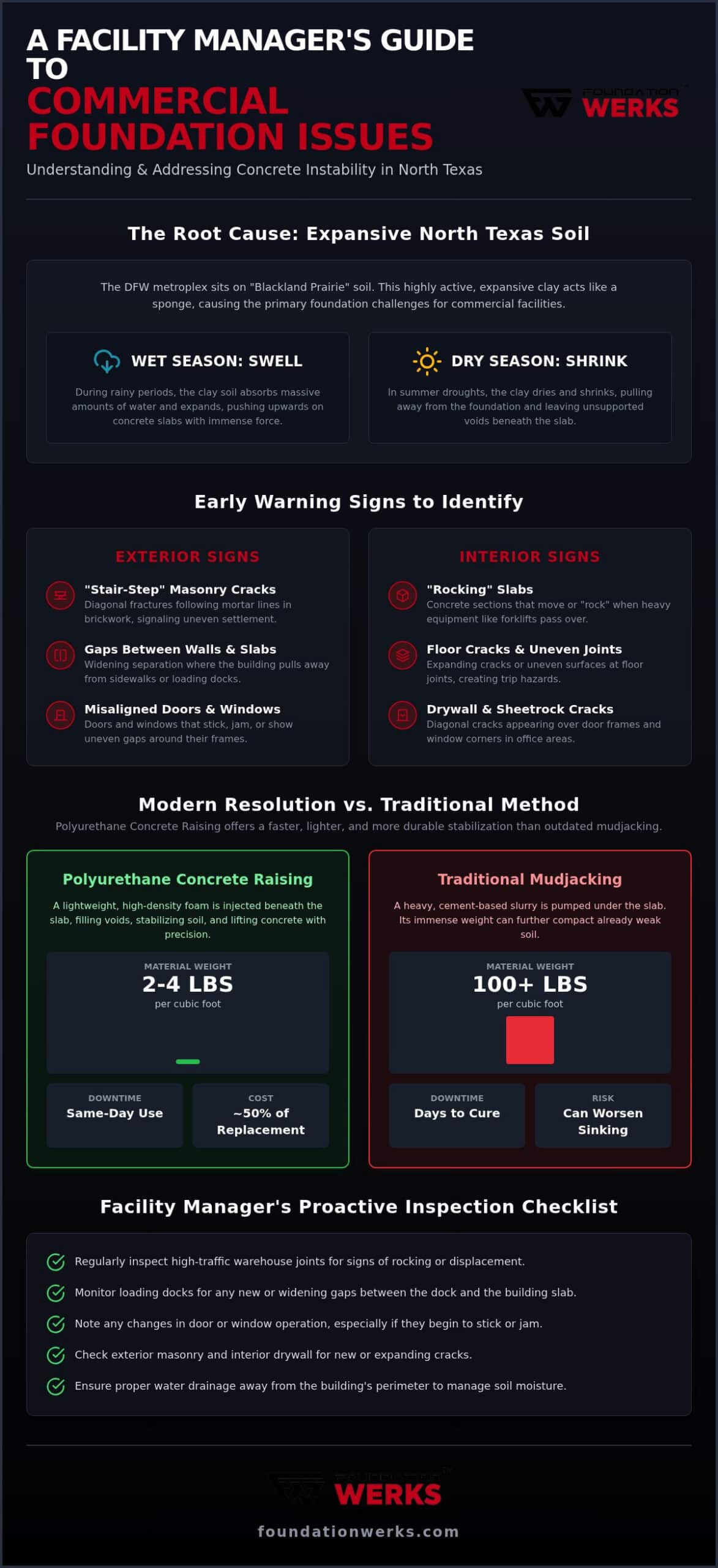
Identifying the signs of commercial foundation problems early can save a facility manager hundreds of thousands of dollars in long-term structural repairs. Unlike residential homes, commercial properties often cover vast footprints. Small shifts in the soil result in massive leverage against the concrete structure. One of the most recognizable indicators is the “stair-step” crack. These diagonal fractures follow the mortar lines in exterior brickwork or masonry. They often signal Structural Settlement, where one corner or section of the building is sinking faster than the rest.
You should also watch for gaps forming between the concrete slab and the facility walls. If you see daylight or notice a widening separation where the floor meets the baseboard, the slab is likely losing support from the soil beneath. This movement often causes doors and windows to stick or lose their alignment. In a warehouse setting, a misaligned bay door isn’t just a nuisance. It’s a security risk and an efficiency killer that disrupts daily operations.
Identifying Exterior Warning Signs
Exterior issues often manifest at transition points where different materials meet. Check the trim around commercial garage doors for new gaps or separating sealant. If the building looks like it’s “pulling away” from adjacent sidewalks or loading docks, the soil is likely contracting. You might also see cracks in the fascia or roofing line. These high-level fractures suggest that the foundation’s uneven shifting is putting stress on the very top of your facility. These symptoms are common in North Texas due to the volatile nature of our local clay.
Interior Red Flags for Facility Managers
Inside the facility, the warning signs are often felt before they’re seen. If you notice “rocking” slabs when forklifts or heavy machinery pass over a joint, you have a void underneath that needs stabilization. These unstable sections eventually lead to large-scale cracks in warehouse floor joints. Left unaddressed, these become uneven surfaces that create OSHA-regulated trip hazards for your staff. For office areas, keep an eye out for diagonal cracks in drywall or sheetrock, especially above door frames. While some minor settling is expected, these symptoms often point to a need for commercial concrete crack repair to stabilize the environment before the damage spreads to the main structure.
Why Commercial Foundations Fail in North Texas: The Role of Expansive Clay
The ground in North Texas isn’t just dirt. It’s a living, moving challenge for any large-scale facility. Most of the DFW metroplex sits on the Blackland Prairie, a region famous for its highly active expansive clay soil. This soil acts like a sponge. It swells significantly when it rains and shrinks dramatically during our brutal summer droughts. This constant movement is the primary driver behind the signs of commercial foundation problems that facility managers encounter every year. When the soil beneath a heavy slab loses moisture and pulls away, it leaves behind empty pockets or voids that can no longer support the weight of the building.
A thorough commercial property inspection checklist often highlights the building perimeter as the first line of defense. If water pools against the foundation or drains poorly, the clay soil becomes oversaturated. This uneven moisture distribution leads to differential settlement, where parts of the slab move while others stay put. Without proper moisture management, even the most robust industrial floors will eventually show signs of distress.
The Dallas-Fort Worth Soil Cycle
Extreme Texas summers lead to deep soil shrinkage. As the clay dries out, it creates massive voids under commercial slabs. Traditional mudjacking was once the standard answer, but it often fails in North Texas. The slurry used in mudjacking is incredibly heavy, weighing about 100 lbs per cubic foot. Adding that much weight to already compromised clay often causes the slab to sink even further. In contrast, Polyurethane Concrete Raising uses a lightweight foam that weighs only 2 lbs per cubic foot. To prevent moisture-driven movement, many facilities benefit from French drain installation to keep the soil around the foundation at a consistent moisture level.
Commercial Load Stress and Void Formation
Industrial facilities face a unique challenge: heavy equipment. In a warehouse, the constant traffic of forklifts and pallet jacks creates significant vibration. This industrial vibration acts like a compactor, forcing loose soil to settle even faster into existing voids. Once a slab loses its sub-soil support, the weight of machinery accelerates the sinking process. This isn’t a one-time event. “Settling” is often an ongoing process in North Texas. Without proactive stabilization, the gaps will continue to grow as the soil cycles through wet and dry seasons. If you suspect your floor is losing its grip, it might be time to schedule a professional assessment to catch these voids before they lead to structural failure.
Slab Settlement vs. Structural Foundation Failure: Identifying the Difference
Distinguishing between a sinking floor and a failing building skeleton is the first step in avoiding massive, unnecessary repair bills. Many facility managers assume every crack requires invasive piering, but that isn’t always the case. Misidentifying the signs of commercial foundation problems can lead to choosing a solution that addresses the wrong layer of the facility. While slab-on-grade settlement affects the usability of the floor, structural failure impacts the safety of the entire building envelope. Understanding this difference ensures you apply the right stabilization method for the specific type of movement occurring.
When is it a Slab Issue?
Slab issues are usually localized to the concrete floor itself. You’ll notice rocking joints when heavy equipment passes over or hear hollow sounds when tapping on the concrete surface. These are clear indicators of sub-slab voids where the soil has shrunk or washed away. In these cases, the building’s structural frame remains stable, but the floor has lost its support. Commercial concrete crack repair combined with Polyurethane Concrete Raising is the most efficient path forward. This process fills the voids and lifts the slab back to its original position without the need for heavy machinery or extended downtime.
Deep Foamjection™ plays a vital role in these scenarios. By injecting high-density foam into the deeper soil layers, we can stabilize the ground that supports the slab. This process addresses the root cause of the settling by compacting the loose soil and creating a solid base. It’s a cost-effective way to restore a level surface and ensure the floor can handle heavy industrial loads again without the disruption of traditional excavation.
When to Consult a Structural Engineer
If you see signs that the actual building frame is compromised, it’s time to call a structural engineer. These signs include major vertical displacement in load-bearing walls, severe separation at the roofline, or windows that have popped out of their frames. Slab lifting is a fast process, often completed in a single afternoon. Structural piering, however, is a much longer and more invasive project designed to anchor the building to deeper strata. Managing expectations for long-term stability is easier when you know exactly which problem you’re solving. We focus on slab and soil stabilization, but we always advocate for the right tool for the job. Identifying whether your issue is a floor problem or a frame problem ensures you don’t spend money on a major structural overhaul when a targeted foam injection would restore your facility’s function.
Facility Manager’s Walk-through: A Checklist for Detecting Concrete Issues
Proactive facility management is the best defense against escalating repair costs. By performing a quarterly walk-through, you can catch the subtle signs of commercial foundation problems before they disrupt your supply chain or create safety hazards. In a high-traffic environment, these issues rarely stay small. A minor dip in a warehouse floor can quickly become a significant liability when subjected to the constant weight of heavy machinery. Documenting these changes with photos and simple measurements allows you to track movement over time and make informed decisions about when to intervene.
Warehouse and Industrial Floor Inspection
Start your inspection in the highest-traffic areas of your facility. Look closely at the joints where concrete slabs meet. If you notice joint seal failure, water and debris can infiltrate the sub-grade, leading to soil erosion and voids. You can test for these hidden pockets using a simple chain-drag or tapping method. A hollow, echoing sound indicates that the slab has lost contact with the soil. If you identify rocking slabs or tripping hazards, you likely need uneven warehouse floor repair to stabilize the surface. Catching these voids early prevents the concrete from cracking under the stress of forklift traffic.
Drainage and Exterior Site Assessment
The exterior of your building often holds the clues to what’s happening underneath. Check your loading docks for any vertical displacement or horizontal gaps forming between the dock and the main structure. These are common signs of commercial foundation problems driven by soil movement. Inspect your drainage systems to ensure water is moving at least five to ten feet away from the slab. Gutters and downspouts should discharge into areas that slope away from the building. If you see “ponding” water or areas where the soil stays saturated long after a rain, your foundation is at risk. Even landscape irrigation can cause issues if it’s over-saturating the clay soil near the perimeter, leading to uneven swelling and slab upheaval.
Use this quick checklist during your next walk-through:
- Quarterly Joint Check: Inspect high-traffic warehouse joints for rocking or sealant failure.
- Loading Dock Alignment: Look for new gaps or height differences at dock plates.
- Drainage Discharge: Confirm all downspouts are clear and discharging away from the foundation.
- Crack Documentation: Mark the ends of existing cracks with a date and check for growth every 90 days.
- Soil Perimeter: Identify any areas where the soil has pulled away from the slab during dry spells.
Identifying these issues early allows for targeted stabilization rather than a full-scale reconstruction. When you spot these red flags, a quick assessment can determine if Polyurethane Concrete Raising is the right choice to restore your facility’s safety and level surfaces.
Modern Resolutions for Commercial Concrete Stabilization
Once you’ve identified the signs of commercial foundation problems, the next step is finding a resolution that doesn’t paralyze your operations. Traditional concrete replacement is often the first thing people think of, but it’s frequently unnecessary. For most facilities in the DFW metroplex, Polyurethane Concrete Raising provides a faster, cleaner alternative. This method typically costs about half of what you’d pay for a full concrete replacement. Because the process is non-invasive, you don’t have to worry about the dust, noise, and weeks of curing time that come with a new pour.
The speed of the repair is a game changer for busy warehouses and industrial hubs. We understand that every hour of downtime impacts your bottom line. With our “Foam Lifts & Levels” approach, the concrete can be used immediately after the repair is finished. You can have a forklift driving over a previously rocking slab just minutes after we pack up our gear. It’s a pragmatic solution that prioritizes your facility’s productivity while ensuring the ground beneath your feet is stable and secure.
Polyurethane Foam vs. Traditional Mudjacking
The technical differences between modern foam and old-school mudjacking are significant, especially in North Texas. Mudjacking uses a heavy grout slurry that weighs approximately 100 lbs per cubic foot. In our expansive clay soil, adding that much weight can actually cause the slab to sink further over time. Our polyurethane foam weighs only 2 lbs per cubic foot. It offers the same lifting power with a fraction of the weight, meaning it won’t overload the sub-soil.
- Nearly Invisible Drill Holes: We use 5/8-inch holes to inject the foam, which are easily patched and hidden. Mudjacking requires much larger ports.
- Clean Process: There’s no grout splatter or heavy equipment tracking through your landscaped areas.
- Eco-Conscious Materials: We use a patented foam made from recycled materials, helping your facility meet its sustainability goals.
The Process of Deep Foamjection™ for Soil Stabilization
For more complex issues where the soil has severely settled, we utilize Deep Foamjection™. This process involves injecting foam deeper into the ground to densify loose sub-soils and fill large underground voids. It’s an essential technique for warehouse floor joint repair because it addresses the problem from the bottom up. By expanding into every corner of a void, the foam creates a solid, lightweight base that resists the seasonal moisture cycles of the Blackland Prairie. This methodology provides a reliable, long-term resolution without the need for invasive structural piering or total slab demolition.
Protecting Your Commercial Investment in North Texas
Managing a large-scale facility in DFW requires a proactive approach to soil movement. By staying vigilant for the signs of commercial foundation problems, such as widening floor joints or misaligned loading docks, you can address issues before they lead to structural failure. Choosing Polyurethane Concrete Raising allows you to stabilize your floors at roughly half the cost of replacement. It’s a strategic move that favors efficiency and long-term facility health over disruptive construction cycles.
At Foundation Werks, we deliver professional concrete stabilization across the entire DFW Metroplex. Our process utilizes a patented eco-friendly foam made from recycled materials, providing a lightweight yet powerful resolution for sinking slabs. The greatest advantage is the immediate same-day usability of all repaired surfaces. Your industrial space can return to full operation the moment we finish. We’re here to help you navigate these challenges with transparency and expertise.
Your facility is a vital asset, and keeping it level shouldn’t be a source of stress. We’re ready to partner with you to ensure your concrete remains a solid foundation for your business growth.
Frequently Asked Questions
Is a crack in my commercial floor always a sign of foundation failure?
No, a crack isn’t always a sign of total failure. Many fractures are caused by initial shrinkage or minor settling. However, they can be signs of commercial foundation problems if you notice vertical displacement or if the slab “rocks” when heavy machinery passes over it. We look for specific patterns, like widening warehouse joints or diagonal wall cracks, to determine if the issue is a slab void or a deeper structural concern.
How much does commercial foundation repair cost in Dallas?
The total cost depends on the square footage and the amount of material needed to fill sub-surface voids. Generally, Polyurethane Concrete Raising is about half the cost of a full concrete replacement. While we don’t provide flat rates without a site visit, choosing stabilization over replacement eliminates the massive expenses associated with demolition, debris removal, and the long-term downtime required for new concrete to cure properly.
How long does the polyurethane concrete raising process take?
Most commercial projects are completed in a single day. A typical warehouse floor or loading dock repair usually takes just a few hours from setup to completion. Because we use small, specialized injection equipment rather than heavy excavation machinery, the process is incredibly efficient. This speed allows your facility to remain operational with minimal disruption, ensuring your supply chain stays on schedule without needing to close down sections for days.
Can I use my warehouse floor immediately after the foam injection?
Yes, you can drive on the repaired slabs the same day. Our high-density polyurethane foam reaches 90% of its full structural strength within 15 minutes of the injection process. This is a massive advantage over traditional concrete pours, which require days or even weeks of curing time before they can support heavy loads. Your forklifts and pallet jacks can resume their normal routes almost as soon as our team finishes the job.
Will the foam material lose density or sink over time?
No, the high-density foam we use is hydro-insensitive and won’t wash away or lose its volume. It creates a solid, lightweight structure that fills voids and densifies the sub-soil. While North Texas clay will continue its natural shrink-swell cycle, the foam remains a stable component of the sub-grade. This provides a long-term resolution for sinking slabs and joint issues without adding the heavy weight that often causes traditional mudjacking to fail.
Do you provide free estimates for commercial properties in McKinney?
We provide professional assessments and estimates for commercial and industrial facilities throughout the DFW metroplex, including McKinney. During our visit, we’ll identify the signs of commercial foundation problems and determine the best stabilization method for your specific site. Our goal is to educate facility managers on the state of their concrete, providing a clear path forward that balances cost-effectiveness with the operational needs of your business.
What is the difference between void filling and foundation piering?
Void filling addresses the empty spaces between the concrete slab and the soil, whereas piering anchors the entire building to deep rock or stable strata. We specialize in Polyurethane Concrete Raising and void stabilization. This approach is ideal for slab-on-grade issues where the floor is sinking or uneven but the main building frame remains sound. It’s a much less invasive and more affordable alternative for industrial floor leveling.
How do I know if I need a French drain for my commercial property?
You likely need a French drain if you notice standing water near your foundation or if the soil stays saturated long after a rainstorm. Poor drainage is a leading cause of slab movement in North Texas. Installing a drainage system helps manage soil moisture levels, which prevents the expansive clay from swelling unevenly. This proactive measure protects your concrete surfaces from the pressure and shifting caused by oversaturated sub-soils.