

What if the hairline crack in your drywall isn’t just your house settling, but a warning sign that the soil beneath your slab is shifting? Most homeowners assume foundation issues are obvious, like a flooded basement or a leaning wall, but the most dangerous signs of foundation water damage are often the ones you have to look for. It’s completely normal to feel a surge of anxiety when you notice a door sticking or a new gap in the brickwork. You start wondering if your home is still safe and how much a repair might cost. We know that stress well, and we’re here to help you navigate it with clear, honest information.
This guide breaks down exactly how to identify red flags before they turn into major structural failures. You’ll learn to distinguish between minor cosmetic flaws and urgent structural needs that require immediate attention. We will also explore how modern, non-invasive resolutions like polyurethane concrete raising provide a reliable, long-term solution without the mess of traditional methods. By the end of this guide, you’ll have a clear checklist to protect your home and your peace of mind.
Key Takeaways
- Identify the early signs of foundation water damage, such as stair-step cracks in exterior brickwork and interior doors that suddenly begin to stick.
- Understand how hydrostatic pressure and soil erosion create hidden underground voids that compromise your home’s structural stability.
- Learn the “Nickel Test” to measure crack width and determine if your foundation movement is an urgent structural concern or a minor cosmetic issue.
- Distinguish between groundwater seepage and plumbing leaks by recognizing indicators like efflorescence, the white powdery stains found on concrete surfaces.
- Explore how polyurethane concrete raising and French drain installation provide durable, long-term resolutions for redirecting water and leveling your slab.
10 Critical Signs of Foundation Water Damage to Watch For
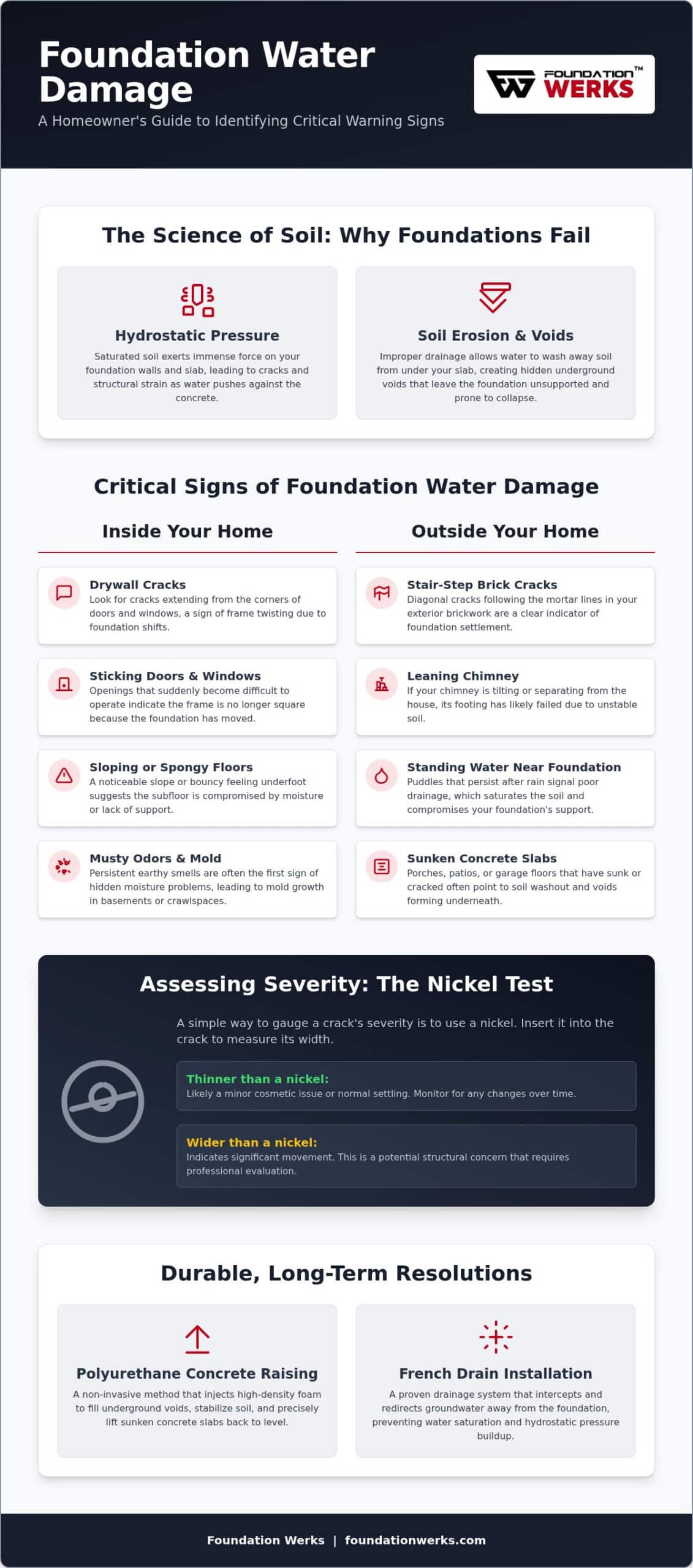
Identifying the early signs of foundation water damage can save you from a structural catastrophe. Foundation issues rarely happen overnight; they’re usually the result of water slowly changing the soil’s ability to support your home’s weight. You might notice fine, hairline cracks in the foundation slab or more concerning “stair-step” cracks following the mortar lines in your exterior brickwork. These aren’t just cosmetic flaws. They suggest the ground is shifting beneath you, often due to excessive moisture or poor drainage.
Look for these common indicators around your property:
- Separation of static structures: If your kitchen cabinets or bathroom counters are pulling away from the wall, it’s a sign the floor or wall is shifting.
- Standing water or muddy patches: Puddles that remain near your foundation perimeter after a light rain indicate that water isn’t being redirected properly.
- Musty odors and mold: Dampness in lower levels often leads to fungal growth. Understanding what constitutes water damage helps homeowners realize that persistent, earthy smells are often the first sign of a hidden moisture problem affecting the concrete.
- Misaligned openings: Doors that suddenly stick or windows that no longer slide easily in their frames are classic signs of a shifting foundation.
Interior Red Flags: More Than Just Cosmetic
Inside your home, the signs are often subtle at first. You might find drywall cracks stretching upward from the corners of doors or windows. This happens because the wooden frame is twisting as the foundation settles. You may also see nail heads popping out of the drywall. When the studs shift due to moisture in the crawlspace, they push the fasteners through the tape and paint. If your hardwood or laminate flooring feels “spongy” or develops a noticeable slope, the subfloor is likely reacting to excessive humidity or direct water infiltration. These interior shifts are rarely isolated; they’re almost always connected to what’s happening under the slab.
Exterior Warning Signs on Your Property
The perimeter of your home offers the most honest look at its structural health. A leaning chimney is perhaps the most dramatic warning. It suggests the foundation footings are no longer level. You should also check the alignment of your garage door. If a gap has formed between the bottom of the door and the pavement, the slab is likely sinking. Sunken porch or patio slabs are also common. These create trip hazards and often point to “washout,” where water has carved out voids in the soil. Addressing these issues with a long-term resolution, such as polyurethane concrete raising, can stabilize the area before the damage spreads to the main structure.
The Science of Soil: How Water Compromises Your Slab
Foundation movement isn’t just about the concrete. It’s about the soil supporting it. In North Texas, our soil behaves like a heavy sponge. When it rains, it expands. When it’s dry, it shrinks. This aggressive cycle is the root cause of most signs of foundation water damage. Understanding the mechanics of your yard can help you spot trouble before it reaches your living room.
Hydrostatic pressure is a major factor in structural failure. When water saturates the soil around your home, it exerts thousands of pounds of force against your slab. This pressure can actually push concrete upward or cause it to crack under the intense strain. Conversely, poor drainage allows water to pool, which leads to the second major issue: erosion. When water has nowhere to go, it begins to move the earth itself.
The Danger of Underground Voids
Water is patient. As it flows beneath your concrete, it often takes soil with it. This is known as the “washout” effect. Over time, this process creates hidden underground voids. Your slab might look perfectly fine on the surface, but it’s actually hollow underneath. Without the support of the earth, the concrete eventually snaps under its own weight or the weight of your home. This is why addressing voids early through residential foundation repair is a critical long-term resolution for maintaining structural integrity.
North Texas Weather Patterns and Your Foundation
Homeowners in McKinney and Frisco face a unique challenge. Our expansive clay soil is incredibly sensitive to moisture levels. During a DFW summer, the ground pulls away from the foundation as it dries out. When the inevitable torrential rains follow, water pours into those gaps. This rapid transition from drought to flood causes the soil to “heave” or swell aggressively. It’s this constant movement that creates the cracks you see in your brickwork.
You’ve likely heard neighbors talk about “watering your foundation.” While this practice aims to keep soil moisture consistent, it’s often misunderstood. Without a professional drainage strategy, you might just be saturating the surface while leaving deeper layers dry. This can create the very hydrostatic pressure you’re trying to avoid. Understanding these local soil dynamics is the first step in moving from temporary patches to reliable, lasting structural health.
Identifying External vs. Internal Indicators of Infiltration
Not all moisture problems are created equal. To find a long-term resolution, you first have to determine if the water is coming from inside your pipes or outside from the yard. Internal plumbing leaks often present as localized damp spots or a sudden, unexplained jump in your water bill. In contrast, groundwater infiltration is usually tied to weather patterns. If you notice dampness only after a heavy DFW storm, you’re likely dealing with external drainage issues rather than a mechanical failure.
One of the most overlooked signs of foundation water damage is efflorescence. This is a white, powdery substance that forms on concrete surfaces. It isn’t mold; it’s actually mineral deposits left behind as water travels through the porous concrete and evaporates. If you see this on your basement walls or garage floor, it proves that moisture is actively moving through the slab. Over time, this migration can weaken the concrete’s structural integrity.
Surface Level Clues: Puddles and Erosion
Take a walk around your property after it rains. Look for “low spots” where water pools against the house. These areas act as reservoirs, allowing water to soak deep into the soil and increase hydrostatic pressure against your foundation. Gutter failure is another major culprit. If your downspouts aren’t extending at least five to six feet away from the structure, they’re dumping hundreds of gallons of water directly onto your foundation corners, which are the weakest points of the slab.
Don’t ignore your driveway or sidewalk joints. In both residential and commercial settings, these joints are often sealed with mastic or specialized joint seals to keep water out. When these seals fail, water funnels directly into the subgrade. This leads to the “sinking slab” effect, creating trip hazards and indicating that the soil beneath is being washed away. Maintaining these seals is a critical part of preventing larger structural shifts.
Structural Clues: Bowing and Shifting
When external pressure becomes too great, you might notice bowing walls in lower levels or crawlspaces. This inward curve is a direct result of the soil outside being over-saturated and expanding against the structure. You can perform a simple “level test” by placing a carpenter’s level on your floors or checking if a marble rolls consistently toward one specific wall. While not a professional diagnostic, a sloping floor often links back to joint failure and significant soil shifts. Addressing these indicators early helps prevent the need for more invasive repairs later.
Assessing the Severity: When to Call a Concrete Specialist
Knowing when to worry is half the battle. Many homeowners see a hairline crack and panic. Others ignore a widening gap for years. The “Nickel Test” is a simple diagnostic tool you can use today. If you can fit a nickel sideways into a foundation crack, it’s wider than 2 millimeters. This usually indicates that the movement is more than just minor settling. You should also differentiate between active and passive cracks. A passive crack is a snapshot. It doesn’t change. An active crack is a movie. It grows, shifts, or leaks after every heavy North Texas rainstorm. These active signs of foundation water damage require a concrete specialist to assess the underlying soil stability before the damage spreads.
The high cost of waiting is often the biggest mistake a property owner can make. Small cracks allow water to reach the rebar or mesh inside your slab, causing it to rust and expand. This creates even more internal pressure. The ground doesn’t wait. Delaying a repair often leads to secondary damage like broken plumbing lines or roof leaks. Choosing a timely long-term resolution is always more affordable than a total foundation overhaul.
Minor Seepage vs. Structural Crisis
Not every moisture issue requires a full-scale lift. Sometimes, minor seepage can be handled by installing a French drain to redirect runoff away from the slab. This simple drainage update often prevents further soil erosion. However, if you notice the slab is physically lower than it was last year, you’re facing a structural crisis. Stabilization and lifting become necessary when the soil can no longer support the weight of the concrete. It’s the difference between managing a wet yard and rescuing a sinking home. A professional can help you decide if you need water redirection or actual slab stabilization.
Commercial Property Considerations
For facility managers, the stakes are even higher. Water damage doesn’t just affect the building’s value; it impacts daily operations and safety. In a warehouse setting, a sunken floor is more than an eyesore. It’s a safety hazard that can damage forklifts or cause employee injuries. Staying compliant with OSHA standards requires proactive concrete crack repair commercial services. Addressing trip hazards before they lead to a liability claim is simply good business. Whether you’re managing a retail space in Frisco or a warehouse in McKinney, keeping your concrete level is essential for facility health.
Long-Term Resolutions: Polyurethane Lifting and Proper Drainage
Once you’ve identified the signs of foundation water damage, the focus shifts from observation to action. Traditional repair methods often involve mudjacking, which pumps a heavy slurry of sand and cement under your slab. This adds significant weight to soil that’s already struggling to support your home. Polyurethane Concrete Raising offers a modern, lightweight alternative. We use an eco-friendly, recycled foam that expands to fill voids and lift concrete without putting unnecessary stress on the ground below. It’s a quietly innovative approach that addresses the root of the problem rather than just the symptoms.
For deeper soil instability, we utilize specialized foam injection techniques to stabilize the earth before the damage worsens. This process strengthens the subgrade and prevents the “heave and shrink” cycle from causing further cracks. DFW businesses prefer this method because it offers immediate usability. While traditional concrete work can take days to cure, our foam-repaired surfaces are ready for heavy traffic on the very same day. It’s a firm, purposeful resolution that respects your time and your property’s integrity.
The Polyurethane Advantage
The technical differences between foam and mudjacking are stark. Our foam weighs only about 2 lbs per cubic foot, compared to the 100-150 lbs of traditional mudjacking material. This prevents the “repair” from sinking the slab even further. The application is also much cleaner. We use 5/8-inch drill holes, which are roughly the size of a penny and nearly invisible once we’re finished. Because this material is waterproof and never loses density, it doesn’t wash away during the intense North Texas rain cycles. It remains a durable part of your home’s structural health for the long haul.
Strategic Drainage with French Drains
Lifting your concrete is only half of the solution. You must also stop the water that caused the erosion in the first place. French drains are essential for redirecting groundwater away from your foundation’s vulnerable zones. They act as an underground highway, catching water before it can saturate the clay soil near your slab. A comprehensive water management plan should also include gutter installation and joint seals to keep the subgrade dry. When we perform warehouse floor joint repair in Dallas, we always emphasize that drainage checks are part of the process. Managing the water flow is the only way to ensure your soil remains stable and your concrete stays level.
Protecting Your Home’s Structural Future
Spotting the early signs of foundation water damage is the best way to prevent a minor issue from becoming a structural crisis. By monitoring crack widths and ensuring your drainage systems are actively redirecting water, you take control of your home’s stability. We understand that foundation movement is stressful; however, modern technology has made the resolution process cleaner and faster than ever before.
At Foundation Werks, we prioritize quality and transparency for every neighbor we serve throughout the DFW Metroplex. Our use of eco-friendly, recycled polyurethane foam allows us to stabilize your concrete with minimal disruption. You don’t have to wait days for results because our repaired surfaces are ready for full use the same day we finish. Whether you are dealing with a sinking driveway or a shifting warehouse floor, we provide the expertise needed to restore your peace of mind.
Your home is your most significant investment. Taking proactive steps today ensures it remains a safe, level sanctuary for years to come.
Frequently Asked Questions
Is foundation water damage covered by standard homeowners insurance?
Standard homeowners insurance policies typically do not cover damage caused by groundwater seepage or long-term soil movement. Most coverage is limited to sudden, accidental events like a burst internal pipe. Because moisture infiltration from the yard is considered a maintenance issue, it is rarely included. You should review your specific 2026 policy riders to see if you have added protection for surface water or backup events.
Can I fix foundation water damage signs myself with DIY kits?
DIY kits are generally effective for cosmetic surface repairs but cannot resolve the underlying structural issues. Patching a crack might hide the visible problem, but it does not address the soil erosion or hydrostatic pressure causing the shift. For a reliable long-term resolution, you need professional equipment to fill underground voids and stabilize the slab. Attempting a DIY fix on structural cracks often leads to more expensive repairs later.
How long does a professional polyurethane foundation repair take?
Most polyurethane concrete raising projects are completed in just a few hours. This is much faster than traditional mudjacking or full concrete replacement. Because our patented eco-conscious foam reaches full strength almost instantly, there is no long curing period. Homeowners and DFW businesses appreciate that driveways, sidewalks, and warehouse floors are ready for immediate same-day use as soon as our crew finishes the injection process.
What is the most common cause of foundation water damage in Dallas?
The primary cause in the DFW metroplex is the interaction between expansive clay soil and extreme weather cycles. North Texas soil swells aggressively during heavy rains and shrinks during droughts. This constant movement creates the most common signs of foundation water damage in cities like McKinney and Frisco. When water pools near the slab, it accelerates this “heave and shrink” cycle, leading to cracks and sinking concrete.
How do I tell if a crack in my foundation is structural or just cosmetic?
Structural cracks are usually wider than a nickel and often appear in a stair-step pattern through exterior brickwork. Cosmetic cracks are typically hairline fractures caused by minor drying. If you notice interior doors sticking or windows that won’t align, these are signs of foundation water damage that suggest a structural shift. We recommend a professional assessment if a crack is wider than 1/8 inch or if it continues to grow over time.
What happens if I ignore signs of foundation water damage?
Ignoring these indicators allows small voids to grow into large caverns beneath your home. Over time, the lack of support causes the slab to snap, leading to interior wall collapses and broken utility lines. What starts as a simple moisture issue can escalate into a total structural failure. Early intervention with foam injection is significantly more affordable than waiting for the damage to require invasive and costly concrete replacement.
Will polyurethane foam lifting damage my landscaping?
No, polyurethane foam lifting is a non-invasive process that protects your yard and landscaping. Unlike mudjacking, we don’t use heavy trucks or large equipment that leaves ruts in your lawn. We only require small 5/8-inch drill holes and thin hoses to deliver the material. This allows us to work in tight spaces near flower beds in Prosper or Allen without disturbing your plants or requiring a massive cleanup.
Will the foam material lose density over time?
No, the high-density polyurethane we use is engineered to be a long-term resolution for unstable soil. Unlike traditional mudjacking slurry, which can wash away or settle over time, this eco-friendly foam maintains its structure and lift capabilities. It is waterproof and resistant to the chemical changes often found in North Texas soil. This ensures your concrete remains supported without the need for frequent repeat injections or maintenance.