

Tearing out a sunken concrete slab is often an expensive, unnecessary mistake that most North Texas property owners can avoid. You have likely noticed those widening cracks or the growing trip hazard on your sidewalk and felt that familiar spike of anxiety. It’s natural to worry about the high cost of replacement or the invasive mess of a week-long construction project. We understand that your time is valuable and your budget is not bottomless.
The good news is that concrete slab lifting North Texas has evolved significantly as we move through 2026. By using advanced polyurethane foam technology, it is now possible to stabilize your foundation and level your surfaces without heavy equipment or long wait times. This guide explores how this eco-friendly solution addresses the root cause of settlement by filling deep soil voids. You will learn how to achieve a safe, level surface that is ready for use the same day, helping you save money while protecting your property’s value for the long term.
Key Takeaways
- Understand how North Texas clay soils cause slab settlement and why addressing underlying voids is essential for a stable surface.
- Compare modern polyurethane foam to traditional mudjacking and see how a lightweight material prevents further soil compaction.
- Discover the precision of concrete slab lifting North Texas services that utilize tiny injection holes to minimize surface damage.
- Identify the simple steps to prepare your home or business for a leveling project that offers same-day usability.
What is Slab Foundation Leveling and Why Does it Matter?
Slab leveling is the technical process of lifting a sunken concrete slab back to its original grade by filling the empty spaces, or voids, underneath it. Over time, the ground beneath your concrete can shift, causing sections of a driveway, patio, or warehouse floor to drop. When you invest in concrete slab lifting North Texas property owners often find it’s a much faster, cleaner alternative to full replacement. It allows you to restore the function of your concrete without the high cost of a new pour.
It’s important to distinguish this process from structural foundation repair. While piers are used to support the deep perimeter beams of a home, Concrete leveling focuses on slab-on-grade surfaces. Ignoring a sunken slab can lead to serious issues. Water often pools in low spots, which can eventually seep toward your home’s foundation. Tripping hazards on sidewalks also create liability risks for businesses and homeowners alike. Addressing these gaps early prevents the concrete from cracking further under its own weight.
The North Texas Clay Factor
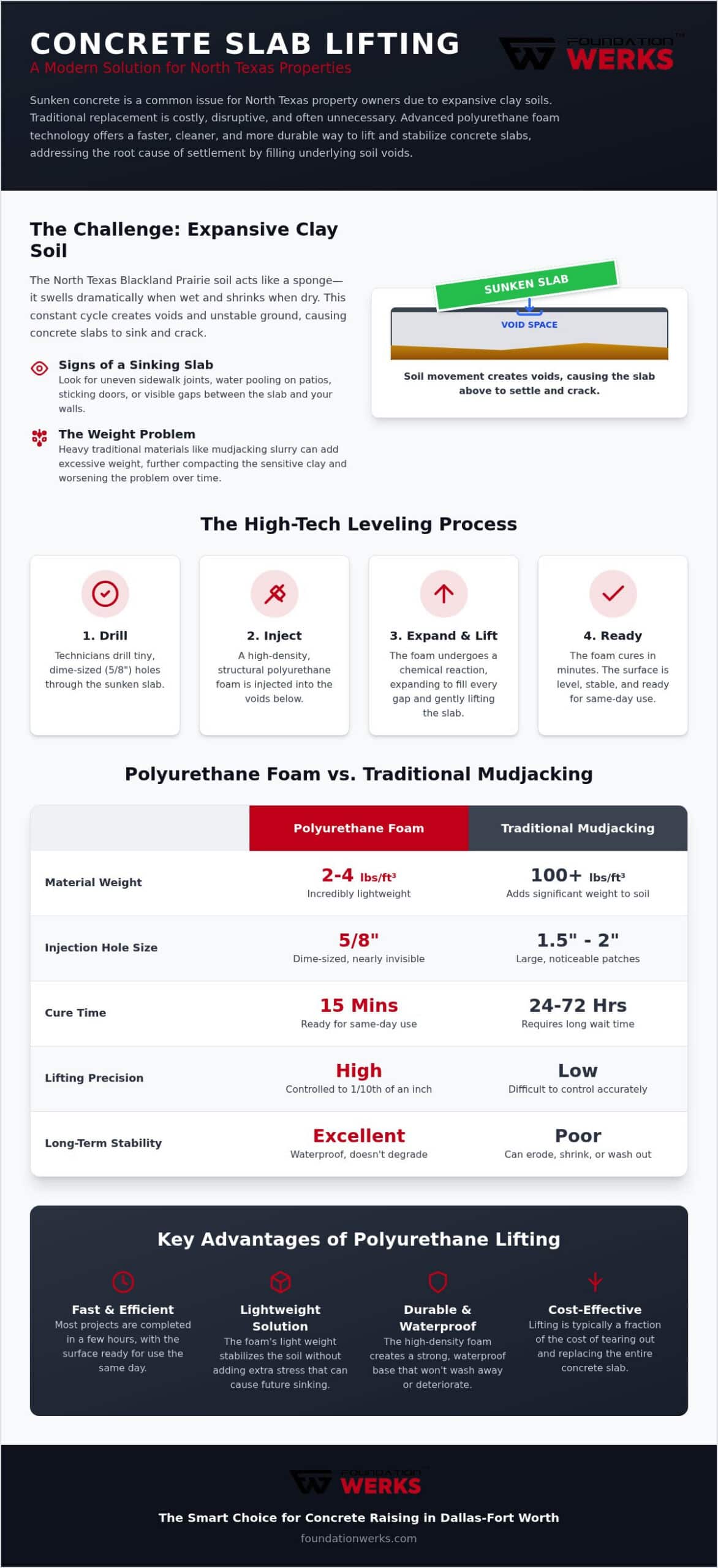
Our region sits on the Blackland Prairie, which is famous for its expansive clay soil. This soil acts like a sponge; it expands significantly when wet and shrinks when dry. This constant movement creates massive pressure and eventually leaves behind hollow pockets. In cities like McKinney and Dallas, traditional leveling materials like heavy mudjacking slurry often fail because they add too much weight to already unstable clay. Polyurethane foam is a better choice here. It’s incredibly light, meaning it fills the voids and lifts the slab without putting extra stress on the sensitive soil below.
Signs Your Slab Needs Leveling
You don’t always need a professional to tell you there’s a problem. Many signs are visible if you know where to look. We recommend checking your property for these common indicators:
- Uneven Joints: If one section of your sidewalk is higher than the next, it’s a clear sign of settlement.
- Water Pooling: Watch for areas where puddles form on your patio or driveway after a light rain.
- Sticking Doors: In rooms with slab-on-grade floors, doors that suddenly rub or won’t close properly often signal a shift in the floor’s level.
- Visible Gaps: Look for spaces opening up between your concrete slab and the baseboards or the exterior siding of your home.
Catching these symptoms early makes the repair process much simpler. It’s about maintaining the safety and value of your property before a small trip hazard turns into a major structural concern.
The Science of Polyurethane Foam Leveling
Modern concrete slab lifting North Texas properties rely on doesn’t involve heavy machinery or massive excavations. Instead, it uses a sophisticated injection process that begins with drilling small 5/8-inch holes into the sunken concrete. These holes are roughly the size of a dime, making them nearly invisible once the project is finished. Through these entry points, a specialized liquid polyurethane is injected directly beneath the slab.
Once the liquid reaches the soil, a chemical reaction occurs. The material expands into a rigid, structural foam that seeks out every empty pocket and crevice. As it expands, it exerts enough upward pressure to lift the concrete with incredible precision. This isn’t a guessing game; technicians can control the lift to within 1/10th of an inch of accuracy. This level of control is essential for ensuring that water drains away from your home and that trip hazards are completely removed. Unlike older methods, this foam is exceptionally durable. It’s engineered to never lose its density or break down, even when exposed to the harsh moisture cycles common in the Dallas-Fort Worth area.
For surfaces other than concrete, such as blacktop, gravel, or pavers, Foundation Werks employs specialized polyurethane injection techniques. These methods are designed to reach deeper into the soil layers, providing a stable and robust base where traditional methods might prove insufficient. It’s a targeted approach to address instability at its source, ensuring the ground can reliably support the weight of your vehicles or outdoor living spaces.
Void Filling and Stabilization
The secret to a successful repair isn’t just the lift itself. It’s the void filling under concrete slab surfaces that prevents the cycle of sinking from starting again. As the foam expands, it travels through the path of least resistance, filling the weakest points in the soil first. This creates a uniform, consistent support structure. According to the USDA Web Soil Survey, the soil profiles in North Texas are notoriously complex. By using a material that forms a strong chemical bond with the underside of the concrete, we ensure the slab stays put despite the shifting ground around it.
Minimal Impact, Maximum Precision
Property owners often choose this method because it protects the aesthetics of their pool decks and patios. Small injection holes are much easier to patch and blend than the large, unsightly holes required by mudjacking. We also take pride in being quietly innovative by using patented foam made from recycled, eco-friendly materials. This allows us to deliver a high-quality repair that is better for the environment. If you’ve noticed your sidewalk or patio starting to dip, our team can provide a quick assessment for concrete stabilizing to restore your property’s safety and curb appeal.
Polyurethane Foam vs. Traditional Mudjacking
When choosing a method for concrete slab lifting North Texas, property owners typically compare modern polyurethane foam with traditional mudjacking. The differences are significant. Mudjacking uses a heavy slurry of sand, soil, and cement to fill voids. This mixture weighs approximately 100 lbs per cubic foot. In contrast, high-density polyurethane foam weighs only 2 lbs per cubic foot. This weight difference is not just a technical detail; it is the primary reason foam has become the preferred choice for modern repairs.
Cleanliness and speed also set these methods apart. Mudjacking requires large, two-inch holes and often involves grout splatter that requires a heavy hose wash-down. Polyurethane injection is a much cleaner process with no messy runoff. The cure time is equally impressive. While mudjacking slurry can take days to fully harden, polyurethane foam reaches 90% of its structural strength in about 15 to 30 minutes. This allows you to use your driveway or warehouse floor almost immediately after the team finishes.
Why Weight is the Enemy in Dallas Soil
In the Dallas-Fort Worth area, the underlying soil is often soft, expansive clay. Adding 100 lbs of heavy mudjacking material on top of already struggling soil can be counterproductive. The sheer weight of the slurry can actually cause the slab to sink further into the clay over time. By using a lightweight foam, we provide a durable solution that doesn’t overload the ground. This is especially critical for warehouse floors and interior slabs where the soil load is a major concern. Reducing the weight on the underlying soil ensures a more reliable result that works with the local environment rather than against it.
The Cost-Benefit Analysis
Choosing concrete lifting instead of replacement typically saves property owners about 50% in total costs. Beyond the direct price of the repair, you have to consider the cost of lost time. For a local business or a busy warehouse, shutting down operations for several days to wait for new concrete or mudjacking slurry to dry is expensive. Polyurethane foam is also waterproof. Unlike soil-based mudjacking material, it will not wash out during the heavy rain cycles common in North Texas. This durability helps prevent the need for frequent re-leveling cycles, making it a smarter investment for your property’s future.
Preparing for Your Slab Leveling Project
Understanding the steps involved in concrete slab lifting North Texas property owners can take helps ensure a smooth experience. It starts with a simple visual inspection. You’ll want to identify which cracks are “active”, meaning they are still growing or shifting, versus those that have been dormant for years. Prioritizing repairs on active settlement areas prevents further damage to the surrounding structure before the problem expands.
Preparing your space is remarkably easy compared to the total demolition required for a new pour. In most cases, clearing the immediate work area of small items or light patio furniture is the only requirement. Because we don’t need heavy machinery on your lawn, you don’t have to worry about your landscaping being torn up or your irrigation lines being crushed by trucks.
On the day of your project, our crew arrives with a specialized injection system. The process is quiet and efficient. Most residential jobs are completed in just a few hours. Once the injection holes are patched and the area is swept, the space is ready for foot or vehicle traffic almost immediately. You won’t have to block off your driveway for days or find alternative parking.
Addressing the Root Cause: Drainage
Leveling the concrete is only one part of a long-term strategy for your property. To keep the soil stable, you must manage how water moves around the slab. Water pooling near an edge often leads to soil erosion, which creates the very voids that caused the sinking in the first place. This is why we often recommend a French drain installation or updated gutter systems alongside our leveling services. Consistent moisture management helps prevent the extreme shrink-swell cycle that plagues North Texas clay and keeps your concrete supported.
Commercial vs. Residential Considerations
Commercial clients have different priorities, often centered on safety and compliance. For those needing uneven warehouse floor repair Dallas facilities rely on, the focus is frequently on OSHA trip hazard compliance and loading dock stability. We work around your production schedule to minimize downtime. For residential homeowners, aesthetics are often the top concern. We take care to match our patchwork as closely as possible to your existing concrete for a clean, professional finish that restores your curb appeal.
Foundation Werks: The DFW Choice for Concrete Raising
Choosing a partner for concrete slab lifting North Texas properties requires a team that understands the unique challenges of our local environment. Foundation Werks serves the entire region, including Dallas, McKinney, and Frisco, with a focus on precision and property respect. We know that your home or business is a significant investment. That is why we have designed our process to be as non-invasive as possible. You won’t see heavy trucks rutting your lawn or massive equipment crushing your flower beds. Our delivery systems are streamlined, allowing us to reach your project with minimal impact on your landscaping.
One of the most significant advantages we offer is the immediate return to service. In a fast-paced area like DFW, you can’t afford to wait days for concrete to cure. Whether we are stabilizing a residential patio for a weekend barbecue or performing large-scale warehouse floor stabilization, the area is ready for use the same day. You can walk, drive, or play on your concrete within minutes of us finishing the job. This efficiency makes us a preferred choice for busy families and commercial facility managers who need results without the typical construction headache.
The Foundation Werks Difference
We believe in doing things the right way, which is why we use a patented, high-density polyurethane foam made from recycled materials. This eco-conscious approach provides a durable, lightweight solution that is better for the North Texas environment. Our crews are more than just technicians; they are knowledgeable professionals who treat every property with the care they would give their own homes. We prioritize transparency in everything we do. From our initial interaction to the final walkthrough, we provide clear communication and straightforward estimates for every residential and commercial project. We want you to feel empowered by the knowledge of how your repair works before we ever start the injection process.
Ready to Level Your Slabs?
Reclaiming your outdoor and indoor spaces shouldn’t be a stressful ordeal. Our 5/8-inch injection process is designed for minimal disruption to your daily schedule. We don’t just focus on a quick lift for aesthetic reasons. Our goal is long-term stabilization that addresses the underlying soil voids that caused the problem in the first place. By filling those hollow pockets with structural foam, we help protect your concrete from future settlement. If you are tired of looking at uneven joints or worrying about trip hazards, it’s time to take action. Contact Foundation Werks today to restore your driveways, sidewalks, and interior floors with the most advanced leveling technology available in 2026.
Take the Next Step Toward a Safer Property
Dealing with sunken concrete doesn’t have to be a source of stress or a drain on your finances. Modern polyurethane technology offers a way to stabilize your surfaces that is over 50% cheaper than traditional concrete replacement. You don’t have to worry about weeks of construction mess or heavy machinery damaging your lawn. By choosing a method that works with our local clay soil instead of against it, you can enjoy a level surface that’s ready to walk or drive on the same day.
When you’re ready to address those trip hazards or pooling water, look for a partner who understands the specific needs of our region. Our team provides expert concrete slab lifting North Texas residents rely on throughout McKinney, Dallas, and Frisco. We focus on delivering long-term stabilization that protects your investment and restores your peace of mind.
Your property deserves a solution that’s as efficient as it is effective. We look forward to helping you reclaim your space and making your concrete surfaces safe and functional once again.
Frequently Asked Questions
How long does polyurethane slab leveling last?
Polyurethane foam leveling typically provides a reliable solution for 10 to 15 years or more. Because the material is waterproof and does not degrade in moist soil, it tends to outlast traditional mudjacking slurry. Its longevity depends on the underlying soil stability and proper drainage management. While no geological solution is an eternal solution, this method offers one of the most durable ways to keep your concrete level.
Can you drive on a driveway immediately after it is leveled?
You can typically drive on your driveway just 15 to 30 minutes after the injection process is complete. The foam reaches nearly all its structural strength almost instantly. This is a major advantage over mudjacking, which often requires a 24 to 48 hour waiting period. It’s a perfect solution for busy households or commercial loading docks that cannot afford long periods of downtime.
Is polyurethane foam leveling safe for the environment?
Yes, the polyurethane foam we use is eco-friendly and made from recycled materials. Once the foam has expanded and cured, it becomes an inert solid that does not leach harmful chemicals into the North Texas soil. It’s a “green” alternative to replacing concrete, as it keeps old slabs out of landfills and reduces the carbon footprint associated with manufacturing and transporting new cement.
Will the foam lose density or wash away over time?
High-density polyurethane foam will not lose its density or wash away over time. It’s a closed-cell material that is completely waterproof, so it doesn’t erode during heavy rain or flood events. Unlike the soil and sand mixture used in mudjacking, this foam remains a rigid, structural solid that continues to support the weight of the slab regardless of moisture levels in the ground.
How large are the holes drilled into my concrete?
We only drill 5/8-inch holes into your concrete, which is roughly the size of a dime. These small entry points are far less invasive than the large two-inch holes required for traditional mudjacking. Once we finish the concrete slab lifting North Texas project, we patch the holes with a cementitious grout that blends with your existing surface. The result is a clean finish with minimal evidence of repair.
Can severely cracked slabs be leveled, or do they need replacement?
Severely cracked slabs can often be leveled if the individual pieces are still large enough to be lifted as units. However, if the concrete has crumbled into very small fragments or spider-webbed completely, replacement might be the more practical choice. We evaluate the structural integrity of each slab during our inspection to determine if concrete slab lifting North Texas services will provide the support you need.
Is slab leveling cheaper than pouring new concrete?
Slab leveling is significantly more affordable than pouring new concrete, typically saving property owners between 50% and 75% on total costs. You avoid the high expenses of demolition, hauling away old debris, and the labor required for a new pour. Because the process is so much faster, you also save on soft costs like lost access to your garage or business entrance.
What is the difference between slab leveling and structural foundation repair?
Slab leveling restores flat surfaces like driveways and patios, while structural foundation repair addresses the deep support beams of a building. If your home’s perimeter is sinking, you likely need piers. If your garage floor or sidewalk is dipping, you need slab leveling. We specialize in stabilizing these flatwork surfaces to ensure they remain safe and functional without the need for deep structural underpinning.