

What if the most significant threat to your facility’s structural integrity isn’t the visible wear on the surface, but the silent erosion happening beneath your feet? You likely recognize that maintaining heavy-load warehouse floors or high-traffic retail slabs requires constant vigilance against trip hazards and structural shifts. When soil washouts or poor compaction create hidden gaps, the need for concrete void filling commercial property managers can trust becomes a matter of urgent risk management.
We understand that your priority is protecting your ROI while avoiding the massive operational downtime that comes with traditional concrete replacement. You need a solution that works with your schedule, not against it. This article provides a comprehensive 2026 checklist designed to help you identify sub-slab instability, evaluate the extent of the damage, and resolve it using advanced polyurethane technology. We will explore how to achieve a stable, long-term resolution that keeps your business moving forward with minimal disruption and peak efficiency.
Key Takeaways
- Learn how to perform a comprehensive facility audit to detect “hollow” sounds and accelerating crack patterns before they lead to structural failure.
- Understand why high-density polyurethane is the industrial standard for its exceptional weight-to-strength ratio and high load-bearing capacity.
- Discover how to minimize operational disruptions with advanced injection methods that allow for a full traffic return in as little as 15 to 30 minutes.
- Identify the specific criteria for selecting a specialized partner for concrete void filling commercial property projects, ensuring they understand complex soil dynamics.
- Gain a clear roadmap for achieving a stable, long-term resolution for sunken slabs that prioritizes both structural integrity and cost-effectiveness.
Facility Audit Checklist: Identifying Critical Voids and Settlement Signs
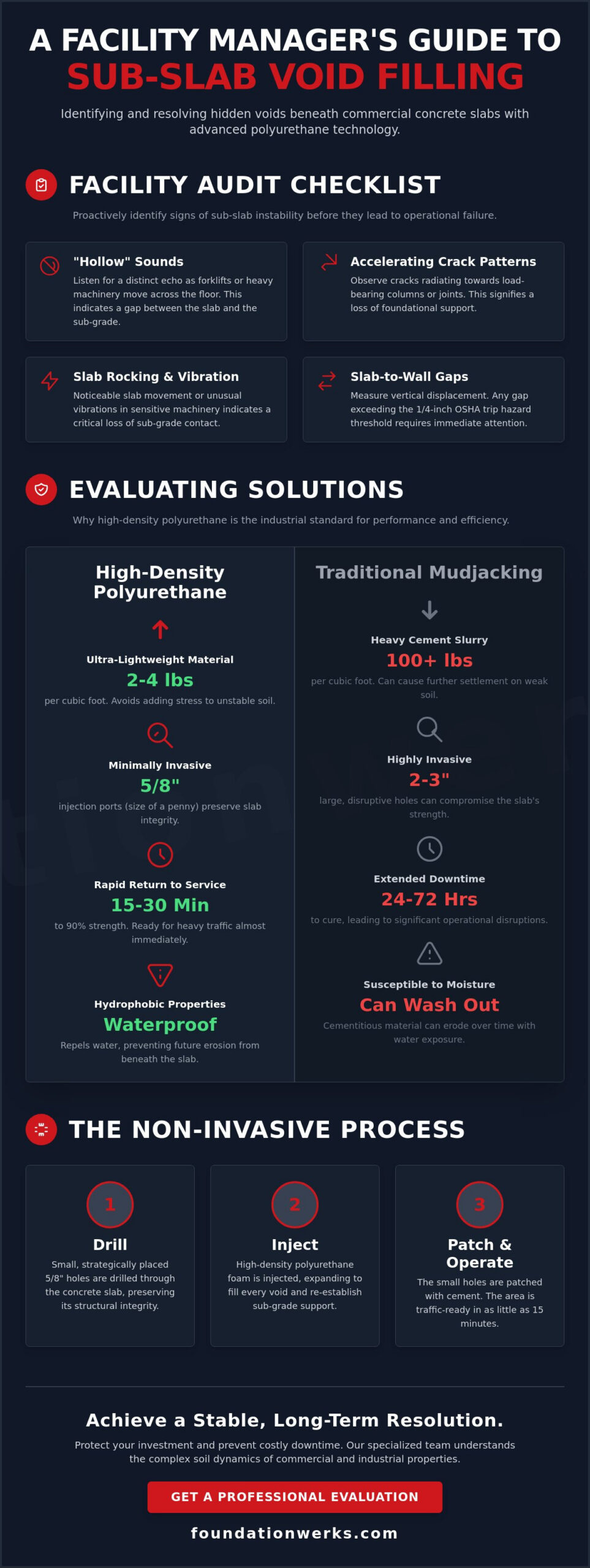
Proactive facility maintenance begins with understanding what lies beneath your floor. Identifying sub-surface instability early can save your business from the logistical nightmare of a full slab collapse. When performing a routine walk-through, listen for a distinct “hollow” echo as heavy machinery or forklifts traverse specific sections. This sound is a primary indicator that the soil has shifted, creating a gap that requires professional concrete void filling commercial property owners can rely on for structural support.
To better understand how these sub-slab gaps are addressed using modern methods, watch this helpful video:
Documenting your findings is essential for a precise evaluation. Pay close attention to accelerating crack patterns that radiate toward load-bearing columns or expansion joints. These fractures aren’t just cosmetic; they signify that the slab is no longer supported by the sub-grade. By understanding various concrete leveling techniques, you can better assess if the movement is localized or systemic. Don’t ignore pooling water near your foundation after a storm. This often points to drainage failures that wash away the very soil meant to hold your building up. Finally, use a feeler gauge to measure slab-to-wall gaps. Any vertical displacement exceeding the 1/4-inch OSHA trip hazard threshold requires immediate stabilization.
Visual Indicators of Sub-Slab Erosion
Keep an eye on your building’s exterior facade. “Stair-step” cracking in brickwork adjacent to concrete slabs is a classic sign of settlement. In North Texas, our intense rain cycles frequently cause soil to wash out from beneath slab edges. If you can see daylight under the concrete in your loading docks or warehouse perimeters, the erosion has already reached a critical stage. Identifying these signs early allows for targeted concrete void filling commercial property applications before the damage necessitates a total replacement.
Operational Warning Signs in Industrial Settings
Your daily operations often reveal what a static inspection misses. Monitor for “slab rocking,” where the concrete moves visibly under the weight of a loaded forklift. This lack of sub-grade support puts immense stress on the slab’s tensile strength. Misaligned overhead dock doors or interior doors that suddenly jam also suggest uneven settlement. Additionally, if sensitive machinery begins experiencing unusual vibration levels, it may be due to a loss of solid foundation contact. These operational hiccups are often the final warning before a more significant structural failure occurs. To better understand why these dangerous gaps develop beneath your floors, review our detailed resource on void filling under concrete slab surfaces in North Texas, which explains the unique role of expansive clay soils in accelerating sub-grade erosion.
Evaluating Void Filling Solutions: Why Polyurethane is the Industrial Standard
Selecting the right material for sub-slab stabilization is a decision that impacts your facility’s long-term operational health. While various methods exist, high-density polyurethane has emerged as the industrial gold standard for concrete void filling commercial property managers who value both efficiency and structural integrity. This material offers an exceptional weight-to-strength ratio. It provides massive load-bearing capacity without adding significant weight to already stressed or unstable soils.
The injection process is remarkably non-invasive. We use small 5/8-inch holes, roughly the size of a penny, to deliver the foam. This preserves the structural integrity of your existing slab, unlike the large, disruptive holes required by older methods. Speed is another critical factor for your bottom line. Polyurethane reaches 90% of its full compressive strength within 15 to 30 minutes. This allows for an almost immediate return to service for heavy forklift traffic and daily operations. Because the foam is hydrophobic, it repels water and maintains its form even in the high-moisture environments typical of North Texas.
Polyurethane vs. Traditional Mudjacking
Traditional mudjacking uses a heavy cementitious slurry that weighs approximately 100 lbs per cubic foot. In the expansive clay soils of North Texas, this added weight often triggers secondary settlement, essentially worsening the problem you’re trying to solve. Polyurethane is significantly lighter and won’t compress the sub-grade further. The process is also far cleaner. There’s no messy slurry or large-scale wash-down required, making it ideal for sensitive warehouse or retail environments. For facilities dealing with recurring floor movement, learning about concrete slab stabilization Dallas professionals recommend can help you understand the full range of advanced solutions available. If you’re concerned about the stability of your facility’s floors, exploring professional stabilization options can provide the clarity you need.
The Sustainability Factor: Eco-Conscious Stabilization
Modern stabilization isn’t just about strength; it’s about responsibility. Our advanced foams are often formulated using recycled materials, helping property managers meet their corporate ESG goals. By opting for void filling instead of a full tear-out, you’re significantly reducing the carbon footprint associated with concrete production and disposal. This approach provides a stable, long-term resolution that respects both your budget and the environment. It’s a forward-thinking choice that prevents unnecessary material waste while securing your property’s foundation.
Implementation Checklist: Choosing a Specialized Partner in North Texas
Selecting a contractor for concrete void filling commercial property needs requires more than a casual reference check. You need a specialist who understands the extreme volume changes in North Texas clay. Verify that your chosen partner focuses on industrial-grade polyurethane applications rather than just residential sidewalk leveling. Commercial slabs supporting heavy racking or high-frequency forklift traffic demand higher-density foams and more precise injection patterns than a simple driveway. A provider with a proven track record in the Dallas-McKinney area will be familiar with the local soil dynamics that lead to sub-slab erosion. For a deeper look at how these regional soil conditions specifically drive the need for professional void filling under concrete slab foundations, our North Texas guide covers the technical details every property manager should know.
A reputable provider should offer a comprehensive site assessment before any work begins. This evaluation must include a review of current drainage patterns and soil conditions specific to your facility’s location. Ask about their specialized equipment. Precision lifting requires high-output proportioners and laser-leveling tools to ensure the slab returns to its optimal grade without over-stressing the concrete. Choosing a partner who prioritizes these technical details ensures a high-quality, stable outcome for your facility.
Minimizing Operational Downtime
Logistics are the lifeblood of your facility. To avoid revenue loss, request a “night or weekend” work schedule. This ensures zero disruption to your peak logistics hours. You should also confirm the specific cure time of the material. High-traffic warehouse floors should be ready for heavy loads in under an hour. For more detailed help on coordinating these repairs, consult our Warehouse Floor Stabilization Guide to streamline your logistics planning.
Long-Term Maintenance and Drainage Integration
Stabilization is most effective when you address the root cause of the void. Evaluate if the initial erosion was caused by poor site drainage. In many cases, a French drain installation is required alongside the repair to prevent water from undermining the sub-grade again. We recommend scheduling annual inspections of high-load areas to catch minor settlement before it becomes a major structural liability. Coupling your repair with professional joint sealing creates an extra layer of protection, preventing water from infiltrating the newly stabilized soil. This holistic approach ensures a stable, long-term resolution that protects your property and your bottom line.
Securing Your Facility’s Future with Precision Stabilization
Maintaining the structural integrity of your warehouse or retail space requires more than just reactive repairs. By utilizing a rigorous facility audit and choosing high-density polyurethane, you ensure your floors can withstand the rigorous demands of heavy industrial traffic. This modern approach to concrete void filling commercial property managers prefer offers a stable, long-term resolution without the massive disruption of traditional replacement. It’s a strategic investment in the longevity of your facility.
Foundation Werks specializes in Dallas-area commercial foundation stabilization, utilizing a patented eco-friendly foam made from recycled materials. Our process is engineered for minimal downtime; high-traffic industrial facilities can often return to full operation in less than sixty minutes. We understand the unique challenges of North Texas soil and provide the technical precision required for complex industrial environments. This ensures your sub-grade remains supported even under the heaviest loads.
Request Your Professional Commercial Site Assessment from Foundation Werks
Taking a proactive step today protects your structural ROI and ensures your business operations remain smooth, safe, and efficient for the long haul. Your property deserves the reliability that only advanced stabilization technology can provide. We look forward to helping you achieve a level, secure foundation for your business’s future.
Frequently Asked Questions
How long does concrete void filling take for a commercial property?
Most commercial projects are completed in a single day, often within just a few hours. This is a primary benefit of choosing polyurethane for a concrete void filling commercial property project. Unlike traditional concrete replacement, which requires days for demolition and weeks for curing, our process allows you to return to full operations almost immediately after we finish the injection.
Is polyurethane foam strong enough to support heavy warehouse machinery and forklifts?
High-density polyurethane is engineered specifically to handle the extreme compressive loads found in industrial environments. It provides massive load-bearing capacity that easily supports heavy racking, sensitive machinery, and constant forklift traffic. The material is strong enough to stabilize the slab while remaining lightweight, ensuring it doesn’t cause secondary settlement in the underlying soil.
Can we continue business operations while the void filling is being performed?
Business operations can typically continue as normal because the process is remarkably non-invasive and quiet. The injection equipment has a small footprint, so we don’t need to block off large warehouse aisles or retail sections. Since the foam reaches 90% of its full strength in 15 to 30 minutes, your team can resume heavy traffic over the treated area almost instantly.
What causes voids to form under commercial concrete slabs in North Texas?
Voids in North Texas are usually caused by the region’s expansive clay soils and intense seasonal moisture cycles. Heavy rain can wash away sub-grade material, while long periods of drought cause the clay to shrink and pull away from the slab. Over time, these gaps are worsened by the vibration and weight of heavy vehicles, which force the concrete to flex into the empty space.
Is void filling with polyurethane more cost-effective than concrete replacement?
Polyurethane injection is significantly more cost-effective than a full tear-out and replacement. You avoid the high costs of demolition, debris removal, and new material pours, which are often double or triple the price of stabilization. It’s a strategic way to achieve a stable, long-term resolution for your concrete void filling commercial property needs without the massive operational downtime of new construction.
How long will the stabilization last after the foam is injected?
The stabilization provided by high-density foam is designed for exceptional longevity and durability. Because the material is hydrophobic, it won’t wash away during future floods or degrade when exposed to moisture. It provides a reliable, steady foundation that remains effective for many years, helping you avoid the cycle of repetitive repairs and protecting your facility’s structural ROI.