

Did you know that the average direct cost for a single trip-and-fall injury on a commercial property has climbed to approximately $42,000? For many North Texas business owners, a small shift in a sidewalk slab feels like a ticking financial time bomb. You likely already know that proactive trip hazard removal for business is a top priority. However, the thought of closing your doors for a week to rip out and replace concrete is a logistical nightmare you’d rather avoid.
This guide explains how to eliminate dangerous offsets quickly and cost-effectively using modern polyurethane technology. We’ll show you how to achieve ADA compliance and restore your surfaces without the mess of traditional demolition. You’ll learn why high-density foam is the preferred choice for stabilizing volatile clay soils, how to meet 2026 OSHA standards, and the specific steps to get your property back to full service the same day. By the end of this article, you’ll have a clear roadmap for maintaining a safe, level property while protecting your bottom line from expensive liability claims.
Key Takeaways
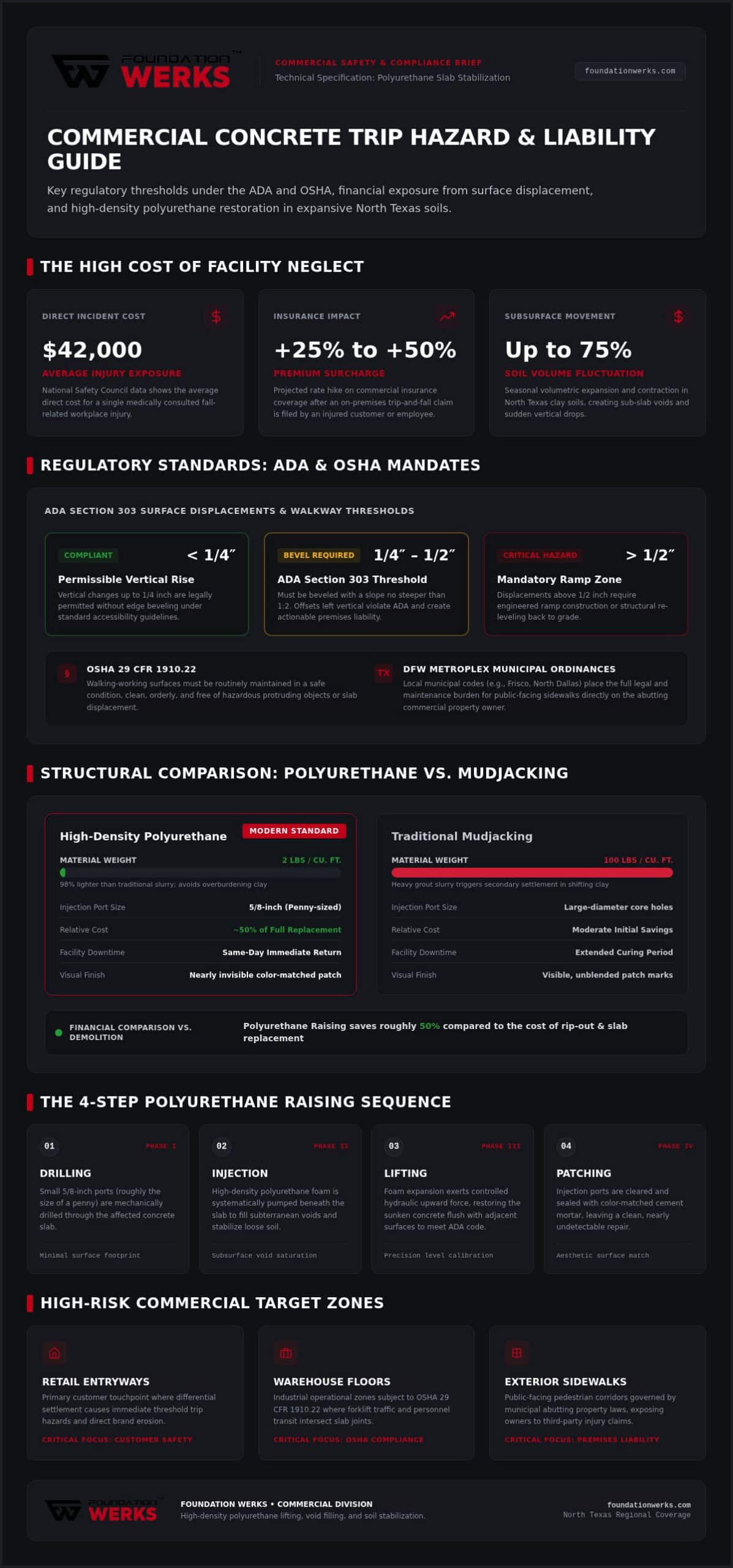
- Understand the ADA “1/4-inch rule” and why ignoring minor vertical offsets can lead to premises liability claims averaging $42,000.
- Discover why polyurethane concrete raising is the modern standard for trip hazard removal for business, offering a solution that costs roughly half as much as full slab replacement.
- Learn why lightweight, eco-friendly foam is superior to heavy mudjacking for stabilizing slabs without adding excessive weight to volatile North Texas soils.
- Identify high-traffic liability zones, from warehouse floors to retail entryways, and see how to restore them for immediate use the same day.
- See how small 5/8-inch injection holes provide a nearly invisible repair that maintains your property’s curb appeal while ensuring safety and compliance.
Protecting Your Business: The High Cost of Concrete Trip Hazards
North Texas clay soil is notorious for shifting under pressure. When these heavy slabs move, they create vertical offsets that catch the toes of unsuspecting customers. The Americans with Disabilities Act (ADA) is very specific about these changes: any vertical rise of 1/4 inch or more is considered a trip hazard. For a business owner, this isn’t just a minor maintenance issue. It’s a significant legal liability that can jeopardize your entire operation. Proactive trip hazard removal for business is the most effective way to shield your company from premises liability claims that often reach tens of thousands of dollars.
The financial impact of a single accident is staggering. According to the National Safety Council, the average direct cost for a medically consulted fall-related workplace injury is approximately $42,000. In the DFW metroplex, local ordinances often place the full burden of sidewalk maintenance on the abutting property owner. If a pedestrian trips on a sunken slab outside your storefront in Frisco or North Dallas, you’re potentially responsible for medical bills, legal fees, and settlement costs. Ignoring a 1/4-inch offset today can lead to a massive financial drain tomorrow.
To better understand how these hazards manifest in a commercial setting, watch this helpful video:
Understanding ADA and OSHA Requirements
Compliance with federal standards is a baseline requirement for any commercial facility. Under ADA Section 303, vertical surface displacements between 1/4 inch and 1/2 inch must be beveled, and anything higher requires a ramp. OSHA 29 CFR 1910.22 further mandates that walking-working surfaces be maintained in a safe condition, free of protruding objects or hazardous holes. Many facility managers now utilize modern concrete leveling techniques to lift these slabs back to their original position. This method ensures you meet regulatory standards quickly without the noise and debris associated with traditional demolition.
The Hidden Costs of Property Neglect
Neglecting your walkways carries costs that don’t always appear on a balance sheet immediately. Uneven concrete damages your brand reputation. Customers notice shifted entryways, and it often signals a lack of attention to detail. Additionally, the soil erosion causing these gaps is a progressive problem. North Texas clay can expand and contract by up to 75% in volume between seasons. If you don’t stabilize the underlying voids now, the slabs will continue to sink. This neglect also catches the eye of insurance providers, who may increase your premiums by 25% to 50% following a reported injury claim.
Polyurethane Foam Injection: The Modern Standard for Hazard Removal
Traditional methods like grinding leave ugly scars on your walkways, while full replacement is a slow, disruptive process. Polyurethane concrete raising offers a cleaner path forward for commercial facilities. The process follows a non-invasive four-step sequence: drilling, injection, lifting, and patching. This streamlined approach to trip hazard removal for business ensures your facility stays operational without the mess of heavy machinery. Unlike traditional mudjacking which uses heavy grout slurries weighing 100 lb per cubic foot, our high-density foam weighs only 2 lb per cubic foot. This is vital in North Texas, where adding excessive weight to expansive clay often triggers more sinking later.
Aesthetics matter for commercial properties and retail store fronts. We use 5/8-inch drill holes, which are roughly the size of a penny. Once these ports are patched with color-matched cement, they are nearly invisible to the casual observer. This allows you to maintain ADA floor and ground surface standards without the patchwork look of large-diameter mudjacking holes or the gouges left by grinding. You get a level surface that looks professional and clean, protecting both your customers and your brand image.
The Science of High-Density Polyurethane
The foam expands rapidly upon injection, filling every subterranean void before lifting the slab with surgical precision. Because it’s a closed-cell material, it never loses density and won’t leach into the water table or erode over time. It’s specifically engineered to withstand the heavy loads of warehouse forklifts and delivery trucks. For larger areas like parking lots or loading docks, specialized deep-injection techniques are applied. This process injects foam deeper into the subgrade to compact weak base soils, providing a stable foundation for heavy commercial traffic. If you’re noticing uneven slabs in high-traffic areas, you can request a commercial evaluation to see if foam injection is the right fit for your property.
Eco-Friendly and Sustainable Solutions
Choosing the right method for trip hazard removal for business shouldn’t mean compromising on environmental values. Our foam is a patented material made from recycled components, making it an ideal choice for businesses pursuing green building initiatives or LEED certification. By choosing to raise existing concrete instead of tearing it out, you significantly reduce the carbon footprint of your maintenance project. There’s no need for heavy haul-away trucks or the massive energy consumption required to produce new ready-mix concrete. Foundation Werks prioritizes these eco-conscious methods because they deliver high-quality results while respecting the local DFW environment. It’s a responsible way to manage infrastructure without unnecessary waste.
Concrete Raising vs. Grinding vs. Replacement: A ROI Comparison
Choosing the right method for trip hazard removal for business is ultimately a financial decision based on return on investment. You have to weigh the upfront price against long-term durability and operational downtime. Polyurethane raising typically costs about 50% less than full replacement. This cost efficiency comes from avoiding heavy demolition and the disposal fees associated with hauling old concrete to a landfill. Beyond the invoice, you must consider the speed of the repair. While new concrete requires a 7-day cure time before heavy traffic, foam-treated slabs are ready for use immediately after completion.
The lack of disruption is a major advantage for high-traffic facilities. Foam injection requires no heavy machinery that might damage your landscaping or crack adjacent slabs. It’s a clean, quiet process that allows your facility to remain compliant with OSHA walking-working surface regulations without shutting down operations for a week. By restoring the original slab to its proper grade, you preserve the professional look of your property while ensuring safety for every visitor.
Why Replacement is Often the Last Resort
Replacement is a heavy-handed solution that often creates more problems than it solves. It involves jackhammers, silica dust, and heavy trucks that can tear up your parking lot or lawn. There is also the aesthetic ‘checkerboard’ effect to consider. New concrete rarely matches the weathered color of your existing slabs, leaving your entryway looking like a patchwork quilt. For high-traffic areas like loading docks or main entrances, the true cost of replacement is the lost revenue while the area is cordoned off for pouring and curing.
The Problem with Concrete Grinding
Grinding is often marketed as a quick fix, but it has significant structural drawbacks. It removes the hardened, cured top layer of the concrete, exposing the coarse aggregate underneath. This leaves unsightly scars and gouges that can’t be easily hidden. More importantly, grinding only addresses the surface height. It does nothing to solve the underlying need for void filling under concrete slab that caused the settlement in the first place. By thinning the slab, you actually increase the risk of future cracks and structural failure under heavy commercial wheel traffic. Grinding essentially treats the symptom while allowing the disease of soil erosion to continue unchecked.
Identifying High-Risk Zones in Your North Texas Facility
North Texas is home to some of the most volatile soil in the country. In McKinney and Dallas, the high-plasticity "black gumbo" clay can expand and contract by 30% to 75% in volume depending on the weather. During a drought, the soil shrinks away from the edges of your slabs. When the rains return, water fills those gaps and erodes the base. This cycle creates subterranean voids that lead to sudden settlement. Identifying these zones early is the first step in effective trip hazard removal for business. You can’t just look at the surface; you have to understand what’s happening underneath to prevent future movement.
Entryways and ADA ramps are the most critical areas for inspection. These are high-traffic zones where even a minor 1/4-inch shift creates a significant liability. A sunken ramp transition doesn’t just fail ADA compliance; it actively endangers visitors using wheelchairs or strollers. Parking lots also present unique risks, especially at the transitions between asphalt and concrete curbs. These "step hazards" are often overlooked until a customer reports an injury, making regular walk-throughs a vital part of your facility management routine.
Warehouse and Industrial Floor Safety
Inside the facility, the risks shift from pedestrian trips to equipment failure. Uneven joints in a warehouse floor are more than just a nuisance. They cause repetitive impact damage to forklift tires and sensitive electronic components. Over time, these jolts lead to worker fatigue and increased maintenance costs for your fleet. Utilizing warehouse floor joint repair Dallas services allows you to stabilize these joints before they lead to a workplace accident. We focus on stabilizing voids under heavy machinery pads to ensure your equipment operates on a level, vibration-free surface.
Exterior Walkways and Parking Areas
Exterior slabs face the brunt of the Texas elements. Poor drainage is the leading cause of sunken sidewalks. When water pools near a building’s foundation, it saturates the soil and weakens the support for the concrete above. You’ll often see the first signs of trouble at curb transitions or where two different pours meet. Addressing these issues early with concrete crack repair commercial prevents moisture from reaching the subgrade. By sealing these entry points and lifting sunken panels, you stop the erosion cycle and extend the lifespan of your existing concrete surfaces.
Same-Day Hazard Resolution with Foundation Werks
Foundation Werks understands the unique challenges of the DFW Metroplex. From the expansive clay in McKinney and Frisco to the high-traffic retail corridors of Dallas, we’ve developed a streamlined approach for trip hazard removal for business. Our goal is to provide a durable restoration that addresses underlying soil issues without disrupting your daily operations. We focus on providing long-term stability and structural support. Given the dynamic nature of shifting Texas soil, our polyurethane methods are engineered to withstand heavy commercial use for years to come. We prioritize a methodical approach that respects your property and your time.
The process is designed for maximum efficiency and minimal site impact. Unlike traditional mudjacking, which often leaves a mess of grout splatter and requires heavy machinery, our polyurethane equipment is self-contained and clean. We don’t bring heavy trucks onto your lawns or sensitive landscaping. Because the eco-friendly foam cures within minutes, your facility stays open for business. You won’t have to cordon off main entrances or loading docks for days, saving you from the indirect costs of lost foot traffic or shipping delays. This efficiency allows you to maintain compliance with safety standards while keeping your revenue streams active.
What to Expect During Your Repair
Our team arrives with a service-first heart, acting as educators rather than just contractors. We explain each step of the process so you understand exactly how your concrete is being stabilized. The injection process is surprisingly quiet and non-invasive, making it an ideal choice for trip hazard removal for business because it minimizes site impact. This allows your customers to continue their shopping or dining experience as usual. In most cases, pedestrians can walk on the concrete panels while our technicians are actively working. We take pride in our punctuality and our commitment to leaving your property cleaner than we found it. Once the small 5/8-inch injection holes are patched, the repair is nearly invisible, maintaining the professional curb appeal of your facility.
Getting Started with a Free Estimate
Every project begins with a comprehensive evaluation of your slab health and underlying soil stability. We don’t believe in one-size-fits-all answers. Our technicians use specialized tools to identify voids and measure the precise amount of lift required to bring your surfaces back to grade. If your property requires additional drainage solutions like French drain installation to manage runoff, or commercial concrete crack and joint repairs to seal out moisture, we’ll include those in your customized plan. Our experts are available to walk you through the technical details and provide transparent information before you make a commitment. You can reach the Foundation Werks team at 800-464-9684 to schedule your assessment and take the first step toward a safer, compliant property.
Securing Your Property and Protecting Your Bottom Line
Managing a commercial facility in North Texas comes with unique structural challenges. Ignoring sunken concrete increases your risk of costly lawsuits and regulatory fines. Choosing professional trip hazard removal for business allows you to address these risks before they escalate into financial disasters. By opting for polyurethane raising, you benefit from patented eco-friendly foam technology that stabilizes the soil without the mess or disruption of traditional demolition.
This method typically provides 50% savings compared to full slab replacement while offering immediate same-day usability. You don’t have to sacrifice your schedule or your budget to maintain a safe, compliant environment for your customers and employees. Taking a proactive approach to surface safety is a smart investment in your property’s long-term health and your brand’s reputation.
Schedule Your Free Commercial Trip Hazard Evaluation
We’re here to help you navigate these repairs with confidence and clarity. Let’s work together to make your business property safer today.
Frequently Asked Questions
How quickly can my customers use the sidewalk after trip hazard removal?
Your customers can use the sidewalk immediately after we finish the job. Unlike new concrete that requires a week of curing, polyurethane foam reaches 90% of its full strength within minutes. This speed is a major benefit for trip hazard removal for business because it prevents costly downtime. You won’t need to cordon off your main entrance or redirect foot traffic for days; the surface is ready for full service as soon as our crew packs up.
Is polyurethane concrete raising cheaper than replacing the slab?
Polyurethane concrete raising typically costs about half of what you would pay for full slab replacement. You save money by avoiding the high costs of demolition, hauling away old concrete, and the labor required for a new pour. Since our process is less invasive and requires fewer crew members, we pass those efficiencies on to you. It’s a cost-effective way to restore property safety and maintain ADA compliance without straining your maintenance budget.
Will the foam lose density or sink again over time?
The high-density polyurethane foam we use never loses its density or structural integrity over time. Once injected, the material remains stable and won’t leach into the soil or erode due to moisture. This material provides a highly durable, long-term solution for sunken slabs. It addresses the underlying voids and provides a stable foundation that resists the typical settling seen with heavier mudjacking slurries, ensuring your walking surfaces remain level for years.
How large are the holes drilled into my commercial concrete?
We drill small 5/8-inch holes, which are roughly the size of a penny. This is significantly smaller than the large 1-to-2-inch holes required for traditional mudjacking. Because the holes are so small, we can often place them in more strategic locations with minimal impact on the concrete’s appearance. After the lift is complete, we patch the holes with color-matched cement, making the repair nearly invisible to your customers and maintaining your property’s professional aesthetic.
Does your process work for warehouse floors with heavy forklift traffic?
Yes, our process is specifically engineered to handle the heavy loads found in industrial environments. The high-density foam provides the compressive strength needed to support forklift traffic and heavy machinery without cracking or shifting. We often use this technology for warehouse floor stabilization and joint repair in the DFW area. By filling the voids beneath the panels, we eliminate the "rocking" effect that damages forklift tires and endangers your warehouse staff during daily operations.
What causes concrete to sink and create trip hazards in the DFW area?
Concrete settlement in North Texas is primarily caused by expansive clay soils, often called "black gumbo." These clays expand significantly when wet and shrink during our hot, dry summers, leaving large voids beneath your slabs. When heavy rain eventually returns, it washes away the uncompacted base material, causing the concrete to sink under its own weight. This cycle is why trip hazard removal for business is such a common necessity for facilities in Dallas, Frisco, and McKinney.
Can you fix severely cracked concrete slabs with foam injection?
We can raise and stabilize most solid concrete slabs, but severely cracked or shattered sections may require replacement. If the concrete is broken into many small pieces, the foam cannot lift the section as a single unit. However, we can often stabilize the soil beneath those cracks to prevent further sinking. During your free commercial evaluation, our team will inspect the structural integrity of your concrete to determine if raising is a viable option for your specific hazard.
Is the polyurethane foam used for lifting eco-friendly?
Our polyurethane foam is an eco-conscious choice for commercial property managers. We use a patented material made from recycled components that won’t leach harmful chemicals into the North Texas water table. Because we raise existing concrete instead of tearing it out, your project significantly reduces waste sent to local landfills. It also avoids the high carbon footprint associated with new concrete production. Foundation Werks prioritizes these recycled materials to help DFW businesses maintain infrastructure responsibly.