

What if your warehouse floor is quietly costing you more in forklift repairs and OSHA fines than the actual price of a professional repair? It’s a common frustration for facility managers in the Dallas-Fort Worth area. You see the uneven joints and the rocking racks, but the thought of shutting down operations for a week to pour new concrete feels impossible. We understand that in an industry where net absorption is hitting record highs, every hour of downtime is a hit to your bottom line.
This guide explores how modern concrete floor leveling for warehouses has evolved to meet today’s rigorous demands. We’ll show you how polyurethane injection offers a durable resolution that supports heavy traffic the same day. You’ll learn how to meet the strict 2026 OSHA National Emphasis Program standards for walking-working surfaces while saving nearly half the cost of replacement. We’re diving into the technical side of sub-slab stabilization and why tiny 5/8-inch holes are the secret to a level, stable facility.
Key Takeaways
- Identify critical liabilities and learn to meet the updated 2026 OSHA safety standards for industrial walking-working surfaces.
- Discover why lightweight polyurethane injection is the superior choice for concrete floor leveling for warehouses, preventing the secondary sinking caused by heavy mudjacking.
- Achieve a long-term solution at roughly half the cost of concrete replacement while avoiding the lengthy 28-day cure times of new pours.
- Minimize facility downtime with a precision leveling process that uses 5/8-inch injection ports and allows for heavy machinery use the same day.
- Learn how DFW’s expansive clay soils affect industrial foundations and why professional stabilization is necessary for warehouse floor longevity.
Why Uneven Warehouse Floors Are a Critical Liability
An uneven floor is more than a nuisance; it’s a silent budget killer. When a warehouse slab sinks, it creates a “step” at the joint. These transitions might seem minor, but for a facility running three shifts, the cumulative impact is massive. Concrete floor leveling for warehouses isn’t just about aesthetics. It’s about stopping a cycle of damage that starts with a tiny void and ends with a failed floor system. If you ignore the root cause, the movement will eventually lead to deep cracks and joint spalling that require much more expensive interventions later.
Many facility managers try to solve the problem with surface patching. While a quick layer of epoxy or mortar might smooth the surface, it’s often a temporary band-aid. It doesn’t address the structural void beneath the concrete. Over time, heavy forklift traffic will crush the patch or cause the slab to sink further. Understanding different concrete leveling methods is essential for choosing a durable resolution that actually stabilizes the subgrade rather than just hiding the symptom.
The Safety and OSHA Factor
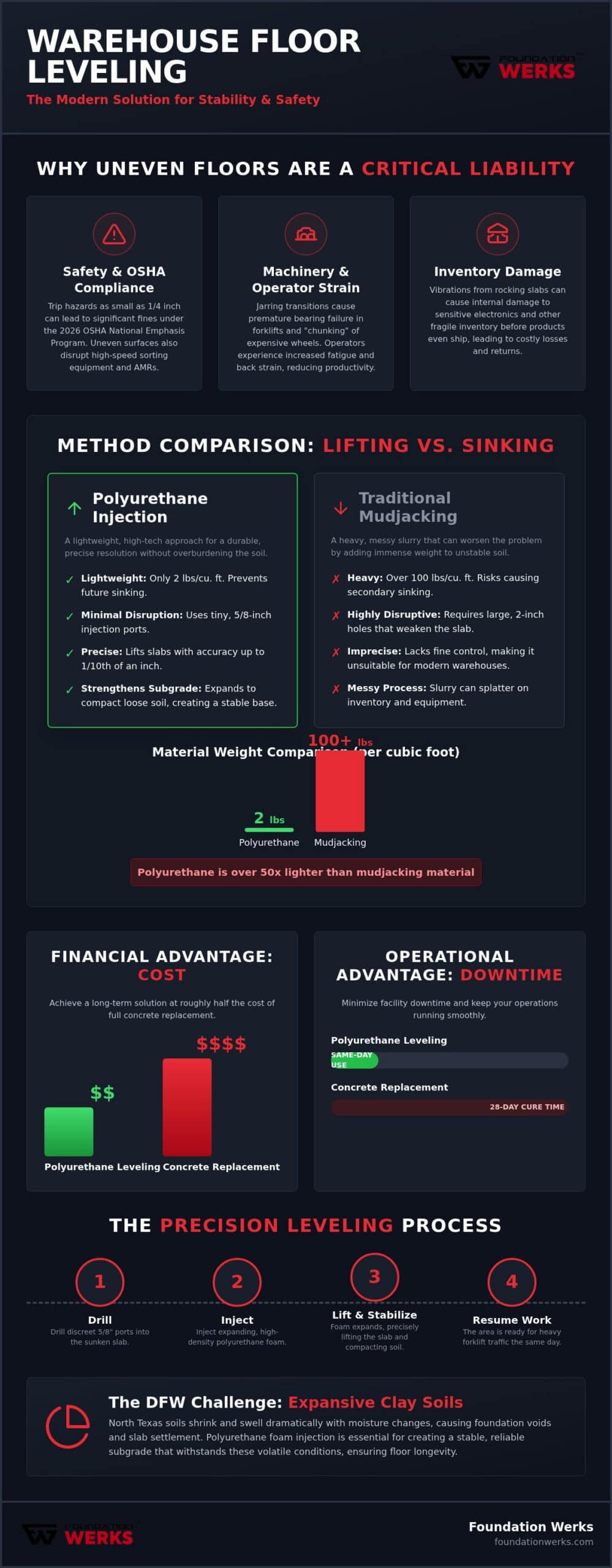
Safety is the most immediate concern for any modern operation. Under the 2026 OSHA National Emphasis Program for Warehousing, inspectors are specifically targeting walking-working surfaces. A trip hazard as small as a quarter inch can trigger significant fines and liability. Beyond compliance, uneven floors are a nightmare for high-speed picking and sorting equipment. Autonomous mobile robots (AMRs) require precise floor levelness to navigate without error. Proactive stabilization protects your team from injury claims and maintains your facility’s market value in a competitive DFW landscape.
Impact on Warehouse Machinery
Your forklifts feel every bump. When a loaded lift hits an uneven joint, the force travels directly into the drive axle and tires. This leads to premature bearing failure and “chunking” of expensive polyurethane wheels. It’s not just the machines that suffer. Operators experience increased fatigue and back strain from jarring transitions. This physical toll can lead to slower pick rates or increased turnover. If you’re moving sensitive electronics or fragile inventory, vibrations from a rocking slab can cause internal damage before the product even leaves the dock. Stabilizing these slabs ensures your equipment lasts longer and your team stays productive.
Polyurethane vs. Mudjacking: Choosing the Right Leveling Method
Choosing the right material for concrete floor leveling for warehouses often comes down to a simple math problem: weight. Traditional mudjacking uses a heavy slurry of sand, soil, and cement that weighs roughly 100 pounds per cubic foot. In contrast, high-density polyurethane foam weighs only about 2 pounds per cubic foot. This 1/50th weight difference is a game changer for industrial facilities. Pumping tons of heavy grout onto unstable soil often triggers secondary sinking, as the subgrade simply cannot support the added mass. By using lightweight foam, we lift the slab without overburdening the very ground that failed in the first place.
Precision is another area where modern foam excels. Technicians can control the chemical expansion to lift a slab within 1/10th of an inch of the target height. This is essential for meeting the strict floor flatness requirements of 2026 automated warehouses. Our process also uses a patented, eco-conscious foam made from recycled materials. This allows your facility to maintain its sustainability goals while achieving a durable resolution for failing floors.
The Problem with Heavy Mudjacking
North Texas is known for expansive clay soils that shrink and swell with moisture changes. When you inject heavy mudjacking grout into these volatile soils, you’re essentially adding a massive weight on top of a moving target. Beyond the structural risks, mudjacking is a messy process. It requires drilling large, 2-inch holes, which are difficult to hide and can weaken the slab’s integrity. The slurry often splatters during injection, which can damage nearby inventory or machinery. Polyurethane uses nearly invisible 5/8-inch injection ports, keeping your workspace clean and professional.
Structural Advantages of Polyurethane
Polyurethane doesn’t just sit in a void; it expands. As the liquid is injected, it flows into every crack and crevice before expanding into a rigid, high-density foam. This expansion compacts the surrounding loose sub-soil, creating a more stable base for heavy traffic. Academic research into the durability of injectable polyurethane foam shows that it maintains its structural properties even in damp environments. Unlike mudjacking material, which can wash away or erode over time, polyurethane is moisture-resistant. This makes it a reliable long-term solution for busy industrial hubs. If you’re looking for a cleaner way to stabilize your facility, consider our commercial concrete raising services as a streamlined alternative to traditional methods.
The Financial Case for Raising vs. Replacing Warehouse Concrete
When you’re managing a high-volume facility, the sticker price of a repair is only one part of the equation. Concrete floor leveling for warehouses typically costs about half of what you would pay for a full slab replacement. However, the real savings often show up in the operational budget. Replacing a slab isn’t just about the new concrete. It involves the heavy costs of demolition, hauling away tons of debris, and the logistical nightmare of a 28-day cure time. During that month, that section of your warehouse is essentially a dead zone, costing you money every hour it remains unusable.
From a tax perspective, choosing to raise your concrete often falls under maintenance and repair rather than capital construction. This can offer immediate tax advantages depending on your business structure. You also avoid the lengthy permitting processes that frequently accompany new construction projects. By opting for a long-term solution that stabilizes the existing slab, you’re protecting your original investment without the headache of starting from scratch.
Eliminating Operational Downtime
Time is your most valuable asset. Our polyurethane injection process allows for immediate usability. You can literally drive a forklift over the repaired area the same day we finish. This is a massive contrast to the weeks of waiting required for new pours. Because we use nearly invisible 5/8-inch injection holes, there’s no massive cloud of silica dust or piles of broken concrete to manage. We can even perform phased repairs. This means we level one aisle or bay at a time, allowing the rest of your 24/7 operation to continue without interruption. It’s a clean, quiet, and methodical approach that respects your production schedule.
Long-Term Value and Maintenance
Simply filling a surface crack doesn’t solve the underlying problem. Deep Foamjection™ goes further by stabilizing the soil and filling the voids that caused the sinking in the first place. This process preserves your existing slab reinforcement and any specialized floor finishes you’ve already invested in. If you’re weighing your options in North Texas, it’s helpful to look at the specific differences between Warehouse Floor Joint Repair in Dallas: Raising vs. Replacement. By addressing the root cause of the settlement, you ensure your floor remains level and safe for the heavy traffic of a modern industrial environment.
The Warehouse Leveling Process: What to Expect
Modern concrete floor leveling for warehouses is a surgical procedure rather than a massive construction project. We don’t bring in heavy jackhammers or massive excavation crews. Instead, we use a methodical, five-step process designed to restore your floor’s integrity with minimal footprint. Understanding the workflow helps you coordinate with your team and ensures there are no surprises on repair day. Our goal is a durable resolution that addresses the void beneath the slab while keeping your facility running.
- Step 1: Precision site mapping and void detection. We identify exactly where the slab has lost support to ensure the injection reaches every critical area.
- Step 2: Strategic drilling of nearly invisible 5/8-inch injection ports. These tiny holes are small enough to be unnoticed once sealed, preserving the look of your floor.
- Step 3: Controlled polyurethane injection and real-time monitoring. We watch the lift as it happens, ensuring the slab returns to its original grade with 1/10th of an inch accuracy.
- Step 4: Port sealing and immediate site cleanup. We remove any debris and seal the ports, allowing for immediate usability of the area.
- Step 5: Structural joint sealing. This final step provides long-term protection against moisture and debris infiltration, preventing future issues.
Minimal Disruption Site Preparation
You don’t need to clear out the entire warehouse to fix a sunken slab. Our equipment is portable and doesn’t require heavy trucks inside your facility. We’re used to working around existing racking and active inventory. Because polyurethane injection is a dry process, there are no messy wash-downs or grout splatters to worry about. It’s a clean work environment that respects your inventory’s safety. You won’t have to deal with the silica dust clouds that usually come with traditional demolition and replacement.
Precision Lifting Technology
We use advanced laser levels to monitor the lift in real time. This ensures a perfectly flat transition between slabs, which is critical for the safe operation of high-speed forklifts and autonomous mobile robots (AMRs). Managing expansion joints during the lifting process is a delicate task that requires specialized experience. For a deeper look at how we handle complex industrial environments, check out our Uneven Warehouse Floor Repair in Dallas: The 2026 Guide to Industrial Stabilization. This level of precision is what makes the difference between a quick patch and a professional, long-term solution.
Industrial Floor Stabilization in the Dallas-Fort Worth Metroplex
North Texas is a powerhouse for logistics, but the ground beneath our feet is notoriously difficult for industrial structures. The expansive clay soil prevalent across the DFW area acts like a sponge, swelling during rainy seasons and shrinking during our intense, dry summers. This constant movement creates significant voids under heavy industrial slabs. Effective concrete floor leveling for warehouses in this region requires more than just lifting the surface. It requires a deep understanding of how local geology impacts structural stability over time. We focus on stabilizing the subgrade to ensure your facility can handle the weight of modern inventory and equipment.
Solving Soil Issues in McKinney and Dallas
In cities like McKinney and Dallas, specific drainage and erosion patterns often accelerate slab settlement. If water isn’t correctly directed away from the foundation, it can wash out the subgrade or cause the clay to shift unevenly. We often find that French drain installation is a necessary complement to our leveling services. By managing groundwater and runoff, we help protect the soil stabilization we’ve achieved. This holistic approach addresses the environmental factors that lead to sinking in the first place. For facility managers looking to stay ahead of these issues, our Commercial Concrete Crack Repair: The 2026 Facility Manager’s Guide offers additional insights into maintaining a safe, high-performing workspace.
Partnering with Foundation Werks
We take an “Educator-First” approach to every project we handle. We don’t believe in high-pressure sales; instead, we empower you with the technical knowledge needed to make the right choice for your facility. Whether your warehouse is in Frisco, Southlake, or the heart of Dallas, you deserve a partner that prioritizes transparency and reliability. Our use of patented, eco-conscious foam made from recycled materials ensures that your repair is as sustainable as it is effective. We serve the entire region, including Irvin, Prosper, and Fairview, ensuring local businesses have access to advanced stabilization technology.
Our team is committed to providing a long-term solution that minimizes your downtime and maximizes your operational budget. We understand that your reputation is built on your ability to deliver, and our job is to ensure your floor never gets in the way of that mission. We provide a durable resolution that restores safety and compliance to your walking-working surfaces without the mess of traditional construction. This commitment to quality is what has made us a trusted name for industrial repairs across North Dallas and the wider DFW area.
Ready to stabilize your facility and protect your equipment? Contact Foundation Werks today at 800-464-9684 to schedule your industrial floor assessment and free commercial estimate. We’re proud to serve the entire DFW metroplex with the professional service your business requires.
Securing Your Industrial Facility’s Efficiency
Maintaining a level, stable warehouse floor is a necessity for safe operations and 2026 OSHA compliance. By choosing professional concrete floor leveling for warehouses, you address sub-slab voids without the massive expense and 28-day cure time of a new pour. Our patented recycled foam technology provides a durable resolution that is 1/50th the weight of traditional mudjacking, ensuring you don’t overburden the sensitive North Texas clay soils.
We take pride in our same-day return to service, allowing your forklifts and robotic systems to get back to work immediately after our injection process. Serving the entire DFW Metroplex, our team at Foundation Werks is here to help you navigate these technical challenges with transparency and local expertise. You don’t have to settle for the hidden costs of uneven joints or the disruption of total replacement.
Your warehouse floor is the foundation of your daily productivity. We look forward to helping you create a safer, more efficient workspace for your team.
Frequently Asked Questions
How long does polyurethane warehouse floor leveling last?
Polyurethane injection provides a long-term solution for unstable slabs in DFW facilities. The material is engineered to resist moisture and decay, meaning it won’t wash out like traditional mudjacking slurry. The high-density foam maintains its structural integrity and density indefinitely. It’s designed to withstand the constant vibration and heavy loads common in busy McKinney and Frisco distribution centers. This ensures a durable resolution that keeps your facility safe and operational for years to come.
Can forklifts drive on the floor immediately after the foam is injected?
Yes, you can return to full operations immediately. One of the biggest advantages of concrete floor leveling for warehouses is the minimal downtime. Unlike new concrete that requires weeks to cure, our patented foam reaches 90% of its full strength within minutes. Forklifts and heavy machinery can drive over the repaired area the same day. This speed is essential for high-volume Dallas warehouses that can’t afford operational delays or lost productivity.
Is polyurethane foam leveling safe for food-grade or pharmaceutical warehouses?
Polyurethane is an excellent choice for sensitive environments like food-grade or pharmaceutical warehouses. The injection process is incredibly clean. There’s no grout splatter, dust clouds, or water wash-downs required. We use a patented, eco-conscious foam made from recycled materials that is inert once cured. This allows your facility to maintain strict cleanliness standards while addressing structural issues without the mess associated with traditional concrete replacement methods or heavy demolition equipment.
How does the cost of foam leveling compare to tearing out and replacing the slab?
Raising your floor typically costs about half as much as a full tear-out and replacement. You save significantly on labor and material costs while avoiding the expensive disposal of old concrete debris. In the DFW metroplex, the total ROI is even higher when you factor in the zero-downtime benefit. You won’t lose weeks of production waiting for a new slab to cure, making this a highly cost-effective alternative for industrial facility managers.
Will the foam material lose density or compress over time?
The foam material is specifically engineered not to lose density or compress over time. Unlike mudjacking material that can settle or shrink, high-density polyurethane remains stable under heavy industrial loads. It’s 1/50th the weight of traditional grout, so it doesn’t add significant mass to the expansive clay soils in North Dallas. This ensures a durable resolution that keeps your slabs level and supported through years of heavy forklift traffic and inventory storage.
What size are the holes drilled into the warehouse floor?
We drill nearly invisible 5/8-inch holes to inject the foam. This is significantly smaller than the 2-inch holes required for traditional mudjacking. Fewer holes are needed overall, which preserves the structural integrity of your warehouse slab. Once the injection is complete, we seal the ports with a color-matched material. The result is a clean finish that is barely noticeable to operators or inspectors in your McKinney, Prosper, or Allen facility.
Can you level a warehouse floor that has heavy racking installed?
We can stabilize and level floors with heavy racking already in place, provided the slab is still in solid condition. The expansion of the foam is powerful enough to lift thousands of pounds of inventory and steel. This allows us to address sinking issues in active aisles without requiring a total teardown of your storage systems. It’s a strategic way to restore safety and OSHA compliance in crowded Dallas industrial spaces without stopping production.
Does polyurethane injection work for large voids under industrial loading docks?
Polyurethane injection is highly effective for stabilizing large voids under industrial loading docks. These areas often experience soil erosion from heavy rain and runoff in the DFW region. Our Deep Foamjection™ process fills these hidden cavities and compacts the surrounding soil to provide a stable base. This is a critical service for concrete floor leveling for warehouses, as it prevents the sudden slab failure that can occur at busy dock doors and ensures operational safety.