
Did you know that a shift of just one-quarter inch in your concrete can trigger an OSHA violation and put your entire logistics operation at risk? In high-traffic North Texas facilities, these small gaps often lead to damaged forklifts and costly workplace injuries. If you’re managing a facility in the DFW metroplex, you’ve likely seen how the local clay soil causes recurring shifts that traditional methods struggle to address. Finding a reliable solution for warehouse floor repair Dallas managers can trust is no longer just a maintenance task. It’s a critical ROI strategy for 2026.
We understand the stress of facing a potential shutdown for floor repairs. You need a solution that works around your schedule, not against it. This article explores how advanced polyurethane stabilization allows you to level and support your industrial slabs with minimal disruption. You’ll discover how to achieve immediate usability for your high-traffic zones while saving significantly compared to full concrete replacement. We’ll break down the benefits of eco-conscious foam and why this modern approach is the smartest way to keep your warehouse moving safely and efficiently.
Key Takeaways
- Understand how North Texas clay soils create sub-slab voids and why seasonal moisture changes are the primary cause of industrial floor settling.
- Discover how high-density polyurethane stabilization restores slab support with minimal 5/8-inch drill holes and immediate same-day usability.
- See why polyurethane concrete raising costs roughly half as much as full replacement while avoiding the 28-day cure times of new concrete.
- Learn how specialized warehouse floor repair Dallas techniques resolve OSHA trip hazards and prevent forklift accidents at critical transition points.
- Identify the key traits of a Dallas-Fort Worth expert who can tailor stabilization solutions to the unique geological demands of the metroplex.
Understanding Warehouse Floor Settling in North Texas
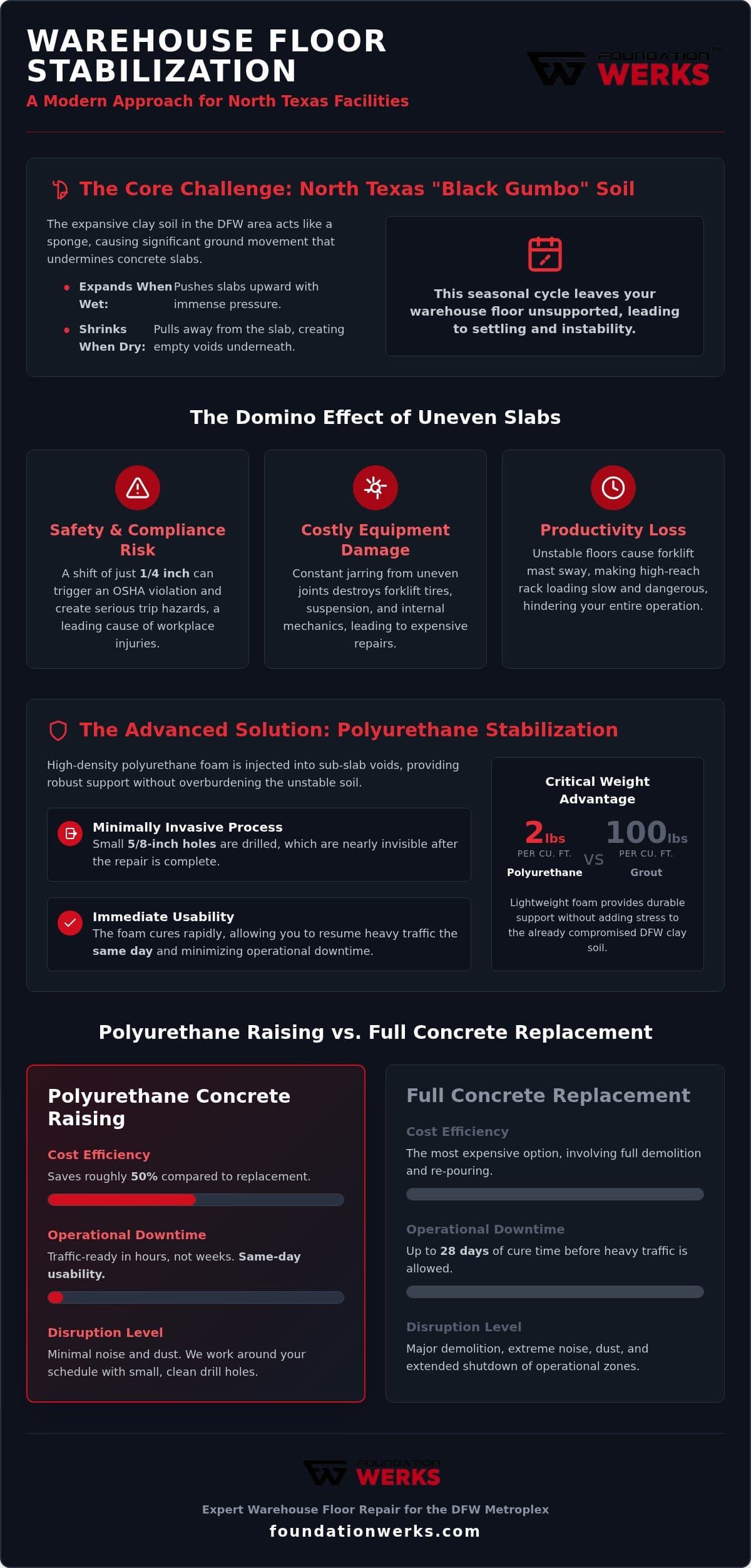
North Texas is notorious for its “black gumbo” soil. For warehouse managers, this expansive clay represents a constant battle against physics. Unlike stable soils found in other regions, Dallas clay acts like a sponge. It expands significantly when wet and shrinks drastically during the long, hot Texas summers. This movement is the primary reason why local facilities require specialized warehouse floor repair Dallas services more frequently than those in other parts of the country. When the soil beneath your slab moves, the concrete has no choice but to follow.
The Role of Expansive Clay in DFW
The clay soil beneath your facility has an “active zone” that can extend several feet deep. When moisture levels fluctuate, the soil exerts thousands of pounds of pressure against the bottom of your concrete slabs. As the soil dries and pulls away, it leaves behind empty pockets. These voids mean your heavy industrial floor is essentially “floating” without a solid foundation. Soil washout is another common issue in the DFW metroplex. If your facility has improper drainage or gutter systems, water can infiltrate the subgrade and physically carry away the soil that supports your floor. This leaves the concrete vulnerable to cracking under the weight of heavy machinery.
Operational Hazards of Uneven Slabs
Ignoring a settling floor leads to a domino effect of operational failures. High-reach forklifts are particularly sensitive to floor levelness. A quarter-inch deviation at the floor level can cause a forklift mast to sway several inches at full extension. This makes rack loading dangerous and slow. Beyond safety, the constant vibration from driving over uneven joints destroys forklift tires and suspension systems. The impact of a heavy load hitting a “rocking” slab joint can cause internal mechanical failures that take your most important equipment out of commission.
Many managers consider The Polyurethane Injection Process as a way to restore stability before equipment damage becomes too costly. When slabs rock or “pump” under the weight of traffic, they eventually crack and spall at the joints. This creates a high-risk zone for employee trips. According to industry safety data, falls are a leading cause of workplace fatalities and account for over 20% of nonfatal injuries. Keeping your floors level isn’t just about efficiency; it’s about protecting your people and your bottom line from the hidden costs of neglect.
Early detection is your best defense. Walk your floor and look for fine, grey powder near joints; this indicates concrete is grinding against concrete. If you notice racking systems that appear slightly out of plumb or cracks that seem to widen during the summer heat, the subgrade has likely failed. Catching these issues early allows for stabilization rather than a full, disruptive replacement that could halt your operations for weeks.
The Polyurethane Injection Process for Industrial Stabilization
Industrial stabilization has evolved beyond the heavy, messy methods of the past. Today, the standard for warehouse floor repair Dallas facilities rely on is high-density polyurethane injection. This method involves injecting a specialized foam into the sub-slab voids caused by soil movement. Unlike traditional mudjacking material, which can weigh up to 100 pounds per cubic foot, our patented foam weighs only 2 pounds per cubic foot. This weight difference is critical in North Texas. Adding heavy grout on top of unstable clay often causes further sinking. Polyurethane provides the necessary lift and support without overburdening the sensitive soil beneath your slab.
The material maintains its density and volume long after the initial application. It’s an inert substance that doesn’t wash away or break down when exposed to moisture. This ensures that the support provided to your industrial slabs remains consistent through the DFW region’s wet and dry cycles. Maintaining these levels is a key part of OSHA Compliance and Safety, as it prevents the development of hazardous vertical offsets that can trip employees or tip equipment. When you choose warehouse floor repair Dallas experts who understand these physics, you’re choosing a solution that respects the unique geological challenges of the area.
How Polyurethane Concrete Raising Works
The process is remarkably non-invasive. Technicians drill small 5/8-inch holes through the concrete. These holes are nearly invisible once the job is finished, which is a major advantage for clean warehouse environments where aesthetics and hygiene matter. Once injected, a chemical reaction causes the foam to expand in all directions. It fills every nook and cranny of the void before hardening in a matter of seconds. Because the foam expands so effectively, we need fewer injection points than other methods. This speed and precision mean your logistics operations can continue with minimal downtime.
Sustainability in Industrial Repair
We take pride in using a patented, eco-conscious foam made from recycled materials. Many industrial managers are surprised to learn that choosing repair over replacement is one of the easiest ways to reduce a facility’s carbon footprint. It keeps old concrete out of landfills and avoids the massive energy expenditure required to pour new slabs. The process is also incredibly clean. There’s no grout splatter or heavy wash-downs required. You won’t have to worry about dust or debris contaminating your sensitive inventory. If you’re looking to improve your facility’s safety while meeting environmental goals, exploring our void filling and stabilization options is an excellent place to start.
Comparing Concrete Raising vs. Full Floor Replacement
Choosing between repair and replacement is a high-stakes decision for any facility manager. For those seeking warehouse floor repair Dallas solutions, the choice often comes down to the budget and the clock. Replacement is a massive undertaking. It involves jackhammers, thick dust, and weeks of waiting. Raising, however, works with your existing slab to restore height and stability without the structural upheaval. It’s a methodical approach that respects both your facility and your bottom line.
Financially, the gap is wide. Raising typically costs about 50% less than pouring a new floor. Beyond the invoice, you have to consider the logistical nightmare of demolition. Tearing out concrete in an active warehouse creates clouds of silica dust. This can contaminate your inventory and sensitive electronics. It also risks damaging your existing rebar and moisture barriers. These components are vital for protecting the subgrade. Once they’re compromised, the scope of work grows significantly. Repairing the slab you already have is almost always the more efficient path.
The ROI of Immediate Usability
In a 24/7 logistics hub, a single day of lost productivity can cost thousands. When you replace a floor, you aren’t just paying for the concrete. You’re paying for the 7 to 28 days of cure time where that area is off-limits. Foundation Werks offers a “drive-on same day” promise. This makes us a preferred choice for warehouse floor repair Dallas managers who can’t afford to stop their workflow. Our polyurethane foam reaches 90% of its strength in minutes. Your forklifts can be back in action by the afternoon, not next month. Avoiding demolition debris also means your team stays productive without the need for intensive cleaning or temporary barriers.
Long-Term Stability and Maintenance
A new slab doesn’t solve a bad subgrade. If you pour heavy new concrete over the same voids that caused the first failure, you’ll likely see the same issues return. Research on Warehouse Floor Settling in North Texas shows that the behavior of the soil is the root cause. Polyurethane addresses this by physically filling the voids and compacting the loose soil. It creates a stable base for your existing concrete. For more specific details on how this applies to slab transitions, you can read about Warehouse Floor Joint Repair in Dallas. This approach focuses on restoring the structural integrity of your current floor rather than starting over on a shaky foundation.
OSHA Compliance and Safety: Managing Trip Hazards
Safety in a high-velocity warehouse starts at the floor level. OSHA standards for 2026 remain strict regarding walking and working surfaces. Specifically, any vertical change in elevation greater than 1/4 inch is considered a trip hazard. While this might seem like a minor offset, it’s enough to catch the toe of a boot or the small wheels of a pallet jack. For facility managers, ignoring these deviations isn’t just a safety risk; it’s a significant legal liability. Proactive warehouse floor repair Dallas services help you stay ahead of inspections and keep your team safe.
Loading docks are particularly dangerous high-risk zones. When a forklift carrying a multi-ton load hits an uneven joint, the sudden jar can cause the mast to sway or the entire vehicle to tip. These incidents happen in seconds and often lead to catastrophic equipment damage or serious injury. Neglecting known floor defects in a commercial setting can lead to increased workers’ compensation premiums and heavy OSHA fines. Integrating a stabilization plan with your regular maintenance schedule is the most effective way to mitigate these risks.
Identifying High-Risk Areas in Your Facility
You don’t need expensive equipment to spot trouble. A simple ‘straight-edge’ test using a 10-foot level or a straight piece of lumber can reveal hidden dips and ridges. Pay close attention to these specific areas:
- Loading Docks: High impact zones where trailers meet the floor.
- Pedestrian Walkways: Areas where foot traffic and machinery intersect.
- Rack Aisles: Where floor levelness directly impacts high-reach stability.
Listen for a hollow sound when equipment passes over a section. This often indicates a ‘rocking’ slab. These slabs move vertically when weighted, which accelerates concrete fatigue and leads to deep structural cracks over time. Identifying these spots early prevents the need for more extensive repairs later.
Joint Repair and Mastic Installation
Stabilizing the slab with polyurethane is the first step, but sealing the joints is equally important for a durable result. Open joints allow water, oils, and cleaning chemicals to seep into the subgrade. This moisture infiltration is a primary cause of soil erosion and the return of sub-slab voids. Using a high-quality mastic or joint seal creates a flexible barrier that moves with the concrete while keeping the foundation dry. For a deeper look at maintaining your surfaces, check out our Commercial Concrete Crack Repair guide. This dual approach of lifting and sealing provides the most reliable protection for your facility’s infrastructure.
Choosing a Dallas Warehouse Floor Repair Specialist
Selecting a partner for warehouse floor repair Dallas managers can trust involves more than just checking a star rating. North Texas soil requires specific local knowledge that general contractors often lack. A team that understands the transition from the heavy clay in McKinney to the varied subgrades in Irving will provide a much more effective solution. Industrial slabs are engineered to handle immense weight, and repairing them requires a specialized understanding of load distribution and sub-slab physics. You need a specialist who focuses exclusively on concrete stabilization rather than a “do-it-all” generalist.
Evaluating the equipment is another vital step. Some traditional repair methods require heavy machinery that can damage your warehouse floors or tear up the landscaping around your facility. Our approach is different. The equipment we use for polyurethane injection is self-contained and non-invasive. We don’t bring heavy tractors or high-impact tools into your workspace. This protects your property from secondary damage while we address the primary settling issues. It’s a cleaner, quieter, and more professional way to restore your facility’s safety.
The Foundation Werks Differentiator
We take quiet pride in our role as educators. We don’t just provide a service; we empower you with the knowledge to make the best decision for your facility. Our use of patented, 2lb per cubic foot lightweight foam is a deliberate choice for the DFW climate. It provides the structural support needed without adding the massive weight that causes North Texas clay to sink further. We serve the entire metroplex, including North Dallas, Frisco, and Allen, with a team of technicians who are as approachable as they are professional. We’re here to solve your problem, not just manage a project.
Getting Started with a Facility Assessment
The first step in restoring your floor’s integrity is a thorough assessment. During a free estimate, our specialists perform a detailed void analysis to determine exactly where the subgrade has failed. We then create a customized action plan that addresses your specific operational needs. We know that timing is everything in logistics. That’s why we offer scheduling flexibility to ensure our work has the smallest possible impact on your daily workflow. You can expect a straightforward, honest evaluation without any high-pressure sales tactics.
Securing Your Warehouse Infrastructure for the Long Term
Managing a high-traffic facility in North Texas requires a proactive approach to concrete maintenance. We’ve explored how expansive clay soils create voids that lead to rocking slabs and safety hazards. By choosing polyurethane stabilization, you address these issues without the weeks of downtime required by traditional replacement. This method provides a reliable path to maintaining OSHA compliance and protecting your expensive forklift fleet. It’s a strategic investment in your facility’s operational longevity.
Foundation Werks is proud to provide warehouse floor repair Dallas managers can rely on throughout the entire DFW metroplex. Our use of patented, eco-friendly foam ensures your slabs are supported without adding unnecessary weight to the subgrade. Most importantly, our process offers immediate usability, so your forklifts can return to work the same day we finish. We’re here to help you navigate these technical challenges with transparency and local expertise.
Your warehouse floor is the foundation of your entire operation. Taking steps now to stabilize your slabs will keep your team safe and your logistics moving smoothly for years to come.
Frequently Asked Questions
How long does warehouse floor repair take for a typical Dallas facility?
Most stabilization projects are completed in a single day. Unlike traditional methods that require days of preparation and cure time; polyurethane injection is remarkably fast. We can often stabilize several hundred square feet of flooring during a single shift. This efficiency allows you to maintain your shipping schedules without the long-term closures associated with full concrete replacement or heavy demolition.
Can forklifts drive on the floor immediately after polyurethane injection?
Yes, forklifts can typically drive on the repaired area within 15 to 30 minutes of the injection. The high-density foam reaches about 90% of its full structural strength in less than half an hour. This immediate usability is a cornerstone of warehouse floor repair Dallas logistics managers rely on to keep high-traffic loading docks and aisles operational throughout the workday.
Is polyurethane foam a durable solution for heavy industrial loads?
Polyurethane foam is specifically engineered to support the massive weights of industrial machinery and racking systems. The material is strong enough to handle heavy-duty forklift traffic and high-capacity shelving without failing. It provides a stable base by filling sub-slab voids and compacting the underlying soil. This structural support is essential for maintaining a level surface under the constant stress of warehouse operations.
Will the foam material lose density or compress over time?
No, the foam maintains its density and volume because it is a closed-cell, inert material. It doesn’t compress, wash away, or break down when exposed to moisture or temperature fluctuations. This characteristic makes it a reliable long-term solution for stabilizing slabs in the DFW area; where soil moisture levels change frequently. It stays exactly where it’s injected to provide consistent support.
How do I know if my warehouse floor needs raising or total replacement?
Raising is usually the best choice if the concrete slab is still structurally sound but has sunken or become uneven. If the floor has severe, deep-reaching structural damage or is crumbling into small pieces, replacement might be necessary. However, most issues like rocking joints, trip hazards, and sub-slab voids can be addressed through stabilization. A professional assessment will determine if the existing concrete can be salvaged.
Does Foundation Werks provide repair services for loading docks and exterior slabs?
We specialize in stabilizing both interior warehouse floors and exterior concrete surfaces like loading docks and approach slabs. These areas are frequently hit by heavy trailers and are prone to soil washout. Our polyurethane process is effective for void filling and lifting in these high-impact zones. We ensure that the transitions between your yard and the warehouse remain smooth and safe for equipment.
What is the cost difference between polyurethane lifting and traditional mudjacking?
While the material cost for polyurethane is sometimes higher, the overall project cost is often lower due to reduced labor and equipment needs. Polyurethane requires much smaller 5/8-inch holes and fewer injection points than mudjacking. Because it doesn’t add significant weight to the soil, it also reduces the risk of future settling. You save significantly on the hidden costs of downtime and cleanup.
Can you fix slabs that are severely cracked or only those that have sunken?
We can stabilize cracked slabs, but the primary goal is to restore the foundation beneath them. If a slab is cracked because it lost support, we can inject foam to fill the void and prevent further movement. Once the slab is stable, we often recommend commercial concrete crack and joint repairs to seal the surface. This prevents moisture from reaching the subgrade and protects the edges from further spalling.