

What if those thin, hairline fractures appearing above your door frame aren’t just “settling” but are actually your home’s way of sounding a silent alarm? It’s unsettling to walk through your living room and notice a new gap in the corner. You’re likely asking yourself, “Why are there cracks in my walls or sheetrock.” while simultaneously worrying about expensive repairs and your home’s dropping value. We understand that stress; it’s hard to feel confident when expert opinions seem to vary as much as the North Texas weather.
The truth is that the Blackland Prairie clay under your foundation is always moving, but a crack doesn’t have to mean a catastrophe. We’ll help you discover the hidden causes of these cracks and how modern stabilization techniques can protect your structural integrity. This guide explores the differences between cosmetic and structural damage, the benefits of eco-friendly polyurethane foam, and the steps to achieve a reliable long-term solution for your home.
Key Takeaways
- Learn to distinguish between harmless settling and structural warning signs by identifying the shape and direction of your wall cracks.
- Understand how the expansive clay soil in Dallas-Fort Worth creates the movement that leads you to ask, “Why are there cracks in my walls or sheetrock.”
- Discover why cosmetic patches are only temporary masks and why addressing soil voids is necessary for a reliable long-term solution.
- Compare the benefits of lightweight polyurethane foam against heavy traditional mudjacking to see which method protects your foundation best.
- Get a clear overview of the non-invasive Deep Foamjection™ process and how it can stabilize your home without the mess of heavy machinery.
Identifying Wall and Sheetrock Cracks: When to Worry
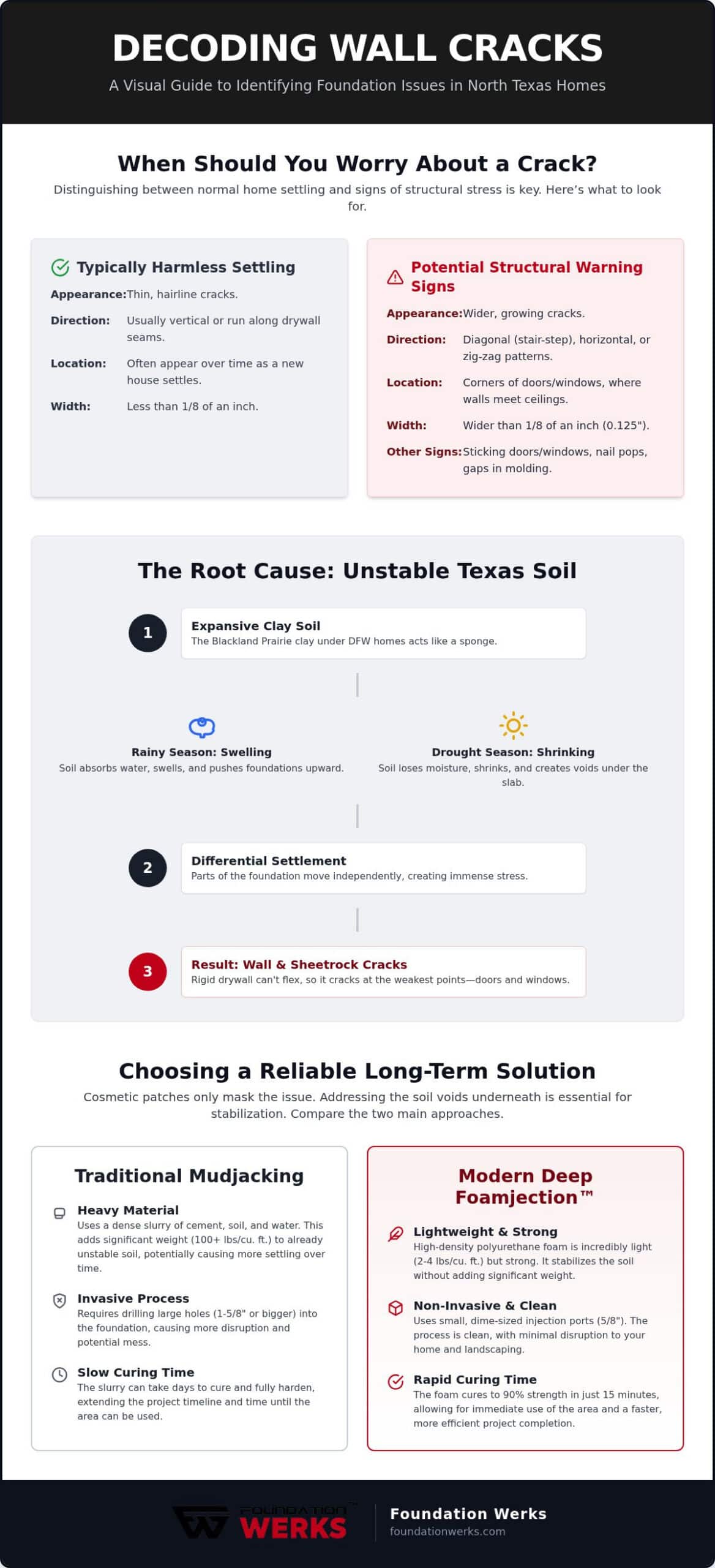
Finding a line running across your living room wall often leads to the urgent question: Why are there cracks in my walls or sheetrock. While every home experiences some minor movement, knowing the difference between a cosmetic settling crack and a structural warning sign is vital for your peace of mind. Settling cracks are typically thin, vertical lines that appear as a house adjusts to its weight over time. In contrast, structural cracks are often wider and run horizontally or in diagonal patterns, suggesting that the ground beneath you is shifting. Differential settlement is the primary driver of sheetrock stress, occurring when one portion of your foundation moves independently from the rest.
This instability is frequently caused by the Expansive clay soils found throughout North Texas. These soils act like a sponge, swelling with moisture and shrinking during our intense summer droughts. When the soil moves, your foundation follows, and your sheetrock is the first place that shows the strain. You aren’t just looking at a wall problem; you’re looking at a soil problem.
The Anatomy of a Sheetrock Crack
Think of your drywall as the canary in the coal mine for your foundation. Drywall is a rigid material, meaning it doesn’t have the flexibility to bend when your home’s framing shifts even a fraction of an inch. When your foundation settles unevenly, it creates shear stress. This stress looks for the weakest points in your walls, which are almost always the corners of door frames and windows. If you notice a crack that has grown wider than 1/8 of an inch, it’s the industry threshold that signals you need a professional inspection to find a long-term solution.
Visual Cues of Foundation Movement
Sometimes the signs aren’t as obvious as a large gap in the wall. You might notice secondary symptoms that seem like minor annoyances but actually point to a larger issue. Common signs include:
- Doors and windows: If a door suddenly sticks or a window latch no longer lines up, the frame has likely been pulled out of square.
- Nail pops and tape peeling: Small circular bumps or peeling seams in your sheetrock occur when the studs move and push against the finish.
- Gaps and masonry: Look for separation where the wall meets the ceiling or gaps in crown molding. Outside, look for a stair-step pattern in the brickwork, which is a classic indicator of significant slab movement.
Recognizing these patterns early allows you to address the root cause before the damage requires more invasive intervention. By the time you’re asking why are there cracks in my walls or sheetrock, your home has usually been under stress for several months.
The Root Causes of Interior Cracks in North Texas Properties
If you live in North Texas, your home sits on some of the most active soil in the country. This soil is the primary reason you’re likely asking, “Why are there cracks in my walls or sheetrock.” The Dallas-Fort Worth area is famous for its Blackland Prairie clay, which is a type of expansive soil that undergoes a dramatic “sponge effect.” When it rains, this clay absorbs water and swells with incredible force. During the inevitable Texas droughts, it loses that moisture and shrinks, leaving gaps beneath your foundation. This constant cycle of expansion and contraction puts immense pressure on your home’s structure, leading to the visible stress you see in your drywall.
Expansive Clay and the DFW Climate
Homes in McKinney and Frisco are particularly susceptible because of the depth of the clay layers in these growing communities. The 2026 weather cycles have been particularly harsh, moving from saturated spring months to bone-dry summer heat. This rapid change forces the soil to move more aggressively than in milder years. Landscaping also plays a role; large tree roots can drink hundreds of gallons of water a day, drying out the soil specifically near your slab and causing one corner of the house to drop while the rest stays put. This localized shrinkage is a major contributor to foundation instability.
Hydrostatic Pressure and Soil Erosion
Water is a powerful force, and when it collects against your foundation, it creates hydrostatic pressure. This pressure can actually push against your foundation walls, but the more common issue in DFW is erosion. When gutters overflow or downspouts dump water directly at the base of the house, the soil loses its load-bearing capacity. This leads to the formation of “voids,” or empty pockets, where the slab is no longer supported by the earth. When differentiating types of wall cracks, professional inspectors look for signs that the slab has dropped into these voids.
Managing this water often requires French Drain Installation for North Texas Properties to keep the soil moisture levels consistent throughout the year. Without proper drainage, the unsupported weight of your home will continue to cause shifts. This is often the underlying reason why there are cracks in my walls or sheetrock. If you suspect your drainage is failing, you can assess your property’s drainage to prevent further movement and protect your investment.
Why Cosmetic Repairs Aren’t a Long-Term Solution
It’s tempting to grab a tub of spackle and a putty knife the moment you wonder, “Why are there cracks in my walls or sheetrock.” While painting over a crack provides instant gratification, it’s a purely cosmetic response to a structural problem. If the underlying foundation is still shifting, that new layer of paint will pull apart in weeks or months. You’re effectively putting a bandage on a broken bone. This “patch and repeat” cycle doesn’t just waste your weekends; it hides the progressive damage happening beneath your feet.
Ignoring the root cause leads to more than just ugly walls. As a slab continues to settle, it can pull on interior plumbing lines buried in the ground or stretch electrical wiring within the wall cavities. These secondary issues are far more expensive to resolve than simple wall repairs. Before you invest in new flooring or a kitchen remodel, stabilization must be your first step. A stable base ensures your interior upgrades don’t crack and fail shortly after installation.
The False Security of Drywall Patching
Drywall has zero structural strength. When a crack returns in the exact same spot, it’s a clear sign that the house’s framing is still under tension. The sinking slab continues to exert force on the studs, which then transfers that stress back to the sheetrock. Interestingly, the same logic we use for Warehouse Floor Joint Repair in Dallas applies to your home. In industrial settings, we don’t just fill the gap; we stabilize the underlying slab to prevent the edges from shifting. Without that support, any filler material will simply crumble under pressure.
Managing Expectations for Structural Resolution
We believe in being honest about the nature of foundation work. While our stabilization methods stop active sinking and provide a reliable long-term solution, it’s unrealistic to expect the ground to stop moving forever. The clay soil will continue to react to the North Texas environment long after we leave. Our goal is to provide a durable resolution that brings your home back to a manageable state. This involves ongoing maintenance like joint sealing and proper drainage to keep the soil moisture consistent. By prioritizing stabilization now, you protect the resale value of your property, showing future buyers that you’ve addressed the home’s integrity rather than just hiding its flaws with a coat of paint.
Modern Stabilization: Polyurethane Foam vs. Traditional Mudjacking
When you discover the damage and ask, “Why are there cracks in my walls or sheetrock,” the next step is choosing a repair method that won’t make the problem worse. For decades, traditional mudjacking was the standard. This process involves pumping a heavy slurry of sand, soil, and cement under the slab. However, this slurry weighs approximately 100 pounds per cubic foot. In the fragile, expansive clay of North Texas, adding that much weight to a failing soil base often backfires. The heavy material can actually cause the foundation to sink further over time as the weak soil collapses under the new load.
Modern polyurethane concrete raising offers a smarter alternative. Our foam weighs only 2 pounds per cubic foot, providing the necessary lift without the crushing weight. It’s a clean, quiet process that uses nearly invisible 5/8-inch drill holes. Best of all, you don’t have to wait days for concrete to cure. Polyurethane reaches 90 percent of its full strength within minutes, offering immediate usability. You can walk on your floors or park on your driveway the same day the work is finished.
The Science of Polyurethane Concrete Raising
The magic of this method lies in the chemical expansion. As the liquid polyurethane is injected, it expands into every tiny void and crevice beneath the slab. This expansion doesn’t just lift the concrete; it compresses the underlying soil, creating a more stable environment. Unlike mudjacking slurry, which can wash away or shrink over time, our high-density foam never loses its volume. It’s a patented, eco-conscious material made from recycled components, providing a long-term resolution that respects both your home and the environment.
Deep Foamjection™ for Soil Stabilization
Sometimes the issue is deeper than a simple surface void. Deep Foamjection™ is a specialized technique we use to strengthen the soil several feet below the grade. While standard lifting focuses on the gap directly under the slab, this method builds a solid “curtain” of support in the sub-grade. This is particularly effective for heavy residential structures and Uneven Warehouse Floor Repair in Dallas. By addressing the soil’s load-bearing capacity at multiple levels, we ensure the foundation has the support it needs to resist future weather cycles.
Stabilizing Your Home with Foundation Werks in the DFW Metroplex
We understand the frustration of looking at a corner and asking, “Why are there cracks in my walls or sheetrock.” Foundation Werks is here to provide a clear path forward for homeowners in McKinney, Frisco, Prosper, and across the North Dallas region. Our process is designed to be as stress-free as possible, moving from a free estimate to a completed project often in the same day. We don’t believe in high-pressure sales; we believe in educating you about the state of your property and providing a technical resolution that works.
Choosing to raise your concrete is a smart financial decision. Raising your concrete typically costs about half of what you’d pay for a full concrete replacement. We also stand by our “Clean Work Environment” promise. Since our equipment is self-contained, you won’t see heavy machinery tearing up your turf or grout splatter ruining your landscaping. We treat your property with the same quiet pride we take in our technical repairs.
What to Expect During Your Foam Lift
The process is remarkably non-invasive. We use 5/8-inch injection ports that are roughly the size of a penny, making them nearly invisible once the job is done. This makes our method ideal for interior floor slabs where you want to minimize disruption to your living space. It’s also a favorite for pool decks and patios where aesthetics matter. Most residential stabilization projects take only a few hours to complete. While it’s common to wonder “Why are there cracks in my walls or sheetrock,” the answer is often a void that we can fill in a single afternoon, allowing you to return to your normal routine immediately.
Protecting Your Property Value
Our deep experience in Commercial Concrete Crack Repair makes us better residential contractors. We apply industrial-grade standards and precision to every home we service. We’ve helped many of your neighbors find peace of mind. Homeowners like Kevin C. and Dan W. have already experienced the difference our methodical approach and honest communication make for their properties. We’re proud to be a local company of real people who care about the stability of our community’s homes.
- Free Estimates: We’ll assess your cracks and provide a transparent quote.
- Expert Team: Our technicians are trained in proprietary Deep Foamjection™ methods.
- Local Focus: We know the specific challenges of North Texas clay.
Don’t let the stress of foundation movement affect your home’s value any longer. You can book your free estimate today by calling us at 800-464-9684. Let’s work together to find the long-term solution your home deserves.
Secure Your Home’s Future with Modern Stabilization
Wall cracks don’t have to mean a loss of home value or the start of a construction nightmare. By identifying the root cause of movement in the North Texas clay, you can move past the recurring cycle of cosmetic patches. If you’ve been asking, “Why are there cracks in my walls or sheetrock.” you now know that soil voids are likely the culprit. Understanding this science is the first step toward a stable home.
Our team uses eco-friendly foam made from recycled materials to fill these voids without adding the dangerous weight of traditional mudjacking. This modern method ensures your surfaces have immediate same-day usability, saving you time and money compared to full replacement. Our professional expertise across the entire DFW Metroplex means we’ve seen these issues before and know how to deliver a reliable resolution for your property.
You deserve to feel confident in the foundation beneath your feet. Let’s address the instability today so you can enjoy your home with total peace of mind tomorrow.
Frequently Asked Questions
Are cracks in my sheetrock always a sign of foundation trouble?
Not necessarily, but they’re often the first warning sign of structural movement. Small, vertical hairline cracks can result from minor seasonal settling or humidity changes. However, if you’re asking “Why are there cracks in my walls or sheetrock.” and you see horizontal lines or stair-step patterns, it usually indicates significant soil shifts. These patterns suggest the foundation is no longer supporting the weight of the walls evenly.
How much does it cost to fix wall cracks caused by foundation settlement?
The total cost depends on the size of the voids beneath your home and the amount of material needed for stabilization. While we provide free estimates to determine exact needs, raising and stabilizing concrete is typically about half the cost of full concrete replacement. Addressing the root cause now provides a reliable long-term solution and prevents the need for more expensive structural repairs or plumbing fixes later.
Is polyurethane concrete raising better than mudjacking for wall cracks?
Polyurethane is the better choice for North Texas homes because it’s incredibly lightweight. Traditional mudjacking uses a heavy slurry weighing about 100 pounds per cubic foot, which can cause weak clay soils to sink further. Our polyurethane foam weighs only 2 pounds per cubic foot. It fills voids and compresses the soil without adding unnecessary weight, providing a much more stable resolution for your foundation.
Can I just patch the cracks in my drywall myself?
You can patch them, but the cracks will likely return if the slab is still moving. Drywall lacks the flexibility to handle foundation shifts. Simply applying spackle only masks the symptoms and leads to a frustrating “patch and repeat” cycle. If you’re wondering “Why are there cracks in my walls or sheetrock.” the answer is often structural. We recommend stabilizing the foundation first so your interior repairs actually hold.
How long does the polyurethane stabilization process take?
Most residential projects, including interior floor slabs and driveways, take only a few hours to complete. Our polyurethane foam reaches 90 percent of its full strength within minutes of injection. This speed allows for immediate same-day usability, so you don’t have to wait for days to walk on your floors or move furniture back into place. It’s a fast, clean process that minimizes disruption to your daily life.
Will foundation stabilization stop my wall cracks from coming back?
Foundation stabilization stops the active sinking that causes sheetrock to shear and crack. While the reactive clay in Dallas requires consistent moisture management, our methods provide a dependable long-term solution. By filling the voids and strengthening the soil, we create a stable base for your home. This resolution ensures your wall repairs stay intact and your home remains structurally sound for years to come.
Is the foam used for concrete lifting safe for the environment?
Yes, we use a patented, eco-conscious foam made from recycled materials. This polyurethane is designed to be inert and environmentally friendly once it has cured. It won’t leach chemicals into the North Texas soil or affect your landscaping. We prioritize using sustainable materials that provide high-quality results without compromising the safety of your property. Our process also requires no heavy, gas-powered equipment on your lawn.
Does Foundation Werks serve residential properties in McKinney and Frisco?
We are based in McKinney and proudly serve the entire DFW Metroplex, including Frisco, Prosper, and Allen. Our team is intimately familiar with the specific challenges created by the Blackland Prairie clay in these communities. Whether you have a sunken interior slab or a cracked pool deck, we provide local expertise and professional stabilization. You can call us at 800-464-9684 to schedule your free estimate and find a resolution for your home.