

What if the traditional methods you’ve relied on for years are actually the reason your warehouse floors continue to sink? For many facility managers, the cycle of patching cracks only to see them reappear feels like an unavoidable part of doing business. It’s a frustrating reality, especially when McKinney’s expansive clay soil is working against your infrastructure every day. You shouldn’t have to choose between a temporary patch and the astronomical cost of a total slab replacement.
At Foundation Werks, we believe in a more sophisticated approach to property maintenance. We’ll show you why conventional commercial concrete repair in McKinney often fails to address the root cause of instability. By debunking five common myths, you’ll discover how modern stabilization techniques can minimize operational downtime and eliminate OSHA trip hazards without the mess of heavy construction. We’re going to explore the technical reality of soil dynamics and provide a clear path toward long-term reliability for your commercial property.
Key Takeaways
- Learn why total concrete replacement is often an unnecessary expense and how non-invasive stabilization provides a more efficient alternative for your facility.
- Discover why modern polyurethane is superior for commercial concrete repair in McKinney, avoiding the excessive weight of traditional mudjacking that can worsen soil compression.
- Understand the role of McKinney’s expansive clay soil in slab failure and why addressing the root cause is essential for long-term reliability.
- Identify why surface-level crack repairs must be paired with deep-soil stabilization and joint sealing to prevent recurring settling issues.
- Gain strategies to eliminate OSHA trip hazards and minimize operational downtime through advanced, high-tech restoration methods.
Myth #1: Total Concrete Replacement is the Only Reliable Solution for Sunken Slabs
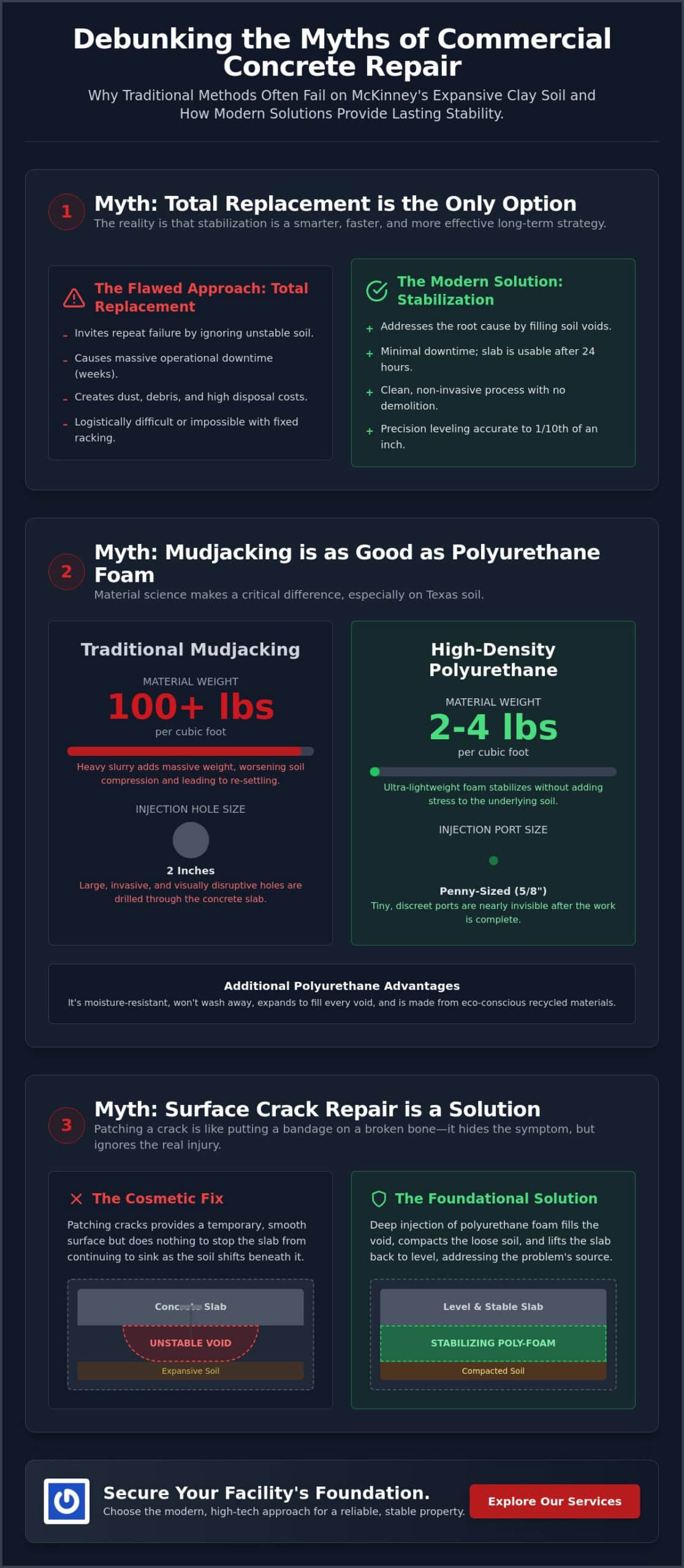
Many property owners assume that once a slab sinks, it’s structurally compromised and must be replaced. This is a costly misconception. Commercial concrete stabilization offers a non-invasive alternative that addresses the void beneath the slab without the need for demolition. When evaluating various Concrete leveling methods, it’s clear that restoration is often the more sophisticated choice for commercial concrete repair in McKinney.
To better understand the precision and efficiency of these modern methods, watch this helpful video:
McKinney’s soil is characterized by expansive clay that shifts with moisture changes. If you simply pour a new, heavy slab over the same unstable ground, you’re inviting repeat failure. The new concrete will likely settle or crack within a few years because the underlying soil issues remain unaddressed. Speed is also a critical differentiator. Modern lifting techniques allow for a 24-hour cure time. This is a massive advantage compared to the multi-day curing process required for new slabs, which can stall your facility’s logistics for a week or more. Smart facility managers should carefully weigh the concrete replacement vs lifting cost to ensure they’re maximizing their maintenance budgets.
The Hidden Costs of Commercial Concrete Demolition
Demolition involves more than just a labor crew. You must account for significant business interruption, extensive dust mitigation to protect sensitive equipment, and rising disposal fees for North Texas facilities. Stabilization avoids these headaches. It preserves your existing reinforcement and maintains joint integrity, keeping your operation running smoothly while avoiding the waste of a full tear-out.
When Lifting is the Superior Strategic Choice
For warehouse floors, total replacement is often logistically impossible due to fixed racking systems or 24/7 schedules. Polyurethane lifting provides a precision solution. We can achieve leveling accuracy within 1/10th of an inch. This ensures that high-reach forklifts and automated machinery operate on a perfectly stable surface without the need to empty the entire building for construction.
Myth #2: Traditional Mudjacking is Just as Effective as Modern Polyurethane Foam
While traditional mudjacking has been used for decades, it’s often a poor fit for the specific geological challenges found in North Texas. The primary issue lies in the sheer weight of the material. Mudjacking relies on a heavy slurry of sand, soil, and cement that weighs upwards of 100 pounds per cubic foot. In contrast, high-density polyurethane weighs only 2 to 4 pounds per cubic foot. When you’re performing commercial concrete repair in McKinney, adding thousands of pounds of heavy slurry can actually accelerate soil compression. This often leads to the slab sinking again under the massive weight of the very material intended to fix it.
Beyond the weight, the physical impact on your property is much lower with foam. Mudjacking requires large, unsightly holes drilled through your concrete, often reaching 2 inches in diameter. Polyurethane utilizes “penny-sized” injection ports that are barely visible once the project is complete. This precision is vital for high-traffic commercial areas where aesthetics and surface integrity matter. Because polyurethane is inherently moisture-resistant, it won’t wash away or lose volume during humid North Texas rainy seasons. If you’re looking for a more advanced approach to facility maintenance, you can explore our specialized stabilization services to see the difference firsthand.
Material Science: Why High-Density Foam Wins in McKinney
Our approach prioritizes both performance and environmental responsibility. We use patented foam made from recycled materials, offering an eco-conscious alternative to traditional cementitious mixes. The real power of this material is its expansion force. As the liquid is injected, it expands rapidly to fill every hidden void and crevice under your commercial slab. This ensures total coverage that a thick, viscous mudjacking slurry simply cannot reach.
Long-Term Stability vs. Short-Term Patches
Polyurethane provides a more stable, long-lasting resolution because it creates a durable chemical bond with North Texas sub-soils. Unlike organic mudjacking mixes that can break down or erode over time, high-density foam remains structurally sound. It doesn’t just sit on top of the soil; it integrates with the environment to provide a foundation that resists the seasonal shifting common in our region. This technical superiority is why modern enterprises are moving away from reactive patches in favor of engineered stabilization.
Myth #3: Surface Crack Repair Solves the Underlying Concrete Issue
Applying a surface sealant to a visible crack without addressing the soil beneath is like painting over rust. It might look better for a few weeks, but the structural decay continues unabated. For effective commercial concrete repair in McKinney, we must look deeper than the surface. Soil erosion and hydrostatic pressure are the primary drivers of slab failure in our region. When water infiltrates cracks, it creates voids that lead to “rocking” slabs, especially under the relentless weight of heavy forklift traffic.
This is why commercial concrete joint sealing must be paired with stabilization. Sealing the surface prevents water intrusion, while stabilization fills the voids that cause the movement in the first place. Understanding why mastic or joint seal maintenance is important in preserving your concrete slabs is essential to this holistic strategy, as failing joints allow water to rush underneath the slab and wash away supporting soil. We advocate for a holistic approach. Protecting your repair investment requires managing the environment around the concrete, not just the concrete itself. Without addressing the root cause, you’re simply managing symptoms rather than securing your facility’s future.
The Role of French Drains in McKinney Concrete Longevity
North Texas rain cycles are notorious for causing “washout” under commercial parking lots. Large volumes of water can quickly strip away the supporting soil, leaving your pavement suspended over empty space. A properly installed French drain serves as a vital safeguard. By redirecting groundwater away from the slab’s edge, you prevent future soil displacement and settling, ensuring your facility remains safe and level through every season.
Stabilizing Warehouse Joints and Voids
Industrial facilities in McKinney have unique requirements for joint load transfer. When a heavy load passes over a joint, any void beneath the slab causes deflection. This bending eventually leads to spalling and structural cracking that can damage equipment and slow down operations. Polyurethane stabilization resolves the root cause of this deflection. It provides a dense, supportive base that distributes weight evenly across the entire slab, restoring the structural integrity of your warehouse floor.
Secure Your Facility’s Foundation Today
Choosing the right approach for your property means looking past surface level patches and understanding the unique challenges of North Texas soil. We’ve explored how modern stabilization outperforms traditional demolition and why lightweight polyurethane is the smarter choice for McKinney’s expansive clay. By addressing the voids beneath your slabs and ensuring proper drainage, you can protect your facility from recurring settling and safety liabilities. It’s about shifting from reactive maintenance to a strategic, long-term resolution for your infrastructure.
Foundation Werks brings specialized industrial stabilization equipment and deep local expertise to every project. Our use of patented eco-friendly polyurethane foam ensures a high-tech, environmentally responsible solution tailored to our region’s specific soil conditions. Don’t let sunken slabs disrupt your operations or create unnecessary risks. You can Request a Professional Commercial Concrete Assessment in McKinney to gain clarity on the best path forward for your property. We’re here to help you restore stability and confidence in your commercial concrete repair in McKinney.
Frequently Asked Questions
How long does commercial concrete repair last in McKinney?
The effectiveness of any repair depends on specific soil conditions and how well moisture is managed around the property. While no reputable professional will promise a definitive or absolute solution, our high-density polyurethane stabilization is designed for long-term reliability. By addressing the underlying voids and McKinney’s expansive clay, we create a stable foundation that resists the seasonal shifting common in North Texas much better than traditional surface patches.
Will polyurethane foam lifting interfere with warehouse operations?
Polyurethane foam lifting is engineered to minimize business disruption. It requires only small, penny-sized injection ports and typically cures within 24 hours. Most warehouse facilities can continue their daily operations with very little rerouting, as the process doesn’t involve heavy demolition equipment or the multi-day curing times required for new concrete slabs.
Is commercial concrete repair in McKinney environmentally friendly?
Modern commercial concrete repair in McKinney is a sustainable alternative to traditional demolition. We use high-density foam that is often formulated with recycled materials and remains inert once it has cured. Additionally, by stabilizing your existing slabs, you prevent massive amounts of old concrete and reinforcement from being hauled to local landfills, significantly reducing your project’s carbon footprint.
How much does commercial concrete stabilization cost compared to replacement?
Stabilization is almost always a more cost-effective strategic choice for facility managers. You avoid the substantial expenses of demolition, debris disposal, and the indirect costs of extended operational downtime. By restoring the integrity of your existing infrastructure, you can achieve a level, safe surface for a fraction of the total investment required for a full tear-out and pour.
Can polyurethane foam lift heavy industrial slabs with machinery on them?
Polyurethane foam possesses an incredible expansion force that is capable of lifting heavy industrial slabs even while machinery remains in place. The material expands rapidly to fill every hidden void before providing the controlled lift needed for precision leveling. This allows us to stabilize warehouse floors without the logistical nightmare of moving fixed racking systems or heavy production equipment.
What is the most common cause of concrete settling for McKinney businesses?
The primary cause of settling is the movement of McKinney’s expansive clay soil combined with poor moisture control. This soil expands when wet and shrinks during dry North Texas summers, which creates empty voids beneath your concrete. Without professional commercial concrete repair in McKinney to fill these gaps, the heavy weight of the slab eventually leads to sinking, cracking, and structural deflection.