

Tearing out and replacing your facility’s sunken slabs might seem like the most thorough solution, but it is often the least efficient way to protect your commercial infrastructure. When you analyze the concrete replacement vs lifting cost, the traditional “rip and replace” method frequently hides secondary expenses like lost productivity and extended operational downtime. You’re likely facing the mounting pressure of OSHA trip hazard liabilities and a maintenance budget that feels increasingly constrained by the unique demands of North Texas soil conditions.
We understand that facility managers need more than a temporary patch; they need a reliable, high-tech strategy that addresses the root cause of soil failure. This guide will show you how to evaluate the true ROI of modern lifting techniques to ensure you’re investing in structural stability without the headache of a construction zone. We’ll examine why polyurethane lifting is now the preferred choice for sophisticated commercial operations, offering a long-term resolution that is typically 50 to 70 percent more cost-effective than full replacement while keeping your doors open for business. Discover how to protect your bottom line with an engineered approach that prioritizes both precision and fiscal responsibility.
Key Takeaways
- Learn why polyurethane lifting typically requires significantly less capital than demolition by eliminating “hidden” expenses like permits and site restoration.
- Discover how to calculate the true concrete replacement vs lifting cost while accounting for the high price of operational downtime and lost productivity.
- Understand why pouring new slabs on failing subgrade is a fundamental flaw and how modern stabilization provides a long-term resolution for sunken concrete.
- Identify when to salvage a slab using the “Spiderweb” rule and how expansive North Texas clay impacts your specific repair strategy.
- Explore how minimally invasive, engineered solutions protect your facility’s structural integrity with a fraction of the disruption caused by traditional construction.
The Economic Breakdown: Concrete Replacement vs. Polyurethane Lifting
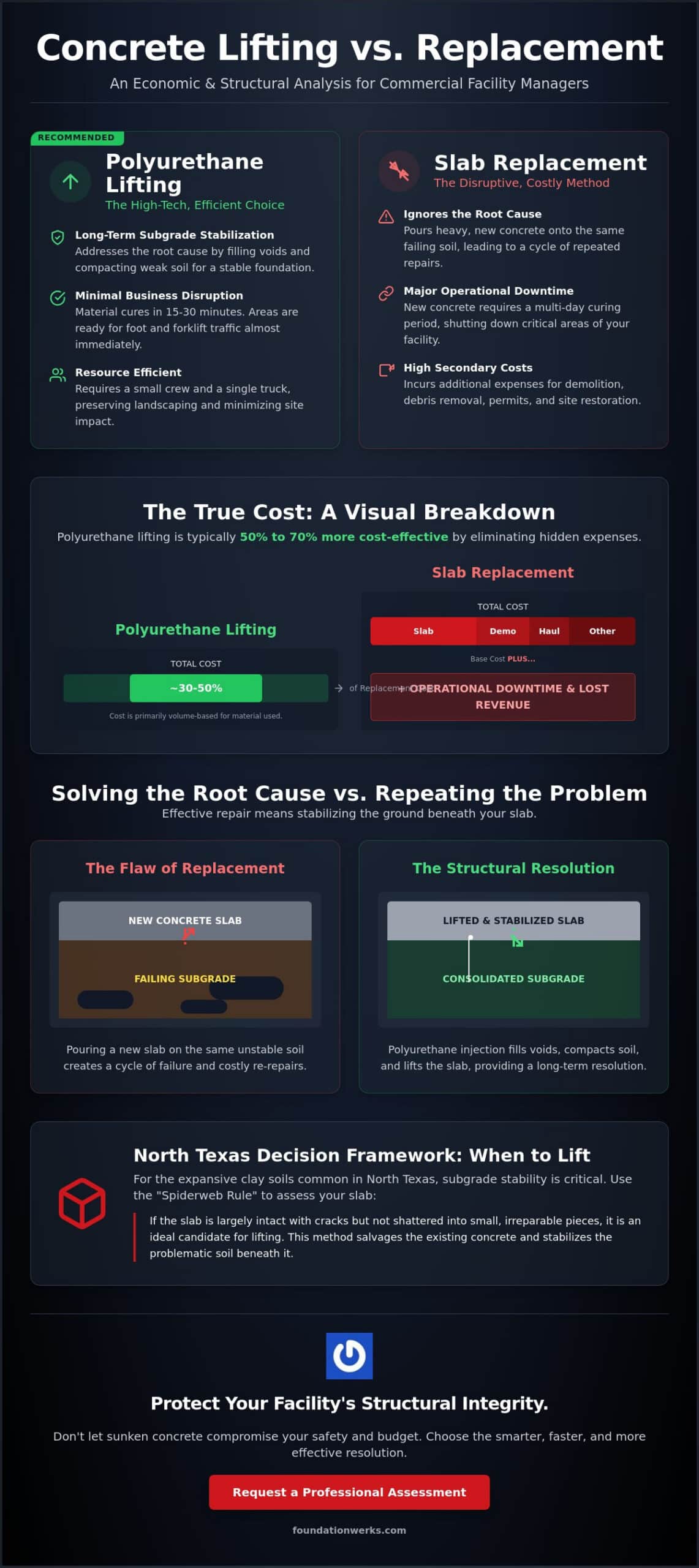
Most facility managers view concrete repair as a choice between a patch and a total overhaul. However, calculating the concrete replacement vs lifting cost requires looking past the line-item estimate for materials. Replacement is a capital-intensive process involving demolition, whereas polyurethane lifting focuses on structural restoration. Research indicates that lifting is typically 50 to 70 percent less expensive than full replacement because it bypasses the heavy labor of tear-outs.
Beyond the slab itself, replacement triggers a cascade of secondary expenses. You’ll encounter municipal permit fees, debris removal costs, and the inevitable site restoration. By contrast, concrete leveling techniques like polyurethane injection use volume-based pricing. This means you only pay for the material needed to fill the void, regardless of how thick the original slab was. This modern method avoids the heavy weight of traditional mudjacking, providing a long-term resolution without adding stress to the underlying soil.
To see the practical application of these cost-saving measures, watch this detailed comparison:
Operational Impact and Facility Downtime
Time is often the most expensive component of any commercial project. Polyurethane cures in as little as 15 to 30 minutes, allowing for immediate traffic. New concrete requires a multi-day curing period where your warehouse or retail floor remains completely inaccessible. When you weigh the concrete replacement vs lifting cost, you must include the price of lost productivity. Keeping your business operational is the primary financial advantage of the lifting process.
Labor and Resource Efficiency
A replacement project requires heavy machinery and a large crew, which inevitably disturbs the surrounding North Texas landscaping. Our specialized teams use a single truck and minimal equipment to perform polyurethane concrete raising. We focus on resource efficiency, ensuring that the repair is completed with a tiny footprint and zero environmental debris. It’s a cleaner, faster, and more sustainable way to restore your facility’s safety and structural stability.
Beyond the Price Tag: Why Structural Stabilization Beats Simple Replacement
New concrete poured over unstable soil is a ticking clock. When you evaluate the concrete replacement vs lifting cost, it’s vital to recognize the fundamental flaw of total replacement: it ignores the subgrade failure that caused the settlement in the first place. Demolishing a slab and pouring a new one puts a heavy load back onto the same failing soil. Without addressing the underlying voids, your new investment is likely to sink or crack within a few years, leading to a cycle of expensive, recurring repairs.
Modern polyurethane injection is a sophisticated engineering solution designed to consolidate the soil base. Studies on the cost-effectiveness of concrete restoration demonstrate that stabilizing existing structures often provides superior foundation resilience compared to starting from scratch. Our high-density foam expands to fill every micro-void, significantly increasing the load-bearing capacity of the ground. This is especially critical for heavy industrial warehouse floors where the slab must support constant forklift traffic and massive racking systems without shifting.
Solving the Root Cause: Soil Erosion and Voids
Void filling under concrete slabs is the only way to prevent future settlement caused by North Texas moisture cycles. Our polyurethane material creates an impermeable barrier that resists water washouts, ensuring the soil remains compacted and stable. For facilities dealing with specific joint failures, integrating this method with specialized warehouse floor joint repair Dallas provides a comprehensive approach to structural health. If you are noticing uneven transitions in your facility, a professional site assessment can reveal if stabilization is the right choice for your budget.
Sustainability as a Value Driver
Choosing stabilization over demolition significantly reduces the carbon footprint of your repair by eliminating the massive energy consumption and emissions associated with new concrete production and debris transport. This eco-conscious approach allows property managers to boost their commercial property ESG scores while maintaining structural integrity. By preserving the existing slab, you’re diverting tons of waste from local landfills and utilizing recycled foam materials that offer long-term resolution without environmental degradation. It’s a forward-thinking choice that aligns fiscal responsibility with modern environmental standards.
North Texas Decision Framework: When to Lift and When to Replace
Facility managers in the Dallas-Fort Worth area face a unique geological challenge. The expansive clay soil common in McKinney and Dallas swells when wet and shrinks when dry, creating a volatile environment for heavy slabs. When you evaluate the concrete replacement vs lifting cost, you must account for the fact that local soil conditions can increase the material costs for new slabs by 15 to 25 percent due to necessary engineered reinforcements. To determine your path, apply the “Spiderweb” rule. If your slab is largely intact but has settled, lifting is the most efficient choice. If the concrete is shattered into dozens of intersecting cracks, it’s likely too pulverized to provide a cohesive surface for stabilization. Before committing to any repair strategy, it’s worth reviewing the common myths about commercial concrete repair in McKinney that often lead facility managers to choose costlier, less effective solutions.
Beyond the budget, liability drives the decision. OSHA trip hazard regulations make sunken slabs a high-priority risk for any commercial property. Lifting offers a rapid resolution that eliminates these hazards without the multi-day disruption of a tear-out. For a comprehensive strategy, we often combine lifting with commercial concrete joint sealing. This protects the newly stabilized subgrade from the moisture cycles that trigger soil movement, providing a long-term resolution for your facility’s infrastructure.
When Replacement is the Necessary Choice
Replacement is the only viable engineering option when the concrete has reached a state of total structural failure. If the surface is crumbling, scaling, or showing signs of deep-seated foundation issues that extend beyond the subgrade, simple lifting won’t suffice. When the slab can no longer support its own weight or the weight of your equipment, a full demolition and re-pour according to modern municipal codes becomes unavoidable. For large-scale renovation projects that require this level of reconstruction, many property owners rely on experienced contractors like Exterior Specialist LLC to ensure the new infrastructure meets professional standards.
Implementing a Stabilization Plan
A successful project begins with a professional site assessment. We evaluate the existing drainage patterns to ensure water isn’t being funneled directly under your warehouse or parking lot. In many North Texas cases, we recommend installing French drains to mitigate soil washout. This holistic approach ensures that your stabilization plan addresses the environment, not just the concrete. Partnering with a team that understands the specific geology of the Metroplex is the most reliable way to protect your facility’s structural integrity.
Maximize Your Infrastructure ROI with Precision Stabilization
Choosing between restoration and replacement is a pivotal decision for your facility’s long-term health. You now understand that the concrete replacement vs lifting cost is about more than just square footage; it’s about mitigating downtime, addressing root-cause soil voids, and maintaining OSHA compliance. Our team specializes in commercial and industrial stabilization across the Dallas-McKinney metro area, bringing a high-tech approach to age-old structural challenges. By opting for our patented eco-conscious polyurethane foam, you’re choosing a method that prioritizes both environmental responsibility and structural stability.
We’re here to help you navigate the complexities of North Texas geology with transparency and technical expertise. Request a Professional Site Assessment from Foundation Werks to ensure your property remains safe and functional for years to come. It’s time to move past the disruption of traditional demolition and embrace an engineered solution that respects your budget and your schedule. We look forward to partnering with you to restore the precision and reliability your operations demand.
Frequently Asked Questions
Is concrete lifting cheaper than replacement?
Yes, concrete lifting is significantly more cost-effective than a full tear-out and re-pour. When you analyze the concrete replacement vs lifting cost, you’ll find that stabilization typically requires 50 to 70 percent less capital investment. This efficiency stems from eliminating the heavy labor of demolition, debris disposal, and the extensive site restoration required for new pours. It’s a fiscally responsible way to restore safety without the high overhead of a construction zone.
How long does polyurethane concrete lifting last compared to a new pour?
Polyurethane foam is an inert material that doesn’t biodegrade or wash away, providing a long-term resolution for settled slabs. While new concrete is subject to the same soil erosion that caused the initial failure, lifting stabilizes the existing subgrade. This method offers comparable longevity to a new pour by addressing the root cause of settlement rather than just replacing the surface material. It ensures your infrastructure remains stable through the harsh North Texas moisture cycles.
Can commercial warehouse floors handle heavy machinery after being lifted?
High-density polyurethane is specifically engineered to support the intense weight loads found in industrial environments. Once the material expands and cures, which usually takes between 15 to 30 minutes, it can easily handle the weight of forklifts, heavy racking, and industrial machinery. This high load-bearing capacity ensures your warehouse floor remains stable under the most demanding operational conditions. You can resume heavy-duty operations almost immediately after the injection process is complete.
Will concrete lifting fix the cracks in my slab?
Lifting is designed to level and stabilize a slab, but it doesn’t physically bond or “heal” existing cracks. While the process often closes the gap in a crack as the slab returns to its original position, you’ll still need professional crack and joint repairs to seal the surface. Combining stabilization with joint sealing prevents moisture from reaching the subgrade and protects your structural investment. This integrated approach is the best way to maintain the integrity of your facility’s concrete.