

What if the small, crumbling gap between your driveway slabs is actually a direct pipeline for the North Texas rain to destroy your foundation? Most homeowners in Dallas and McKinney see a missing piece of joint sealant and think it’s just an eyesore or a minor tripping hazard. You’re likely worried about the cost of a full concrete replacement, especially when you see your driveway sinking further after every storm. It’s a common concern, and you’re right to be cautious about the health of your property.
Understanding why is mastic or joint seal maintenance important in preserving my concrete slabs is the first step toward avoiding those massive repair bills. When joints fail, water rushes underneath the slab, washing away the soil and creating voids that lead to settlement. This guide will show you how proactive maintenance prevents soil erosion and extends the life of your existing concrete. You’ll learn the direct link between joint failure and sinking slabs, giving you the knowledge to protect your North Texas home or commercial walkway before minor gaps become major problems.
Key Takeaways
- Understand why is mastic or joint seal maintenance important in preserving my concrete slabs by preventing water from washing away the soil underneath.
- Discover how North Texas’s expansive clay soil and extreme weather cycles make joint maintenance a non-negotiable part of property care.
- Learn to spot the visual cues of sealant failure, like cracking or vegetation growth, before they turn into major structural issues.
- See how proactive sealing protects your subgrade and prevents the “washout” effect that leads to sinking driveways and walkways.
- Find out how integrating joint repair with polyurethane concrete raising offers a clean, efficient way to restore and protect your property.
Understanding Mastic and Joint Seals in Concrete Preservation
Mastic is a high-performance, flexible, and waterproof sealant specifically engineered to protect the expansion joints between heavy concrete slabs. While many homeowners view these gaps as a minor cosmetic issue, professional-grade mastic acts as the primary defense system for your property’s structural integrity. Understanding Mastic and Joint Seals and how they function is the first step in moving from temporary cosmetic repairs to true concrete preservation.
Why is mastic or joint seal maintenance important in preserving my concrete slabs? It’s about creating a barrier that protects the foundation of your home or business from the ground up. An unsealed joint allows water, chemicals, and debris to penetrate deep beneath the surface. By maintaining these seals, you aren’t just making the concrete look better; you’re preventing the structural instability that leads to sinking and cracking.
The Critical Role of Expansion Joints
Concrete is a dynamic material that reacts to the environment. In the intense North Texas heat, slabs expand. During our winter cold snaps, they contract. Expansion joints are intentional gaps designed to allow this movement without causing the concrete to buckle or crack. Mastic serves as the essential buffer in this process, creating an “accordion effect” that accommodates shifting while keeping the joint watertight.
A major issue often overlooked is the problem of incompressible materials. When a joint seal fails, the gap fills with dirt, pebbles, and small rocks. These materials don’t compress. When the concrete tries to expand in the summer heat, it hits these hard objects instead of a flexible sealant. This pressure results in spalling, where the edges of your concrete slabs chip and break away. Keeping joints clear and sealed prevents this mechanical damage before it starts.
Mastic vs. Standard Joint Fillers
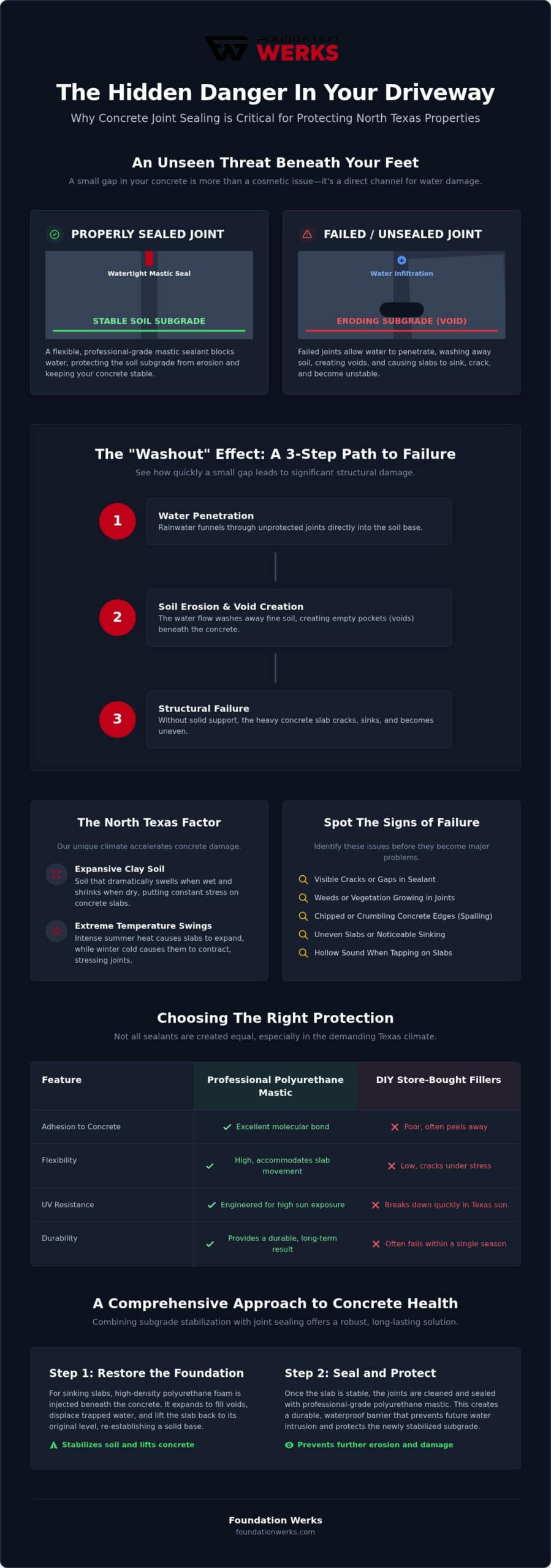
Not all sealants are created equal. You’ll often find “DIY” fillers at local hardware stores that rely on silicone or simple acrylics. These products frequently fail in the Dallas climate because they lack the necessary adhesion to porous concrete substrates. They tend to peel or pull away after just one season of temperature swings. Professional-grade polyurethane joint sealants are different. They bond deeply with the concrete at a molecular level, ensuring the seal remains intact even as the slabs move.
- Adhesion: Professional mastic sticks to the sidewalls of the joint, preventing water bypass.
- Flexibility: High-grade materials can stretch and compress repeatedly without tearing.
- UV Resistance: Texas sun breaks down cheap materials; professional sealants are designed for high UV exposure.
Choosing the right material ensures that your maintenance efforts provide a durable, long-term result. While no repair lasts forever in the ever-shifting Texas soil, using superior materials significantly extends the life of your concrete slabs and delays the need for more invasive repairs.
Protecting Your Subgrade: How Sealants Prevent Soil Erosion
Your concrete slabs are only as stable as the soil beneath them. Why is mastic or joint seal maintenance important in preserving my concrete slabs? The answer is largely invisible until the damage is done. When joint seals fail, every rainstorm turns those open gaps into funnels. Water rushes through the joints and begins the “washout” effect, where fine sediment is carried away from the subgrade. This process creates empty pockets, or voids, directly under your driveway or warehouse floor. Without a solid foundation of soil, the heavy concrete eventually cracks under its own weight or the weight of your vehicles.
Trapped water also creates a destructive phenomenon known as “pumping.” When a vehicle drives over a slab with a saturated subgrade, the concrete flexes. This movement acts like a piston, forcing water and liquefied soil back up through the open joints. Over time, this literally pumps the support system out from under your property. If you’ve already noticed hollow sounds when walking on your concrete, you likely need void filling to restore that lost support before sealing the joints to prevent further erosion.
The Danger of Subgrade Voids
Subgrade erosion is the #1 cause of sinking slabs. Even a narrow 1/4-inch gap in a joint can swallow hundreds of gallons of water during a typical North Texas downpour. These small openings lead to major structural failures because the erosion is rarely uniform. One corner of a slab might stay supported while another hangs over an empty void. This uneven support is exactly what causes those jagged, diagonal cracks that are so expensive to fix. By keeping your mastic intact, you ensure that water stays on the surface and flows toward your drainage system instead of under your slab.
Managing Hydrostatic Pressure
Water doesn’t just wash soil away; it also exerts a surprising amount of force. This is called hydrostatic pressure. During heavy rains, water trapped under an unsealed slab can actually push upward against the concrete. This pressure destabilizes the slab and makes it more prone to shifting. Why is mastic or joint seal maintenance important in preserving my concrete slabs during these wet cycles? It acts as the primary seal that keeps the subgrade dry and stable.
In areas with poor drainage, we often recommend installing French drains as a secondary defense. While the joint seal keeps water from entering through the top, a French drain manages the groundwater levels around the perimeter. Together, these systems ensure your soil stays at a consistent moisture level. If you’re concerned about the stability of your walkways, our team can help you determine if your property needs a combination of sealing and drainage updates to protect your investment.
The North Texas Factor: Why DFW Concrete Needs Extra Protection
Living in the Dallas-Fort Worth metroplex means your property is subject to some of the most challenging geological conditions in the country. While concrete in other states might fail due to freeze-thaw cycles, our issues stem from the ground itself. The soil here doesn’t just sit still; it moves constantly. This environmental stress is exactly why is mastic or joint seal maintenance important in preserving my concrete slabs in North Texas. Without a high-performance barrier, the unique characteristics of our local landscape will accelerate the deterioration of even the best-poured concrete.
Expansive Clay Soils and Slab Movement
If you live in McKinney, Frisco, or Dallas, you’re familiar with our expansive clay soil. This soil acts like a sponge, swelling significantly when it absorbs water and shrinking during our frequent droughts. This “Summer-Winter Cycle” puts immense pressure on your concrete joints. When the clay shrinks in July, it pulls away from the slabs, often widening the expansion joints and tearing low-quality sealants.
Standard, rigid fillers simply can’t keep up with this movement. They’ll snap or lose their bond within a single season. Why is mastic or joint seal maintenance important in preserving my concrete slabs in this environment? It provides a flexible seal that can stretch and compress without losing its watertight integrity. This flexibility is the only way to accommodate the rhythmic shifting of North Texas clay without allowing water to bypass the joint and reach the subgrade.
Heat, UV, and Thermal Expansion
The Dallas sun is another major factor that most generic maintenance guides overlook. On a typical 100-degree summer day, your concrete slabs can expand significantly. If your joints are open or filled with “incompressible” materials like Texas sand, gravel, or debris, the slabs have nowhere to go. They’ll press against these hard objects, leading to “point loading.” This concentrated pressure causes the edges of your slabs to chip and break, a process known as spalling.
Beyond physical expansion, the UV radiation in North Texas is incredibly high. Cheap, hardware-store sealants often dry out and become brittle under constant sun exposure, leading to “alligatoring” or deep cracks in the sealant itself. High-quality mastic must be UV-resistant to survive North Texas summers and remain pliable for years. By choosing professional-grade materials and keeping them maintained, you prevent debris from entering the joints and ensure the sealant doesn’t bake into a useless, brittle strip. This proactive care keeps your slabs moving freely and prevents the costly edge damage that often leads to a full replacement.
When to Maintain: Identifying Joint Seal Failure Before Damage Occurs
You don’t need to be a structural engineer to spot the early warning signs of a failing joint. Most issues start with subtle visual changes that, if ignored, lead to the structural failures we’ve already discussed. Understanding why is mastic or joint seal maintenance important in preserving my concrete slabs starts with knowing what “healthy” looks like. When a seal is intact, it should be a continuous, flexible barrier that’s firmly bonded to both sides of the concrete slab. If you see gaps, cracks, or peeling, the clock is already ticking on your subgrade’s stability.
Catching these failures early is the difference between a simple maintenance visit and a major construction project. Once water finds a path through a compromised seal, the erosion process begins immediately. If your driveway feels “bouncy” under your car or if you hear a hollow “thud” when walking over certain areas, the soil has likely already begun to wash out. These cues are your property’s way of telling you that the primary defense system has failed.
A 5-Point Joint Health Checklist
Regular inspections can save you from the stress of unexpected slab settlement. We recommend checking your joints twice a year, ideally before the heavy spring rains and after the peak summer heat. Use this checklist to evaluate your property’s needs:
- Loss of Bond: Look for hairline gaps between the sealant and the concrete edge. If you can slide a business card into the gap, water can get in too.
- Backer Rod Visibility: If you can see the foam “rope” underneath the mastic, the sealant has reached the end of its life and needs replacement.
- Pumping Signs: Watch for muddy water stains or dried silt near the joints after a rainstorm. This indicates water is moving soil under your slabs.
- Debris Accumulation: Check for rocks, sand, or twigs wedged in the joints. As we discussed, these “incompressible” materials cause spalling during heat cycles.
- Vegetation Growth: Weeds growing through a joint are a clear sign that the seal is gone and a fertile environment of wet soil exists underneath.
The Cost of Procrastination
The financial benefit of early maintenance is undeniable. A proactive joint sealing project is a fraction of the concrete replacement vs lifting cost you’ll face once the slab actually sinks. In commercial settings, the stakes are even higher. Ignoring a failing seal leads to trip hazards and liability risks that can’t be ignored. Deferred maintenance often turns a simple seal job into a complex project requiring commercial concrete repair in McKinney to stabilize the foundation.
Think of mastic maintenance like changing the oil in your car. It’s a small, routine investment that prevents a total engine failure. By keeping your joints sealed, you ensure your concrete remains level and safe for years to come without the need for a full-scale replacement.
Protect your property with a professional joint seal inspection
Long-Term Solutions: Integrating Joint Repair with Polyurethane Stabilization
Lifting a sunken slab without sealing the joints is like filling a bucket that has a hole in the bottom. You’ve addressed the immediate symptom of settlement, but the underlying cause remains active. This is exactly why Polyurethane Concrete Raising is the ideal partner for professional mastic installation. While the foam restores the height and fills the voids we discussed earlier, the joint seal acts as the shield that keeps that new support system dry and stable.
The Foundation Werks process follows a methodical “Lift, Level, Stabilize, and Seal” approach. We use high-density, eco-conscious polyurethane foam to gently nudge slabs back into place. Unlike traditional mudjacking, which uses heavy, wet slurry that can add extra stress to the soil, foam is lightweight and waterproof. It won’t wash away if water gets underneath, but it works best when it doesn’t have to fight the elements. Why is mastic or joint seal maintenance important in preserving my concrete slabs after they’ve been lifted? It ensures the foam and the subgrade stay in a “closed system,” protected from the North Texas rain and the “pumping” effect of traffic.
Why Leveling Needs Sealing to Last
Lifting fixes the current height, but sealing prevents the next sink. When we perform polyurethane injection, we drill small 5/8-inch holes, about the size of a dime, to deliver the material. Once the slab is level and the voids are filled, those holes are patched and the expansion joints are cleaned. If those joints aren’t sealed with professional-grade mastic immediately after the lift, you’re leaving the door open for water to re-enter and start the erosion process all over again.
A properly sealed joint creates a watertight cap over the entire subgrade. This is why is mastic or joint seal maintenance important in preserving my concrete slabs over the long term. It transforms your driveway or warehouse floor from a collection of individual, vulnerable pieces into a unified, protected system. One of the biggest benefits of this integrated approach is immediate usability. Because the foam cures in about 15 minutes and the mastic skins over quickly, you can often walk or drive on your concrete the very same day the work is completed.
The Foundation Werks Approach in DFW
Our team understands the specific local standards required for McKinney, Frisco, and Dallas properties. We don’t just apply a generic fix; we use materials designed for the expansive clay and high UV exposure unique to our region. Our polyurethane foam is made from eco-conscious, recycled materials, providing a durable update that respects the environment while delivering industrial-strength stabilization.
Don’t wait for a small gap to turn into a major trip hazard or a structural failure. Whether your slabs have already settled or you simply want to prevent future issues, we can help. Reach out to Foundation Werks today for a free estimate in the North Dallas area, and let’s ensure your concrete stays level and protected for years to come.
Secure Your Property’s Foundation Today
Maintaining the joints between your concrete slabs isn’t just about curb appeal; it’s about structural survival in our unique North Texas environment. By keeping water and debris out of your expansion joints, you prevent the soil erosion and subgrade voids that lead to expensive settlement. Understanding why is mastic or joint seal maintenance important in preserving my concrete slabs allows you to move from reactive repairs to proactive property care. It’s the most effective way to ensure your driveway or walkway stays level through every season.
Foundation Werks provides expert solutions across McKinney, Frisco, and the entire DFW Metroplex. Our approach combines patented eco-conscious polyurethane foam technology with professional-grade mastic installation. This ensures your driveway or walkway remains level and protected while offering same-day usability for all concrete repairs. You don’t have to wait for major cracks to appear before taking action. We’re here to help you navigate the challenges of expansive clay soils with confidence and reliability.
Take the first step toward a safer, more stable property today. We look forward to helping you extend the life of your concrete.
Frequently Asked Questions
How often should I have my concrete joints inspected and resealed?
You should have your concrete joints inspected annually and professionally resealed every two to three years. This schedule is standard for North Texas properties because our extreme heat and expansive clay soil cause significant movement. Frequent checks allow you to catch small separations in the bond before water reaches the subgrade. Maintaining this rhythm ensures the closed system protecting your foundation remains fully functional and prevents the need for more invasive repairs.
Can I use regular silicone caulk from a big-box store for my driveway joints?
You shouldn’t use standard silicone caulk because it lacks the necessary adhesion and durability for porous concrete surfaces. Big-box store products often fail to bond with the sidewalls of the joint, leading to peeling within a single season of Texas weather. Professional-grade polyurethane mastic is specifically engineered to handle the thermal expansion and UV radiation common in Dallas. It provides the flexibility required for a long-term solution that protects your investment.
What is the difference between mastic and a standard concrete expansion joint?
An expansion joint is the physical gap between slabs, while mastic is the flexible material that fills and seals that gap. The joint itself allows the concrete to move without cracking, but without mastic, the gap is open to water and debris. Why is mastic or joint seal maintenance important in preserving my concrete slabs? It’s the component that keeps the joint waterproof and prevents the washout effect under the slabs.
Will sealing my concrete joints stop my driveway from sinking further?
Sealing alone won’t lift a slab that has already settled, but it stops the primary cause of future sinking. By preventing water from reaching the soil, you eliminate the erosion that creates voids. If your driveway has already sunk, we recommend combining joint sealing with polyurethane concrete raising. This integrated approach restores the slab’s height and then seals it to maintain that stability over the long term.
How long does the mastic installation process take for a standard driveway?
A standard residential driveway usually takes about half a day to complete. This includes cleaning out old debris, prepping the joint edges, and applying the new sealant. One of the biggest advantages is that the material skins over quickly. You can typically walk on the surface almost immediately and drive your vehicle over the new seals within just a few hours of the professional installation being finished.
Is it better to seal joints in the summer or the winter in Texas?
Spring and fall are the ideal times for installation, but we can seal joints year-round in Texas. In the summer, concrete expands and joints are at their narrowest; in the winter, they’re at their widest. Our professional-grade sealants are designed to handle these extremes regardless of the season. The most important factor is ensuring the joints are dry during the actual application to ensure a strong, lasting bond with the concrete.
What happens if I ignore the weeds and dirt growing in my concrete cracks?
Ignoring vegetation and debris leads to point loading and spalling. As dirt and rocks fill the joints, they become incompressible. When the concrete expands in the heat, it presses against these hard materials instead of a flexible seal; this causes the edges of your slabs to chip and break. Additionally, weeds indicate that water is already present in the subgrade, which accelerates the erosion process and eventually leads to significant slab settlement.
Can mastic be applied to pool decks as well as driveways?
Yes, mastic is an essential component for preserving pool decks and preventing deck-to-coping separation. Pool environments are constantly exposed to water and chemicals, making a watertight seal even more critical for the structure. Why is mastic or joint seal maintenance important in preserving my concrete slabs in a pool area? It prevents water from seeping behind the pool wall, which can lead to expensive structural repairs or coping stones coming loose.