
What if a half-inch gap in your loading dock was actually a $16,550 liability waiting to happen? You’ve likely noticed those uneven joints causing your forklifts to jar or your pallets to wobble. It’s a common frustration for facility managers who balance safety with the intense pressure of high-volume output. You shouldn’t have to choose between a level surface and your daily production targets. Modern warehouse floor stabilization has evolved into a high-speed logistical strategy that addresses the root cause of sinking slabs without the mess or delay of a full tear-out.
We understand that your floor is the foundation of your entire operation. This 2026 guide will show you how to resolve sunken slabs and eliminate OSHA trip hazards using high-density polyurethane injection. You’ll discover a method that’s 50% more cost-effective than pouring new concrete and allows your team to get back to work the same day. We’ll walk through the technical standards for 2026, the mechanics of void filling, and how to secure long-term stability for your facility.
Key Takeaways
- Understand the specific geological factors in North Texas that trigger slab sinking and how to identify them before they become costly OSHA violations.
- Compare modern polyurethane injection to traditional mudjacking to see why the lighter 2lb foam prevents the secondary settling often caused by heavy slurries.
- Calculate the ROI of warehouse floor stabilization, which typically costs half as much as replacement and eliminates operational downtime.
- Explore how integrated solutions like joint sealing and French drain installation provide long-term resolutions by addressing the root cause of soil erosion.
- See how precision foam lifting uses nearly invisible 5/8-inch drill holes to restore a level surface that’s ready for heavy forklift traffic on the same day.
Identifying the Root Causes of Warehouse Floor Instability in North Texas
In the Dallas-Fort Worth region, warehouse floor stabilization isn’t just about fixing concrete; it’s about managing the volatile soil beneath it. North Texas is famous for its expansive clay. This soil acts like a geological sponge, undergoing extreme volume changes based on moisture levels. During our intense, dry summers, the clay contracts and pulls away from the slab. When the rains return, it swells with immense pressure. This constant movement creates hollow spaces, or voids, that leave your industrial floor suspended without proper support.
The problem accelerates when you add the weight of 40 foot racking systems and heavy forklift traffic. These loads exert dynamic force that a hollow subgrade cannot resist. Every time a hard wheeled forklift crosses a joint, it hammers the concrete. If there’s a void underneath, the slab deflects. Over time, this leads to “rocking slabs” where the concrete physically moves under load, further crushing the soil and widening the gap between the floor and its foundation.
Soil Erosion and Void Formation
Water is often the silent culprit behind slab failure. Poorly maintained gutters or inadequate drainage systems allow water to pool near the foundation, where it eventually seeps under the floor. This moisture washes away the fine particles in the subgrade, leaving behind significant hollows. When evaluating solutions like Polyurethane Injection vs. Mudjacking, it’s clear that filling these voids is the only way to restore structural integrity. You should watch for these visual signs of sub-surface trouble:
- Hairline cracks that radiate from the corners of slabs or widen near joints.
- “Pumping” at joints, where dust or moisture is forced out when a forklift passes over.
- A hollow sound when tapping the concrete or visible dipping in high traffic lanes.
The Logistics Impact: Why Level Floors Matter
A sunken floor is more than an aesthetic issue; it’s a direct threat to your operational efficiency. Uneven joints are the primary cause of premature wear on material handling equipment (MHE). Most industrial forklifts have no suspension. Every bump translates directly into the mast, the tires, and the operator’s joints. This leads to increased maintenance costs and potential worker compensation claims.
Safety compliance is another major driver for warehouse floor stabilization. OSHA typically identifies vertical displacements of 1/4 inch or more as trip hazards. Beyond the risk of fines, there’s the hidden cost of “ghost” downtime. Operators naturally slow down to navigate damaged floors, which reduces your picks per hour and overall throughput. Maintaining a level surface is a fundamental requirement for a high speed, safe logistics environment.
Polyurethane Injection vs. Mudjacking: The Modern Industrial Standard
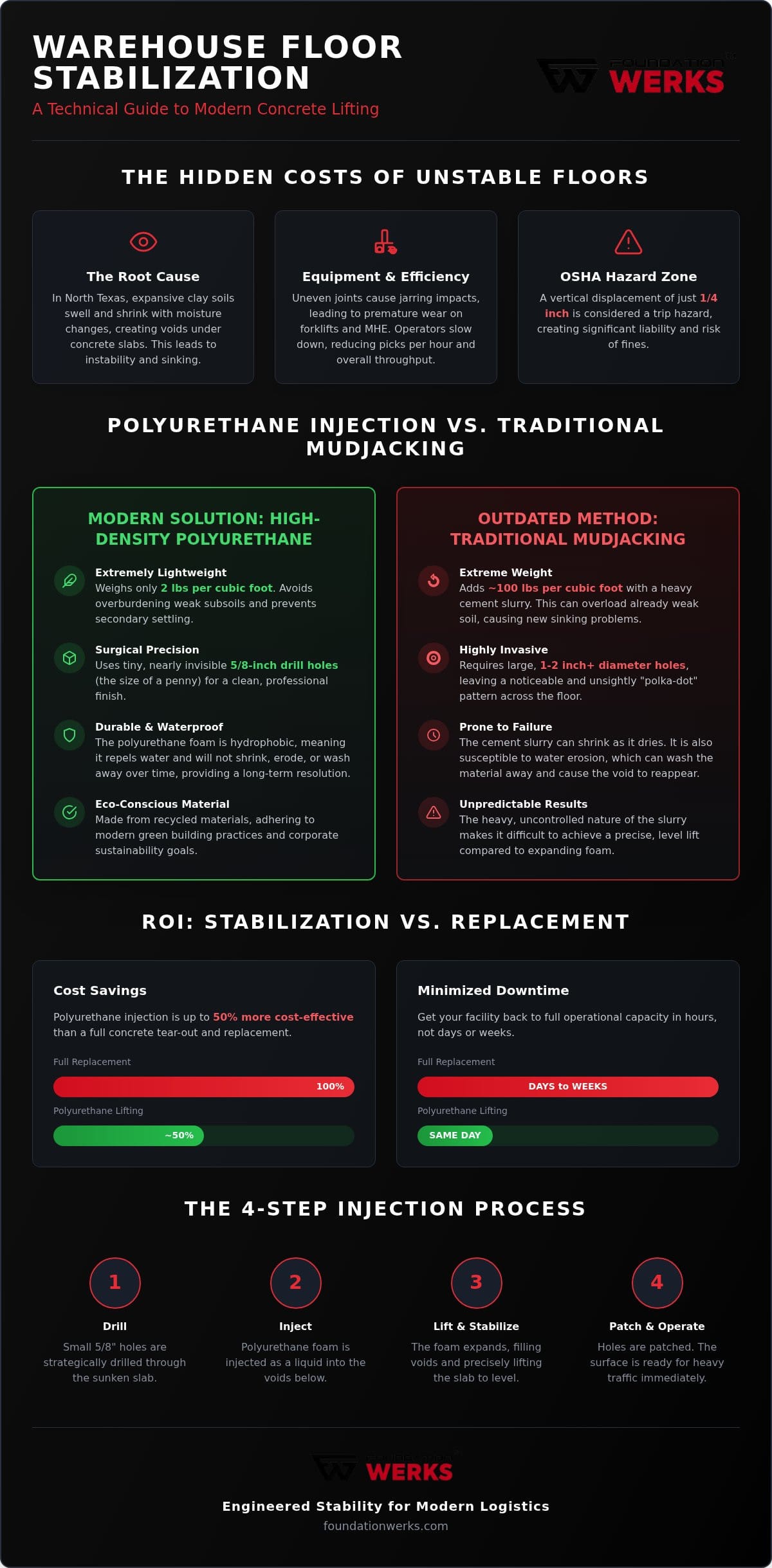
Traditional mudjacking has been around for decades, but it’s often the wrong choice for modern industrial environments. The primary issue is weight. Mudjacking uses a heavy slurry of sand, cement, and soil that weighs roughly 100 pounds per cubic foot. In the expansive clay soils of North Texas, adding that much mass to a failing subgrade is often counterproductive. It can trigger secondary settling because the weak soil beneath simply can’t support the new weight. It’s like trying to fix a sinking ship by adding more lead to the hull.
In contrast, high-density polyurethane weighs only 2 pounds per cubic foot. This lightweight profile provides effective warehouse floor stabilization without overloading the soil. It’s a precision tool rather than a blunt instrument. We use 5/8-inch drill holes, about the size of a penny, which are nearly invisible once patched. Traditional mudjacking requires much larger holes that often leave a “polka-dot” look across your facility. Sustainability also matters for modern corporate goals. We use a patented, eco-conscious foam made from recycled materials, allowing you to achieve structural goals while adhering to green building practices.
The Science of High-Density Polyurethane Foam
The material starts as a liquid and expands rapidly once injected. This expansion allows it to flow into every micro-void and hairline crack, ensuring a long-term resolution. Unlike mudjacking slurry, which can shrink or wash away over time, polyurethane is hydrophobic. It resists water and never loses its density. It’s engineered to meet Comprehensive Stabilization and Drainage Strategies, providing enough compressive strength to support high-rack loads and heavy material handling equipment.
Application Process in Active Facilities
We understand that your warehouse can’t stop moving. Polyurethane requires fewer injection points than traditional grouting, meaning we don’t have to tear up your entire floor layout. Our equipment is non-invasive and doesn’t produce the messy grout splatter or dust associated with older methods. There’s no need for a heavy wash-down or a professional cleaning crew after we leave. If you’re noticing rocking slabs or uneven joints, it’s helpful to consult with a specialist who understands the nuances of industrial subgrades. Our process is designed to be as quiet and clean as possible, keeping your operations on schedule.
Concrete Lifting vs. Replacement: Calculating ROI and Downtime
When faced with a sunken slab, many facility managers assume a full tear-out is the only answer. That’s a costly mistake. For most industrial applications, warehouse floor stabilization via polyurethane injection is about 50% more cost-effective than replacement. You aren’t just saving on the material costs. You’re avoiding the massive labor expense of demolition, hauling, and disposal of old concrete debris. In an era where every budget line is scrutinized, choosing a repair that costs half as much as replacement is a clear win for the bottom line.
The real ROI shows up in your production schedule. New industrial concrete typically requires a 28-day cure time before it can handle the weight of heavy forklift traffic. In a high-volume warehouse, losing a loading dock or a main aisle for a month is often unacceptable. Polyurethane foam cures in minutes. You can walk on the slab immediately and drive heavy machinery on it the same day. This speed eliminates the massive opportunity cost of stalled operations.
There’s also the risk to existing infrastructure. Modern facilities often have embedded sensors, guide rails for automated systems, or complex heating and cooling lines. A full replacement puts these assets at risk of damage during the demolition phase. Precision lifting restores the floor’s level without disturbing what’s already inside the concrete, preserving your facility’s technology and structural integrity.
Operational Continuity: Zero-Downtime Logistics
We work around your schedule. Repairs can often be completed in a few hours during off-peak shifts or over a weekend. This flexibility means you don’t have to shut down loading docks or redirect traffic for weeks. Because there’s no heavy demolition, you don’t have to worry about dust or the liability of an open construction zone in a working facility. It’s a clean, quiet process that keeps your logistics moving without the typical headaches of a construction site.
Long-Term Structural Value
Proactive stabilization does more than just level the surface. It protects the slab edges from spalling and prevents further cracking by filling the voids created by soil movement. Maintaining a level floor preserves the value of your commercial real estate and extends the life of your material handling equipment. To see how these savings add up, check out how warehouse floor joint repair Dallas saves on total replacement costs. Investing in warehouse floor stabilization today prevents the “run-to-failure” cycle that leads to catastrophic floor failure and much larger capital expenditures later.
Beyond the Lift: Comprehensive Stabilization and Drainage Strategies
Lifting a slab is a critical first step, but warehouse floor stabilization requires a holistic approach to prevent the problem from returning. If you don’t address why the soil failed in the first place, you’re just treating the symptom. Most slab movement in North Texas stems from moisture mismanagement and unprotected joints. By combining precision lifting with professional grade sealing and drainage, you create a system that resists the natural cycles of the local clay soil. It’s about building a defense that keeps the subgrade dry and the concrete edges protected.
Commercial Concrete Joint Repair
Joints are the most vulnerable part of any industrial floor. When the joint filler fails, water seeps through to the subgrade, and forklift tires begin to chip away at the exposed concrete edges. This edge spalling isn’t just a trip hazard; it’s a sign that the slab is losing its structural support. For a deeper look at managing these issues, read our guide to concrete crack repair commercial. We use professional mastic installation to create a flexible, watertight seal that moves with your building while keeping the subgrade dry and stable.
Industrial Drainage Solutions
Water management is the foundation of long term soil stability. Commercial roofs collect massive amounts of runoff, which often dumps directly next to the foundation. If this water isn’t redirected, it will eventually find its way under your warehouse floor. We install industrial French drains to intercept this water and move it safely away from the structure. This prevents the erosion cycles that create the voids we fill during the lifting process. It’s a simple addition that pays for itself by preventing future settling.
For exterior areas like loading docks, gravel lots, or blacktop approaches, we use Deep Foamjection. This process stabilizes the soil at deeper levels, providing a solid base for heavy vehicle traffic. Creating a comprehensive maintenance plan that includes regular joint inspections and drainage checks is the best way to avoid the need for emergency repairs. It’s about being proactive rather than reactive, ensuring your facility remains a high traffic logistics hub without the constant worry of floor failure.
Implementing a Warehouse Stabilization Plan with Foundation Werks
Choosing a partner for your industrial concrete repair is about more than just finding someone with a foam gun. It’s about working with a team that understands the logistical pressures of a DFW distribution center. At Foundation Werks, we approach warehouse floor stabilization as a specialized engineering task. We don’t just fill holes; we restore the structural integrity of your facility using methods that respect your timeline and your corporate sustainability goals. Our use of patented, eco-friendly foam made from recycled materials ensures that your maintenance remains as green as it is effective.
We’ve built our reputation on transparency and technical precision. When you work with us, you’re getting a neighborly approach backed by industrial strength expertise. We take pride in our quiet innovation, providing long-term resolutions that allow you to focus on your core business rather than worrying about the ground beneath your feet. From the first assessment to the final injection, our goal is to provide a seamless experience that minimizes your stress and maximizes your floor’s lifespan.
Our Local Expertise in North Texas
The DFW metroplex presents unique challenges that out-of-state contractors often overlook. The expansive clay soil in areas like McKinney, Frisco, Southlake, and North Dallas requires a specific understanding of how moisture cycles affect large scale slabs. We’ve spent years perfecting our techniques in this specific environment, successfully stabilizing logistics hubs across the region. Dealing with an uneven warehouse floor repair Dallas? We’ve likely resolved a similar issue for a facility just down the road from you. Our local case studies highlight our ability to lift heavy-load slabs and secure joints in some of the busiest warehouses in Texas.
Getting Started: Your Facility Assessment
Every project begins with a thorough, professional assessment. We don’t believe in one-size-fits-all solutions. Instead, we follow a methodical three step process to ensure your facility gets exactly what it needs:
- Step 1: We identify every trip hazard over the 1/4-inch OSHA threshold and use specialized equipment to locate subsurface voids.
- Step 2: Our team engineers a custom injection plan tailored to your floor’s specific load requirements and traffic patterns.
- Step 3: We execute the lift with rapid precision, allowing for an immediate return to service so your forklifts can keep moving.
Secure Your Facility’s Foundation for the Future
Maintaining a safe and efficient loading environment doesn’t require weeks of downtime or a massive capital expenditure. By choosing modern warehouse floor stabilization, you’re investing in a solution that respects both your budget and your operational schedule. You’ve seen how high-density polyurethane resolves the unique challenges of North Texas soil while offering 50% cost savings compared to full concrete replacement. It’s a strategic choice that prioritizes long-term structural health over temporary surface patches.
Our process uses patented eco-friendly foam made from recycled materials, ensuring your facility meets modern sustainability standards without sacrificing performance. With nearly invisible injection points and same-day usability for heavy machinery, you can eliminate OSHA trip hazards without missing a single shipment. We take pride in delivering results that keep your team safe and your forklifts moving at peak efficiency. Our team is ready to provide the technical expertise and reliable service your facility deserves.
Your floor is the literal base of your business success. We’re here to help you keep it level, safe, and ready for whatever the next shift brings. Let’s build a more stable future for your facility together.
Frequently Asked Questions
How quickly can we use the warehouse floor after polyurethane injection?
You can use your warehouse floor immediately after the job is finished. Our polyurethane material cures in minutes, allowing for same-day walking and driving. This is a critical advantage for logistics hubs in the DFW metroplex that can’t afford operational delays. Unlike new concrete pours that require weeks of curing, our foam injection process lets you resume heavy machinery traffic without skipping a single shift.
Is polyurethane foam strong enough to support heavy forklifts and racking?
Yes, high-density polyurethane is specifically engineered to support the extreme weight of industrial racking and heavy material handling equipment. While the foam itself is lightweight at 2 pounds per cubic foot, its compressive strength is formidable. It effectively fills the voids beneath the slab to provide a stable, solid base. This ensures your facility’s infrastructure remains secure under the heaviest loads common in North Dallas distribution centers.
Will the foam material lose density or break down over time?
The polyurethane material we use for warehouse floor stabilization is hydrophobic and does not lose density over time. Because it doesn’t absorb water or wash away like soil or mudjacking slurry, it provides a long-term structural resolution for sunken slabs. It maintains its volume and strength regardless of the moisture cycles in the North Texas clay, preventing the return of hollow spaces beneath your concrete floor.
How much does warehouse floor stabilization cost compared to replacement?
Professional warehouse floor stabilization typically costs about 50% less than a full concrete replacement. When you factor in the avoided costs of demolition, hauling away old debris, and the massive expense of operational downtime, the savings are even more significant. For facility managers in McKinney and Frisco, this represents a cost-effective way to maintain high safety standards and OSHA compliance without a massive capital expenditure.
Can all sunken warehouse slabs be raised, or are some too damaged?
Most solid concrete slabs can be successfully raised and stabilized using our foam injection methods. However, if a slab is severely shattered into small, disconnected pieces, it may be too damaged for a precision lift. During our free commercial assessment, we’ll examine the structural integrity of your floor to determine if stabilization is a viable option or if a partial concrete replacement is necessary for your facility.
What is the difference between polyurethane lifting and traditional mudjacking?
The primary difference is weight and precision. Mudjacking uses a heavy slurry weighing 100 pounds per cubic foot, which can cause further sinking in weak DFW soils. Polyurethane weighs only 2 pounds per cubic foot. Additionally, we use nearly invisible 5/8-inch drill holes, whereas mudjacking requires much larger holes. Our process is cleaner, faster, and requires fewer injection points to achieve a level and stable surface.
Does Foundation Werks offer warranties on industrial floor stabilization?
Foundation Werks takes great pride in our reputation for reliability and follow-through. We provide warranties on our industrial stabilization projects to give facility managers peace of mind. Our team stands behind every injection we perform in the Dallas area, ensuring that the work meets our high standards for quality and durability. We’ll discuss the specific terms of your warranty during the initial project proposal and assessment phase.
Will the injection process cause significant dust or debris in my facility?
No, our process is exceptionally clean and won’t create a mess in your facility. There’s no grout splatter, dust clouds, or heavy wash-down requirements involved in the injection. Because we don’t use heavy equipment that traverses your property, we preserve your facility’s aesthetics and landscaping. We understand that maintaining a professional, clean warehouse environment is essential for your logistics operations and your site’s safety protocols.