

Could the very ground your pool sits on be working against you? If you’ve noticed a growing gap between your coping and the concrete, you’re likely asking, why is my pool deck sinking McKinney Texas? It’s a frustrating sight that turns a backyard oasis into a series of trip hazards and ugly cracks. You aren’t alone in this worry. Many North Texas homeowners feel a sense of dread when they see their outdoor living space start to settle, fearing that an expensive pool replacement is the only way out.
The good news is that your sinking deck is often a symptom of McKinney’s Blackland Prairie clay rather than a structural failure of the pool itself. In this guide, you’ll discover how the extreme expansion and contraction of our local soil causes concrete to shift. We’ll also explain why adding more heavy material can actually make the problem worse. You’ll learn how modern polyurethane lifting provides a lightweight, long-term resolution that restores your level walking surface in a single afternoon. We’re here to help you understand exactly what’s happening beneath the surface so you can protect your investment without the mess of a full demolition.
Key Takeaways
- Learn how high-plasticity Blackland Prairie clay causes pool decks to shift during North Texas weather cycles.
- Understand why is my pool deck sinking McKinney Texas and how poor drainage creates dangerous hidden voids under your concrete.
- Discover why lightweight 2lb polyurethane foam is safer for your pool than traditional 100lb mudjacking grout.
- See how precision 5/8-inch holes allow for a clean repair that’s ready for foot traffic the very same day.
- Learn why a long-term resolution focuses on stabilizing the soil to manage the natural movement of our local terrain.
Understanding Why Pool Decks Sink in McKinney, Texas
Many homeowners assume they have a “concrete problem” when they see their pool deck start to dip or pull away. In reality, you likely have a soil problem. If you’ve been asking why is my pool deck sinking McKinney Texas, the answer lies beneath your feet in the form of Blackland Prairie clay. This specific type of soil is famous among local builders for its high plasticity. This means it changes volume significantly based on moisture levels. It isn’t a reflection of the quality of your concrete, but rather a result of the volatile environment it sits on.
The McKinney Clay Factor: Expansion and Contraction
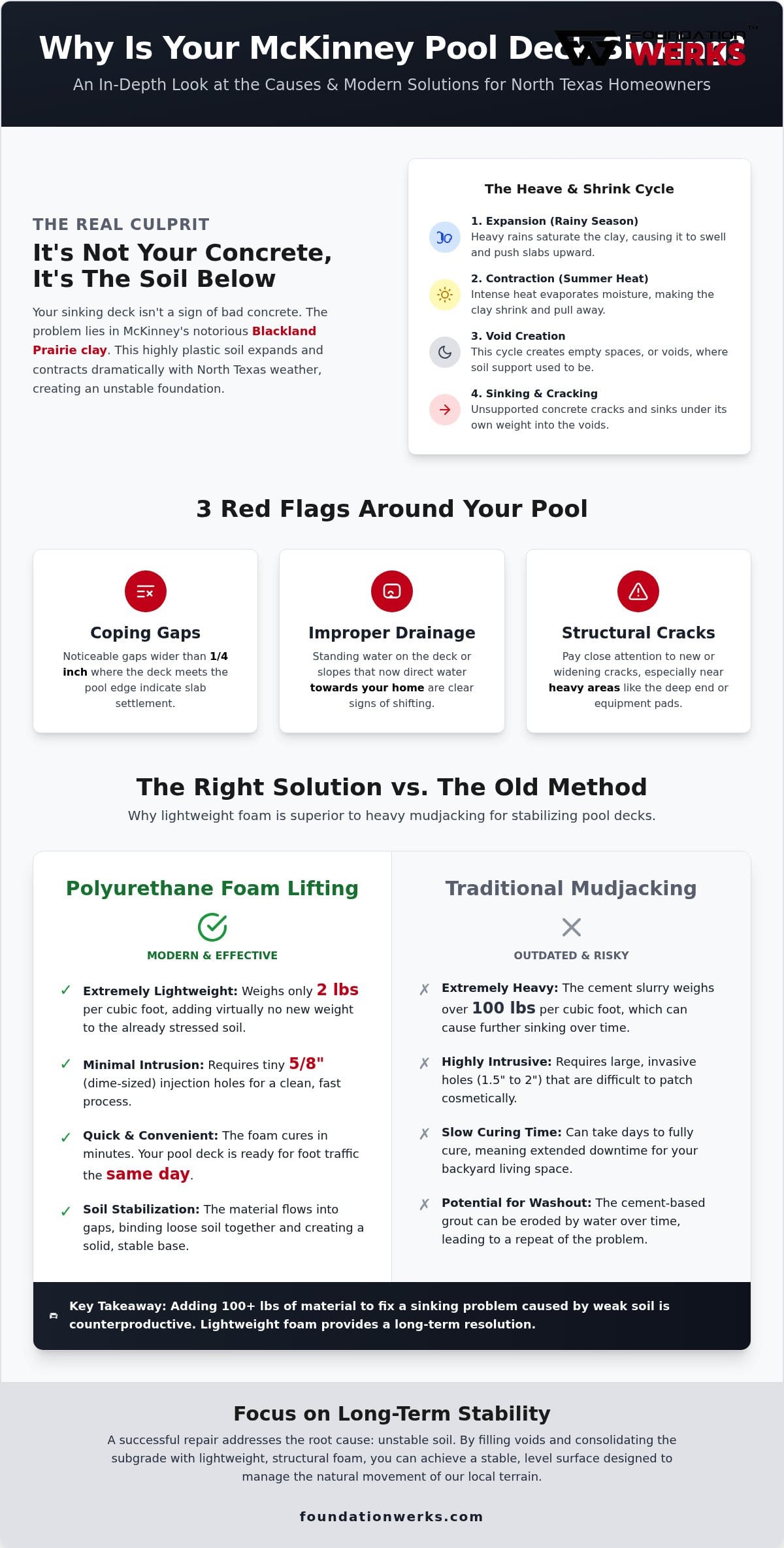
McKinney’s native clay acts like a giant sponge. During a typical North Texas spring, heavy rains saturate the ground, causing the clay to expand and push upward. When the intense summer heat arrives, that moisture evaporates. The soil then shrinks and pulls away from the concrete slab. This relentless cycle of “heave and shrink” eventually leaves empty spaces, or voids, under your deck. Because pool decks are constantly exposed to splash-out and evaporation, they experience these shifts more intensely than other parts of your property. The soil simply can’t provide a stable foundation when it’s constantly moving.
Identifying the ‘Red Flags’ Around Your Pool
You don’t need a degree in geology to spot the early signs of soil failure. Recognizing these issues early can prevent a minor slope from becoming a major trip hazard. Watch for these common indicators:
- Coping Gaps: Look at the joint where your deck meets the pool tile or coping. If you see a gap wider than 1/4 inch, the slab is likely settling or pulling away.
- Improper Drainage: Concrete is designed to shed water away from the pool. If you notice standing water on the deck or slopes that point toward your home, the subgrade has shifted.
- Structural Cracks: Pay attention to cracks that align with the deep end or pool equipment pads. These areas carry more weight and are often the first to show signs of soil fatigue.
It’s helpful to remember that even the best-poured slabs can’t withstand the movement of McKinney’s clay without proper support. When the soil underneath shrinks, it leaves the concrete hanging in mid-air. Gravity eventually wins, and the slab drops to find the new soil level. Understanding this cycle is the first step in finding a resolution that addresses the root cause of the movement.
The Role of Drainage and Soil Erosion in Pool Deck Failure
While the native clay soil sets the stage for movement, water is almost always the lead actor in the drama of a settling slab. If you are investigating why is my pool deck sinking McKinney Texas, the answer often flows from your roof or your pool edge. When water isn’t managed properly, it becomes a powerful erosive force that physically removes the support system beneath your concrete. This creates a “void,” or an empty pocket of air, where solid earth used to be. Without that soil to lean on, the heavy concrete slab inevitably drops.
Many homeowners try to address this by simply patching the surface cracks. While this might look better for a few weeks, it does nothing to fill the hollow space underneath. Patching is a cosmetic response to a structural problem. If the void remains, the sinking will continue regardless of how much caulk or mortar you apply to the surface. Furthermore, a sinking pool deck often slopes toward the home, which can lead to water pooling against your foundation and creating even more expensive issues elsewhere.
Erosion: The Silent Deck Killer
Erosion often happens out of sight. During McKinney’s heavy spring rains, water can find its way into small gaps between the pool coping and the deck. As the water rushes through these openings, it carries fine soil particles away with it. You might notice small mounds of dirt or “washout” areas near the edge of your yard where this soil has migrated. These voids create weak spots. Eventually, the concrete loses its ability to bridge the gap and snaps, leading to the sudden cracks and trip hazards that make your backyard unsafe for guests.
Integrated Solutions: French Drains and Gutter Control
Diverting water is the most effective way to protect your pool area after a repair. One of the most common culprits we see is a gutter downspout that discharges directly onto the pool deck or right at the edge of the concrete. This concentrated flow of water acts like a pressure washer on the subgrade soil. To prevent future settling, it’s vital to ensure your gutters are piped away from the pool perimeter.
For yards with natural slopes that trap water near the pool, French drain installation provides a reliable way to intercept surface water before it can do damage. By creating a dedicated path for water to follow, you stop the erosion cycle at its source. Combining professional soil stabilization with smart drainage management ensures your outdoor space remains level and safe for years to come. Understanding these water patterns is a key part of our process when we evaluate a sinking deck.
Polyurethane Foam vs. Mudjacking: Which is Safer for Your Pool?
When homeowners ask why is my pool deck sinking McKinney Texas, they’re usually looking for a way to stop the drop without destroying their backyard. For decades, mudjacking was the standard answer. This process involves pumping a heavy slurry of sand, cement, and soil under the slab. While it can lift the concrete, it often creates a new set of problems for your property. The biggest issue is weight. Mudjacking material weighs roughly 100 pounds per cubic foot. When you add that much mass to the already soft, unstable clay common in our area, you’re essentially putting a heavy anchor on top of a weak foundation. This often leads to the deck sinking again because the soil simply can’t support the new load.
Polyurethane foam offers a much smarter alternative. It weighs only about 2 pounds per cubic foot. It’s strong enough to lift a multi-ton concrete slab but light enough that it won’t cause the underlying soil to collapse further. Beyond the weight, the physical footprint of the repair is much smaller. Mudjacking requires large 1 to 2-inch holes drilled throughout your deck, which are difficult to hide later. Our polyurethane method uses tiny 5/8-inch holes that are nearly invisible once the job is done. This keeps your pool area looking clean and professional.
Protecting the Pool Bond Beam
The bond beam is the thick, reinforced concrete ring that runs around the top edge of your pool. It’s the structural heart of the vessel and the most expensive part to repair if it cracks. Mudjacking pumps move material at high pressure, which can create intense lateral force. This pressure can push against the bond beam and cause structural damage or tile popping. Because polyurethane foam expands naturally and is injected at a lower pressure, it lifts the slab without putting that dangerous stress on your pool’s internal structure. It’s a precision tool rather than a blunt instrument, allowing for a controlled lift that respects the integrity of your pool.
Material Density and Longevity
Longevity is a major concern for any homeowner. Traditional mudjacking grout is essentially dirt and cement, which can eventually erode or wash away if another drainage issue occurs. Polyurethane is different. It’s a closed-cell material that never loses its density and won’t wash out even in the wettest McKinney spring. We use an eco-conscious foam made from recycled materials, so you’re choosing a sustainable resolution for your home. Best of all, there’s no waiting period for the material to cure. You can walk on your deck and host a pool party just minutes after we finish the lift, providing immediate usability for your family.
The Restoration Process: What McKinney Homeowners Should Expect
When you realize why is my pool deck sinking McKinney Texas, you want a resolution that doesn’t turn your backyard into a construction zone. Our restoration process is designed to be surgical and efficient. We start by drilling nearly invisible 5/8-inch holes in strategic locations across the affected slabs. These holes are roughly the size of a penny, ensuring your deck’s aesthetic remains intact while we gain access to the voids beneath.
Next, we inject our eco-conscious polyurethane foam through these ports. We monitor the lift in real-time with laser precision. This ensures we don’t over-lift or put unnecessary pressure on your pool’s structural components. Our foam is formulated from recycled materials, making it a sustainable choice for your home. Once the deck is safe and even, we carefully patch the drill holes with a custom concrete mix that matches your existing surface for a seamless finish.
A Clean Work Environment for Your Pool
One of the biggest advantages of polyurethane is the lack of mess. Traditional methods often involve heavy trucks and wet grout that can splatter into your pool water, leading to cloudy filters and chemistry issues. We don’t require dusty wash-downs or heavy equipment traversing your McKinney landscaping. Our equipment stays on the street or in the driveway, and we only run small hoses to your pool area. This protects your expensive flower beds and irrigation systems from heavy tire ruts. Our “Same-Day” promise means you can swim and play as soon as our crew leaves. There’s no waiting for heavy concrete to cure or worrying about a ruined lawn.
Void Filling and Stabilization
Understanding why is my pool deck sinking McKinney Texas helps you appreciate the need for deep stabilization. The foam expands in all directions, reaching into the smallest crevices created by our shifting clay. It doesn’t just lift the slab; it fills the empty pockets of air that cause future failure. In cases where the soil is unstable several feet down, we utilize Deep Foamjection™ to stabilize deeper layers. This ensures the slab is fully supported across its entire surface, not just propped up at the edges. By addressing the voids thoroughly, we provide a long-term resolution that manages the unique challenges of our North Texas soil.
Managing Expectations: Long-Term Stability for North Texas Concrete
Living in North Texas means accepting that the ground beneath us is constantly in flux. When you ask why is my pool deck sinking McKinney Texas, you’re looking for a way to stop the cycle of settling and cracking. While we can’t change the nature of the heavy clay soil, we can provide a reliable resolution that focuses on stabilization. It’s about managing the environment to keep your surfaces level for years to come. We don’t promise an eternal solution because we know the soil will continue to expand and contract with the seasons. Instead, we offer a technical approach that addresses the current voids and reinforces the subgrade to minimize future movement.
Preserving Your Investment with Mastic Maintenance
Water is the primary catalyst for soil movement in our area. Once your deck is lifted, keeping water from reaching the subgrade again is your most important task. This is where joint seals and mastic come into play. These flexible barriers sit between the pool coping and the deck slabs, acting as a waterproof shield. If your mastic is cracked or peeling, it allows rain and splash-out to seep directly into the soil, restarting the erosion process. You can learn more about how these barriers protect your property in our guide on Why Mastic Maintenance is Key for Dallas Concrete Slabs. Regular inspections of these joints can save you from needing another round of repairs down the road.
When to Replace vs. When to Lift
Lifting is a fantastic tool, but it isn’t always the right choice for every backyard. We use a ‘Rule of Thumbs’ to help homeowners decide. If your concrete is shattered into many small pieces, lifting likely won’t provide the structural integrity you need. In those cases, concrete replacement is the better path. However, for slabs that are largely intact but simply out of level, polyurethane lifting is the superior option. It typically costs about half as much as a full tear-out and pour. For residential projects over $1800, the return on investment is clear. You get a safe, level deck without the massive bill or the weeks of construction mess that come with a new pour. It’s a faster, cleaner way to restore your outdoor living space.
If you’re ready to restore the safety and beauty of your backyard, our team is here to help. We focus on providing honest assessments and professional results that respect your time and your budget. Schedule a free estimate with the Foundation Werks team today to see if your pool deck is a candidate for polyurethane lifting.
Restore Your Backyard Oasis Today
Your pool deck doesn’t have to be a source of stress or a safety hazard for your family. By understanding that why is my pool deck sinking McKinney Texas is largely due to our local Blackland Prairie clay, you can choose a resolution that addresses the root cause. We’ve seen how lightweight polyurethane foam provides a superior alternative to heavy mudjacking, protecting your pool’s bond beam while filling hidden voids. It’s a technical approach that respects the delicate balance of your pool’s structure.
Our process uses patented, eco-conscious foam made from recycled materials, ensuring a clean and sustainable repair. With nearly invisible 5/8-inch drill holes and immediate same-day usability, you can get back to enjoying your pool without the mess or high cost of a full replacement. We take pride in delivering results that help you feel confident in your home’s foundation and outdoor spaces.
You deserve a level, safe, and beautiful outdoor living area. Let’s work together to stabilize your concrete and preserve your investment for many seasons to come.
Frequently Asked Questions
How long does polyurethane concrete lifting last on a pool deck?
Polyurethane foam provides a long-term resolution because it never loses density. Unlike traditional mudjacking slurry, this material won’t wash out or erode over time. It remains stable beneath your slab regardless of moisture levels in the Blackland Prairie clay. While we can’t control future shifts in the deep soil layers, the foam itself is built to outlast the concrete it supports. It’s a reliable way to keep your surfaces level for years.
Can you lift a pool deck if there is a leak in the pool plumbing?
It’s best to repair any plumbing leaks before we begin the lifting process. Constant water from a leak is a major factor in why is my pool deck sinking McKinney Texas because it aggressively erodes the subgrade. Lifting a slab over an active leak won’t address the root cause of the erosion. Once the pipes are secure, we can safely stabilize the soil and restore a level surface to your deck.
Is the foam used for concrete lifting environmentally safe for my pool?
Yes, our patented polyurethane foam is eco-conscious and safe for your backyard environment. We use material made from recycled components that won’t leach harmful chemicals into your soil or pool water. Because the foam is a closed-cell material, it’s inert and non-toxic once it cures. You don’t have to worry about your family’s health or the local McKinney ecosystem after our repair team finishes the stabilization process.
How much does it cost to fix a sinking pool deck in McKinney?
Raising a sunken slab typically costs about half the price of a full concrete replacement. Every project is unique, so we provide free estimates to determine the exact scope of work. Please keep in mind that our residential projects must meet an $1800 minimum. This investment covers the high-quality recycled foam and the precision equipment needed to restore your pool deck’s safety and value without the mess of demolition.
Will the drill holes be visible on my stamped or colored concrete deck?
We work hard to make our repair as discreet as possible. We use tiny 5/8-inch drill holes that are significantly smaller than the large ports required for mudjacking. Once the lift is finished, we patch these holes with a color-matched concrete mix. For stamped or textured decks, we take extra care to blend the patches so they disappear into the existing pattern and color of your outdoor living surface.
What happens if I don’t fix my sinking pool deck right away?
Waiting to address a sinking deck often leads to more expensive structural problems. Small voids eventually grow into large cavities that can cause the concrete to shatter beyond repair. Additionally, the uneven slabs create dangerous trip hazards for guests. You also risk damaging the pool’s bond beam if the sinking deck pulls away or puts uneven pressure on the pool’s reinforced edge, leading to costly tile and coping repairs.
Can polyurethane foam lift a deck that has already been mudjacked before?
Yes, polyurethane is an excellent choice for re-lifting slabs that were previously mudjacked. Because mudjacking material is so heavy, it often causes the soil to sink even further over time. Our lightweight foam fills the gaps left by the old grout and provides a stable lift without adding unnecessary weight. It’s a common way we help McKinney homeowners who are dealing with the failure of traditional, heavy grout repairs.
How soon can I use my pool after the concrete lifting is done?
You can use your pool area as soon as our crew leaves your property. Polyurethane foam reaches 90% of its full strength within 15 minutes of injection. There’s no long curing period like you would find with a new concrete pour. Your family can walk on the deck, set up patio furniture, and host a pool party the very same afternoon our work is finished, providing immediate usability for your home.